Charter Oak Bank (1861)


In the nineteenth century, many brownstone-faced commercial buildings were constructed in downtown Hartford. Most of these have since been demolished, but the Italianate building at the northeast corner of Asylum and Trumbull Streets survives. The ground floor has been altered, but the floors above have original brownstone moldings over the regularly-spaced windows, a different design for each floor. The building was constructed in 1861 for the Chater Oak Bank, which occupied it until 1915, being succeeded by City Bank, which closed in 1932.

YouTube player

Ensworth Carriage House (1888)

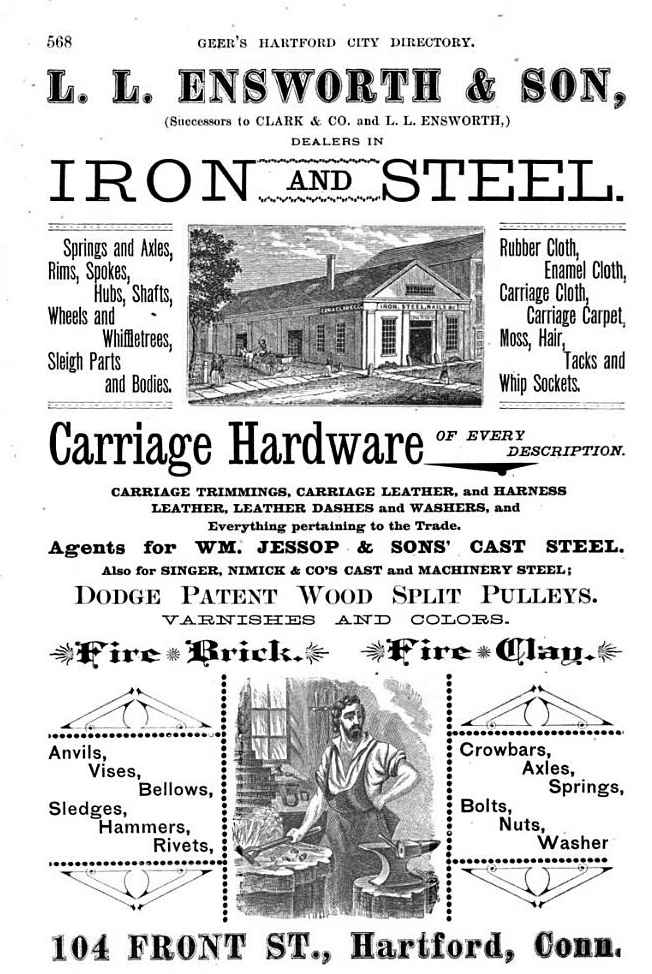
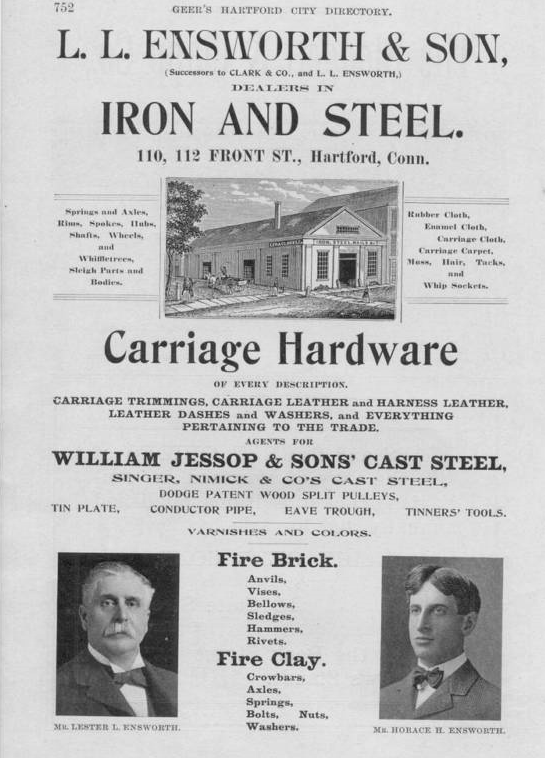
Lester L. Ensworth owned a business that produced iron and steel hardware and carriage parts. He was a partner with George H. Clark in Clark and Company, located at the corner of Front and Ferry Streets in Hartford. Ensworth became sole owner in 1892 and the company was renamed L. L. Ensworth & Son in 1901. In 1888, Ensworth moved his family into a large house on the corner of Farmington and Girard Avenues, in Hartford’s West End. The house is no longer standing, but the carriage house survives. Built in grand Queen Anne style to match the no longer extant house, the Ensworth Carriage House has a variety of Victorian features, unified by its exterior covering of shingle siding. Today, the building is home to a ballet company.

Goodwin Square (1989) and City Place (1980)

goodwin-square-and-city-place.JPG

Happy New Year from Historic Buildings of Connecticut! Hartford’s three tallest buildings are City Place, at 163 meters (535 ft), the Travelers Tower, at 161 meters (527 ft), and Goodwin Square, at 159 meters (522 ft). In the image above are Goodwin Square (left) and City Place (right), both designed by the architectural firm of Skidmore Owings And Merrill. City Place I was built in 1980 and has thirty-eight floors above ground (the adjacent City Place II was built in 1989 and has 18 floors). Most of the building is office space, with retail and restaurant space on the lower floors. Goodwin Square was built in 1989 and has thirty floors. This modern skyscraper connects to and shares a lobby with the Goodwin Hotel, originally built as an apartment building in 1881. The facade of the Goodwin Hotel remains, but the interior was completely replaced in the 1980s. The skyscraper was eventually deemed to have been a bad investment and the hotel closed in 2008. Also visible in the lower left of the above photograph are the tops of the two towers of the Soldiers and Sailors Memorial Arch.

Albert Sisson House (1867)

albert-sisson-house.jpg

Albert L. Sisson was born in Bloomfield and became successful in Hartford operating a meat market in the Sisson Block, a building which once stood at Main and Sheldon Streets, and as a tobacco trader. In 1867, he built a brick Italianate house on his estate on Hubbard Street, which was renamed Sisson Avenue in his honor in the 1870s. He was also involved at the time in the founding of the Asylum Avenue Baptist Church. Sisson died in 1886 and his wife, Mary Gorton Sisson, died in 1898. The house was used for a time as a hospital for scarlet fever patients and in 1902 was acquired by the cathedral corporation of the Hartford diocese. Bishop Michael Tierney of Hartford gave the property to the Sisters of the Good Shepherd for use as a home for wayward girls. The house was expanded in 1905 and additional buildings, including Marian Hall and Euphrasia Hall, were constructed on the estate in 1920s. The “House of the Good Shepard” complex was sold by the Sisters in 1979 and today serves as subsidized senior housing.

Union Baptist Church, Hartford (1871)

Union Baptist Church is one of the oldest black congregations in Hartford. In 1889, there was a split in church’s membership and, although both groups wished to retain the name of Union Baptist Church, one group had already claimed a charter before the other group arrived, so the latter group established itself as Shiloh Baptist Church. The English Gothic building which is today Union Baptist Church, at 1921 Main Street in the city’s North End, was built in 1871 and was originally the Memorial Church of St. Thomas, an Episcopal church built in honor of Bishop Thomas Church Brownell, the founder of Trinity College. By the 1920s, St. Thomas Church was facing diminishing attendance. St. Monica’s, a black Episcopal congregation, which had been meeting in a dilapidated church formerly used by Shiloh Baptist Church, was allowed to use the Parish Hall of St. Thomas Church. Eventually, in 1925, the church was offered to Union Baptist Church and St. Monica’s congregation moved to a smaller church, on Mather Street, which Union Baptist had erected in 1908 and was now vacating.

Leaders and members of Union Baptist Church made important contributions to the early civil rights movement: the Reverend John C. Jackson, who who became pastor in 1922, worked to open employment opportunities for African Americans and in 1943 helped establish the Connecticut Inter-Racial Commission, now the Commission on Human Rights and Opportunities. C. Edythe Taylor, a member of the church, was the first African American teacher in the Hartford public school system. The Union Baptist Church is on the Connecticut Freedom Trail. (more…)