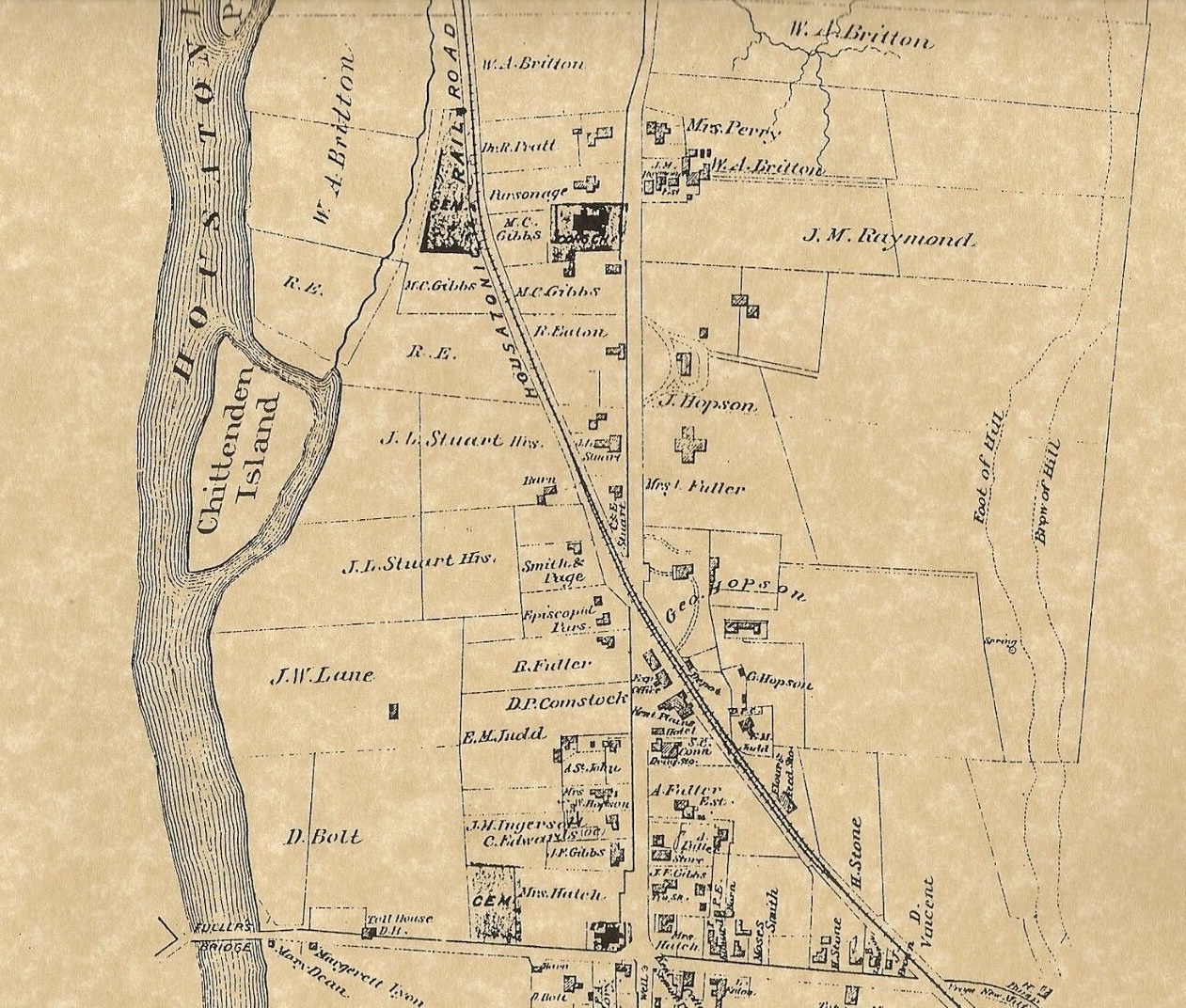
George Hopson House (1850)

The Italianate-style former house at 50 North Main Street in Kent was built circa 1850. It is associated with the prominent Hopson family, who were wealthy farmers and iron merchants in Kent in the nineteenth century. It is identified as the residence of George Hopson in an 1874 map of Kent. In more recent years, the house was converted to become a branch of the New Milford Savings Bank (which became NewMil Bank in 2000) and is now a branch of Webster Bank (which acquired NewMil Bankcorp in 2006).

Mildred C. Mallory Building (1963)

Mildred C. Mallory Building

Designed to fit in with the many historical nineteenth-century buildings at Mystic Seaport, the museum’s MIldred C. Mallory Building was erected in 1963 using stone from a house in the Fort Rachel area of Mystic that had been destroyed in the 1938 hurricane. Serving as Mystic Seaport’s members’ lounge and membership office, the building named for Mildred C. Mallory (1897-1961) as a memorial to honor her efforts for the museum’s membership program. The first floor is covered with granite ashlar and the second floor with clapboards.

(more…)

Benjamin Bissell House (1849)

The stone house at 637 Bantam Road in Litchfield, which is now a restaurant, was built in circa 1849 by Benjamin Bissell, who had acquired the land in 1840. He sold the house in 1850 to Abel H. Clemons. Stone houses are uncommon in the area, but around the same time Benjamin was constructing this house, Henry B. Bissell used granite from the same quarry to build the stone at 202 Maple Street. The house has limited stylistic elaboration, except for a prominent Italianate-style hip roof with a monitor/cupola. After 1875 the house was owned by the Brundage family.

Capt. John E. Williams House (1861)

Capt. John E. Williams House

The hip-roofed house at 19 Gravel Street in Mystic was built in 1861 by Capt. John E. Williams. His earlier house on the site, built in 1844, was moved to make way for the new house. Capt. Williams was known for being the captain of the clipper ship Andrew Jackson, which was called the “Fastest Ship in the World.” Built by the firm of Irons & Grinnell in Mystic, the ship made a famous run in 1859–1860 around Cape Horn from New York City to San Francisco, which was performed in 89 days and 4 hours. The only other square-rigged ship to perform an 89-day run driving from New York City to California was the Flying Cloud, an extreme clipper which did so twice (in 1851 and 1854), the faster of these times being 89 days and 8 hours. Many consider this to be the record passage, because it was for a completed voyage, anchor to anchor, while the Andrew Jackson‘s time was pilot to pilot as the ship had to spend the night waiting for a pilot boat and did not actually tie up at a San Francisco wharf until the next day.

(more…)

Samuel Fielding House (1750)

The gambrel-roofed colonial cape-style house at 25 Marjorie Circle in Hebron was built c. 1745-1750 by Samuel Feilding. Soon after construction it was owned by Rev. Benjamin Pomeroy (1735-1784), a congregational minister who was influenced by the First Great Awakening. In 1791 the house was acquired by Amasa Gillett, whose widow later married Benjamin Phelps (the house was later called the Widow Polly Phelps Place). Gillett’s daughter Sibyl, who lived in the house until her death at the age of 95, made bonnets and had her shop in the house in the 1850s. Earlier, in 1835 the largest room in the house was used for Miss Bradford’s school for select young ladies. There is also a gambrel-roofed barn on the property.