Built around 1860, the Edmund Hurlburt House is a great example of Italianate architecture, featuring an elaborate portico, with paired arched windows above, and a cupola. Hurlbut and his partner, James Ashmead, were in the goldbeating business. The house is located on Congress Street, which Hurlburt and Ashmead helped develop and which is now a historic district with many Greek Revival and Italianate houses. Francis Pratt and Amos Whitney, the founders of Pratt and Whitney, also lived on Congress Street.
George A. Fairfield House (1866)
George A. Fairfield was a prominent leader in Hartford’s industrial growth after the Civil War. He was president of the Weed Sewing Machine Company and the Hartford Machine Screw Company. Fairfield Avenue was named for him and in 1866 he built an imposing Second Empire style mansion there. The house features many extravagant elements, including an medieval-style octagonal tower to the rear. The house is now subdivided into condominiums. The Oliver H. Easton House, another striking Second Empire home, is located across the street.
J.C. Brown House (1833)
The J.C. Brown House was originally built, on Maple Street in Bristol, for the clockmaker Lawson Ives in 1833. Lawson and his uncle Chauncey Ives began the clock-making firm of C. and L.C. Ives in 1830. The company eventually failed in the wake of the 1837 Panic and ensuing depression. The house was sold in 1844 to J.C. Brown, another clockmaker, who often had the image of his house painted tablet of his ogee shelf clocks. After his bankruptcy in 1856, Brown’s clock company was bought by the E.N. Welch Manufacturing Company (later to become the Sessions Clock Company). The Greek Revival style Brown House has two entrances with columned porticos: the one facing Maple Street (west elevation) has Ionic columns and the one facing Woodland Street (south elevation) has Doric columns. The house has been converted for use as offices.
Dr. Roger Waldo House (1750)

At the intersection of Moulton Road and the Old Turnpike in Mansfield is a one-and-a-half story house with overhanging gable ends, probably built in the middle of the eighteenth century. Around 1770, it was purchased by Seth Pierce, Sr. and Jr., who sold it to Dr. Roger Waldo in 1798. Waldo, who died in 1816, was a prominent physician and representative at the Connecticut General Assembly. There is evidence of a blacksmith shop possibly having been on the property, which would have served the Mansfield Four Corners community.
The Clifford D. Cheney House (1904)
One of the mansions of the Cheney family of silk manufacturers, the Clifford D. Cheney House, on Forest Street in Manchester, faces Hartford Road across the “Great Lawn,” around which the mansions are situated. The house, like a number of the other Cheney mansions, was designed by Charles Adams Platt, an architect, artist and landscape designer, whose mother was Mary Elizabeth Cheney. The house is distinctive with its pink stuccoed exterior.
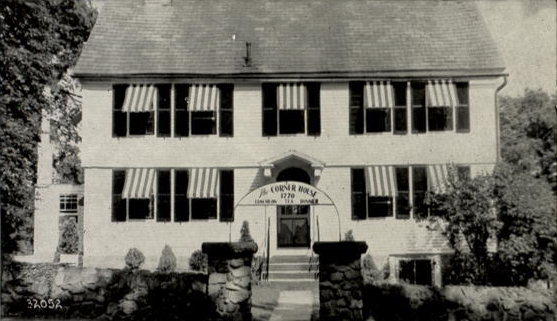
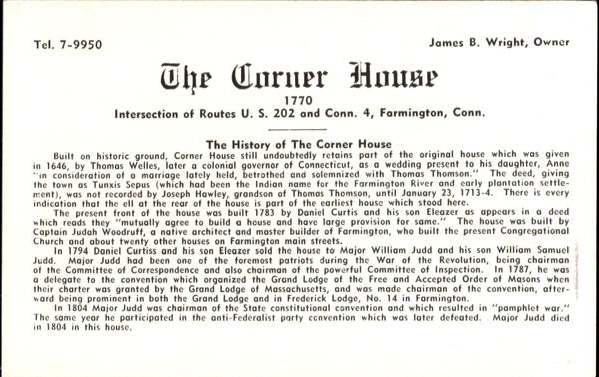
The Corner House (1783)
Located at the corner of Main Street and Farmington Avenue in Farmington, the Corner House was built around 1783, perhaps incorporating part of an earlier dwelling that was on the property when it was acquired by the brothers, Daniel and Eleazer Curtiss, in 1774. In 1807, the house was bought by Elijah Cowles, Jr. and Jonathan Cowles. In more recent times the building was a restaurant. Today it is used for offices and the Farmington Inn is attached to it.
The Dexter-Adams House (1781)
The Dexter-Adams House, on Centre Street in Mansfield, was built sometime after the land it was constructed on was purchased in 1781 by William and Nathan Dexter. It was purchased in 1803 by Barzillai Swift and was later lived in by his daughter, Lucy, and her husband, Dr. Jabez Adams, one of Mansfield and Windham’s physicians of the late eighteenth and early nineteenth centuries. He worked for a while in partnership with his brother-in-law, Dr. Earl Swift. Dr. Adams’ daughter, Alice, married the builder Edwin Fitch, who possibly made some of the later alterations to the house. The nineteenth century changes include the addition of a mansard roof and a porch.