The Kelo House (1890)

kelo-house.jpg

The Kelo House, also known as the Little Pink House, was built in 1890 in a residential area of New London by John Bishop, a prominent local carpenter. It had various owners after Carpenter’s death in 1893 and few years later was moved to the Fort Trumbull neighborhood of New London. In the late 1980s, the Little Pink House and the house next to it were restored by the preservationist, Avner Gregory. On the market for many years, the house was not occupied until Susette Kelo moved in in 1997. When the City of New London sought to use the right of eminent domain to acquire the neighborhood for private development (which would bring in more tax money) it started a legal battle that went all the way to the Supreme Court in 2005. Although Kelo lost in Kelo vs. City of New London, the public reaction to the abuse of eminent domain laws led to citizen activism and new reform legislation in favor of property owners. Three years after the decision, in 2008, the house was rededicated on a new site on Franklin Street in New London. The house had been reacquired and moved by Avner Gregory and stands as a monument, with an explanatory plaque out front, to the battle over eminent domain. A new book about the case, Little Pink House: A True Story of Defiance and Courage, by Jeff Benedict, has just been published.

William Coit House (1763)

coit-house.jpg

In the eighteenth century, Coit Street (then Cove Street) in New London followed the shoreline of Bream Cove, an arm of New London Harbor. The Cove later shrank in the nineteenth century from silting and filling in to create additional land. When the William Coit House, on the corner of Washington and Coit Streets, was built around 1763, it was therefore on the water, although this is no longer the case. The Coits were a shipbuilding family and William Coit commanded ships during the Revolutionary War. Coit was also captain of a militia company, composed largely of sailors, that marched to the Siege of Boston in 1775.

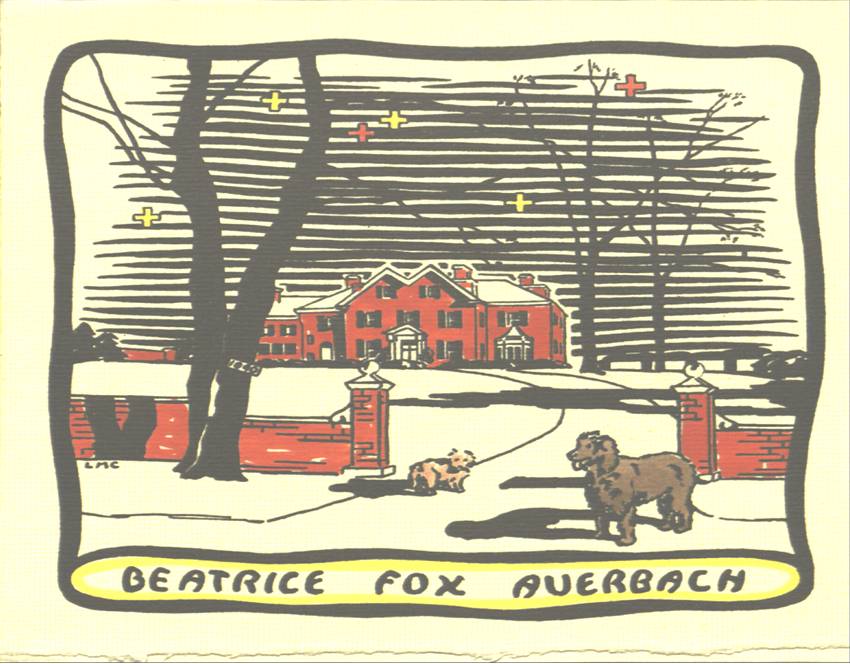
Beatrice Fox Auerbach House (1911)

beatrice-fox-auerbach-house.jpg

The residence of Beatrice Fox Auerbach, on Prospect Avenue in Hartford, was built in 1911 and was designed by the firm of LaFarge & Morris. Additions were made to the home in 1923. The Georgian Revival style house also features elements of the Tudor Revival, including the twin gables and a leaded casement bay window. Beatrice Fox Auerbach was the granddaughter of Gerson Fox, who in the 1840s had founded the store in Hartford that would evolve into the G. Fox & Company department store. Beatrice Fox‘s father, Moses Fox, succeeded his father as president of the company and Beatrice married George Auerbach, who eventually became the company’s secretary-treasurer. Her husband died in 1927 and after her father‘s death in 1938, she became the store’s president. Under her leadership, the company grew until it became the largest privately owned store in the country. She remained president until she sold her privately owned stock in 1965. Auerbach, who died in 1968, was also renowned civic leader and philanthropist. A biography by Virginia Hale has recently been published called A Woman in Business: The Life of Beatrice Fox Auerbach. In 1979 the house was given to the University of Hartford.

The Simon Shailer House (1827)

simon-shailer-house.jpg

Rev. Simon Shailer became minister of Haddam’s Baptist Church in 1822. In 1827, he built a house on Saybrook Road in Shailerville adjacent to a house he had constructed for his son that same year. The houses are very similar in their Federal style design, although the Simon Shailer House has a Victorian-era balustraded porch with a hipped roof. Another son of Simon Shailer, Nathan Emery Shailer, also became a Baptist minister. After Rev. Simon Shailer died in 1864, his widow and daughter lived there and it is now owned by a descendant.

The Russell Shailer House (1827)

russell-shailer-house.jpg

Around 1827 in the Shailerville section of Haddam, where many homes were built by the close-knit Shailer family, Russell Shailer built a Federal style home after his marriage to Huldah B. Arnold. At first, his father, Rev. Simon Shailer, continued to own the land on which the house was built and built a home for himself at the same time next door. When Simon, a Baptist minister, died in 1864, Russell, who was a deacon in the church, received full title to the property. Behind the house was the Shailer and Knowles factory, where stamped and pressed metal products were manufactured from the 1870s to 1914. The houses of both father and son continue to be owned by a descendant of Russell Shailer.

Noah Pratt House (1805)

noah-pratt.jpg

In the eighteenth century, Hezekiah Pratt owned farm land in Essex, known as Cornfield Point, which stretched from Main Street south to the Connecticut River. When he died, four of his sons inherited land along the south side of Main Street where they built their homes. One of the sons was Noah Pratt, whose 1805 house was later sold to his brother, Asahel, in 1808 and then to Uriah Hayden in 1817. Uriah Hayden was the grandson of the Uriah Hayden, who ran the Hayden Tavern in Essex, and the great-grandson of Nehemiah Hayden, who had been a loyalist during the Revolutionary War. The house remained in the Hayden family until 1977 and is now used for offices.