The Prince Aspinwall House (1761)

prince-aspinwall-house.jpg

The Prince Aspinwall House is on Centre Street in Mansfield Center. It was either built or enlarged by Aspinwall when he acquired the property in 1761. Aspinwall father, Peter Aspinwall, was from Woodstock and his mother, Rebecca Storrs, was the daughter of one of Mansfield’s original proprietors. From 1794 to 1799, the house was the residence of the Rev. Elijah Gridley, third pastor of Mansfield’s First Congregational Church. In the nineteenth century, a Gothic gabled front entrance was added, but this was later removed and two large dormer windows took its place.

Obadiah Spencer House (1826)

Obadiah Spencer, an Essex merchant, built a house on Pratt Street in 1826. Later in financial trouble, he sold the house in 1831 to ship carpenter Richard Hill. Owned in the 1840s by a group of Baptists who were considering making it a church rectory, the house was later a rental property. Much expanded over the years, it has more recently been made into condominiums. Note: This post was written on 09/02/2011 and backdated so that there would be a regular post for 04/01/2009 as well as an April Fool’s Post.

Heublein Tower (1914)

heublein-tower-01.jpg
YouTube player

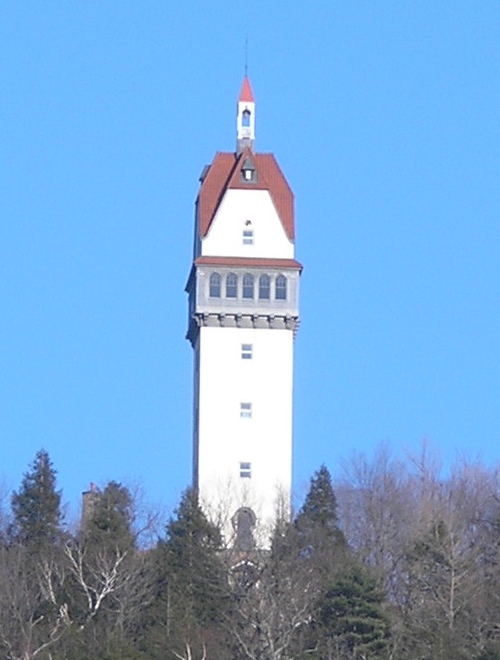
The 165-foot Heublein Tower, in Talcott Mountain State Park in Simsbury, is a very notable Connecticut landmark which provides spectacular views of Hartford and the Farmington River Valley. It was built as a residence for Gilbert Heublein, a food and drink magnate and manufacturer of A1 Steak Sauce, and was modeled on castles in his native Bavaria. In 1875, a young Heublein was hiking on the mountain with his fiancee and said, ”Someday Louise, I’m going to build you a castle on this mountain.” The Tower, constructed to withstand 100 MPH winds, was designed by Smith and Bassette and built by T. R. Fox and Son in 1914. The rest of the residence was added around 1925. The tower later opened to the public as part of the state park and many visitors hike up to visit it each year. There have been a number of restorations of the building, most recently through the efforts of the Friends of Heublein Tower.

The Nathaniel Hempsted House (1759)

huguenot-house.jpg

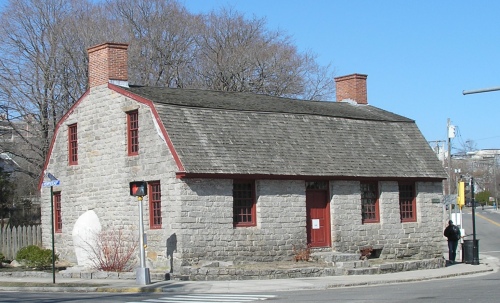
The Nathaniel Hempsted House is a stone, gambrel-roofed house on Jay Street in New London. It was built in 1759 by Nathaniel Hempsted, the grandson of the diarist Joshua Hempsted, whose house is located just behind it. Like the William Coit House, the Nathaniel Hempsted House was once on the waterfront, before Bream Cove was filled in. The building was once known as the Old Huguenot House, because it was believed that Huguenots (French Protestants) helped to build it. Actually, it was Acadians (Catholic French Canadian refugees) who were more likely involved in the construction. The house was later sold out of the Hempsted family, but was eventually acquired by Connecticut Landmarks to join the adjacent Joshua Hempsted House as a museum.

The Joshua Hempsted House (1678)

hempstead-house.jpg

Joshua Hempsted is a well-known citizen of colonial New London because he kept a detailed diary for nearly fifty years, from 1711 until his death in 1758. Hempsted was a farmer, surveyor, carpenter, gravestone carver and local official who was born and lived in a house at 11 Hempstead Street, which had been built by his grandfather in 1678. Joshua added the east section of the house in 1728. It is New London’s oldest surviving house and was occupied by the Hempsted family until 1937. With the death of Anna Hempstead Branch, the house was left to the Antiquarian and Landmarks Society, which restored the house in 1956. Today, along with the adjacent house of Joshua Hempsted’s nephew, Nathaniel Hempsted, the Hempsted Houses are a Connecticut Landmarks site open to the public.

Deshon-Allyn House (1829)

deshon-allyn-house.jpg

Daniel Deshon was a New London-based whaling captain and merchant who built a house for himself and his wife Fanny on Williams Street in New London in 1829. Mrs. Deshon died in 1833 and the house was put up for sale, being purchased in 1851 by Lyman Allyn, who was also a successful whaler. The house remained in the Allyn family until 1926, when Harriet Upson Allyn, Lyman’s last surviving child, died. Harriet Allyn had provided for the construction of the adjacent Lyman Allyn Art Museum, which was built in 1932. The Deshon-Allyn House was also opened to the public as part of the museum campus. The house was refurbished in 1956, a major restoration was undertaken in 1996, and another renovation in 2008.

The Nelson Hotchkiss House (1850)

nelson-hotchkiss.jpg

Nelson Hotchkiss was a New Haven builder and manufacturer, who also became a real estate developer. He and Henry Austin were involved in the Park Row development in Trenton, New Jersey in the 1840s. Later, Hotchkiss built three Italianate-style houses, most likely designed by Austin, on Chapel Street in New Haven. One was Hotchkiss’s own home, built in 1850. That same year a house was also constructed for his partner, William Lewis. In 1854, Hotchkiss built his second home on Chapel, but only lived there for two years before moving back to his earlier residence.