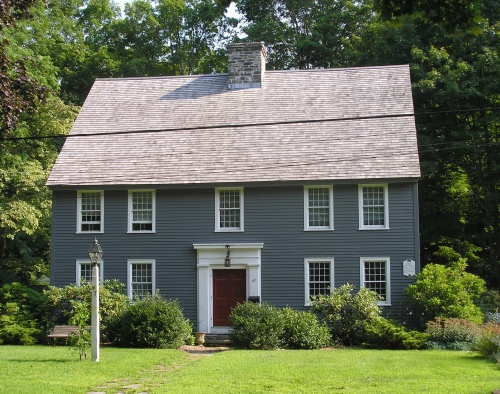
Second Dr. John Redfield House (1780)

the-second-dr-john-redfield-house.JPG

Dr. John Redfield of Guilford, who was living in an earlier home built in 1768, constructed a new mansion house on the Green in 1780. The property where the new house was built had previously belonged to David Naughty, a merchant. After Naughty’s death in 1739, his wife Ruth Naughty was co-executor of his will, along with nephew David Naughty II. Ruth Naughty successfully managed her husband’s affairs, paying his debts in Boston. When she died in 1773, she named Dr. Redfield as executor of her will, but he was soon caught up in a lawsuit with David II. Dr. Redfield won the case and, as owner of the entire property, tore down the Naughty House in order to build his own. The outraged Naughty later stipulated in his will that he be buried across the Green from Redfield’s house with his head sticking out above ground to stare at his enemy’s home. These wishes were never carried out. Since 1945, the Redfield House has been owned by the Guilford Savings Bank and serves as the bank’s main office.

The Orrin Thompson House (1832)

orrin-thompson-house.JPG

Orrin Thompson founded the carpet industry in Enfield, establishing the Thompsonville Carpet Manufacturing Company in 1828. In 1832, Thompson built an impressive brick residence on 32 acres in Enfield. The company grew, but by the 1850s Thompson was in debt and had to turn it over to his creditors, who renamed it the Hartford Carpet Company. Thompson’s house was later owned by G. Harrison Mifflin and subsequently sold to the Felician Sisters: the Congregation of Sisters of St. Felix of Cantalice, Our Lady of the Angels Province. The building currently houses an adult day care facility. In blog related news, please also take a look at my new blog, Historic Places, where I will feature places I have visited recently outside of Connecticut and Massachusetts.

Richard Hayden House (1806)

hayden-rectory.JPG

Richard Hayden, an Essex shipbuilder and merchant, built the first brick house in town in 1806. He had earlier lived in the house which is now the Griswold Inn. Hayden was head of the Hayden Shipyard and he built a ship’s chandlery in 1813, which was later moved across Main Street. During the War of 1812, he built a privateer schooner, Black Prince, which he advertised in New York. This was one of the causes of the British Raid on Essex in 1814, which led to serious financial losses for Hayden, who died two years later. His widow and children remained in the Federal-style house until 1833, when Richard Hayden’s cousin, Samuel Hayden, bought the house. In 1894, Samuel’s daughter, Mary Tucker, left the house and furniture to St. John’s Episcopal Parish and it is now the church’s rectory.

Ingham Octagon House (1890)

ingham-octagon.JPG

Located on Main Street in Old Saybrook is an octagon-shaped house known as the Ingham House. It was a prefab building, said to have been purchased from the Sears and Roebuck Catalogue around 1890. The attribution to Sears and Roebuck is open to question, because a number of online sources indicate that the company only began offering kit houses in 1908, and apparently such homes were only available in the United States starting around 1906. So the origins of the house must be considered as still undetermined. The building, which is not a completely symmetrical octagon, has been extensively remodeled to become a dentist’s office.

Addendum: The house was constructed by Horace Archer and was the residence of Robert Burns for many years. Robert Burns was a partner in the nearby Burns and Young store on Main Street. His daughter, Mary Burns, lived in the house and was postmistress for many years.

The Hull-Hitchcock House (1764)

amos-hull.JPG

The Dr. Amos Hull House, built in 1764, is at 744 South Main Street in Cheshire. Dr. Hull used the house as a home and office. He served in the Revolutionary War, dying in camp in 1776. His widow, Martha Hitchcock, then married Dr. Gould Norton, who occupied the house, practicing medicine and running a tavern. The house was then owned by Pliny Hitchcock, who died in 1864 and was a stonemason and one of the leading farmers of Cheshire. In the 1930s, the house was extended by one bay (adding one window) to the right. By 2002, the Hull-Hitchcock House and the nearby John Hull House were in deteriorating condition and in danger of being torn down, until developers who acquired the properties agreed to restore both houses. Readers of Historic Buildings of Connecticut might also be interested in reading today’s post at Historic Buildings of Massachusetts, which features the Joseph Moore House, located in what is known as the Southwick Jog, the section of Massachusetts which extends into Connecticut’s northern border.

The First Dr. John Redfield House (1768)

dr-john-redfield.jpg

Dr. John Redfield, who had studied medicine with Dr. Benjamin Gale of Clinton, settled in Guilford and in 1768 built the first of two houses he would occupy in the town. His first house was on Park Street and, in later years, a Victorian porch was attached in the front. In 1937, the house was disassembled to make way for a new town hall parking lot. In 1942, the house (without the Victorian porch) was rebuilt on Broad Street for Judge George C. Conway. The house has a particularly steep roof which provides enough space for two attic windows in the gable. Historic Buildings of Connecticut now has a page on Facebook. If you are a Facebook user, you can become a fan!!

Ralph Isham House (1820)

ralph-isham.JPG

Around 1820, Ralph Isham, a merchant, built an impressive Federal style house on Colchester Green, next to the home of his father, Joseph Isham. The house was next owned by Henry Burr, a full partner in the Hayward Rubber Company, who had married Isham’s daughter, Lucretia. After her death in 1857, Burr continued to own the house, but rented it out. Among the tenants was the Justice of the Peace and house carpenter, Judge William Finley. The house had other residents over the years, but has more recently been used for commercial purposes.