Samuel Richards House (1792)

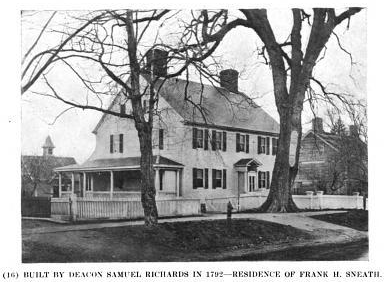
In 1736, Timothy Hawley sold land along Main Street in Farmington to Ezekiel Tompson. A house may already have been standing on the property and then been expanded into its present form by Thompson, or he may have built the house himself. Whichever the case, the house was in existence by 1783, when it was inherited by Ezekiel‘s son, Isaiah Thompson, who sold it that same year to Deacon Samuel Richards, who had served as a captain in the Revolutionary War and was the first postmaster of Farmington. In Farmington, Connecticut, the Village of Beautiful Homes (1906), it is said that the house was built by Richards in 1792 and this has been the date traditionally given for its construction. The house was next owned by Abner Bidwell, a merchant involved in the construction of the Farmington Canal.

Clyde M. Hill House (1931)

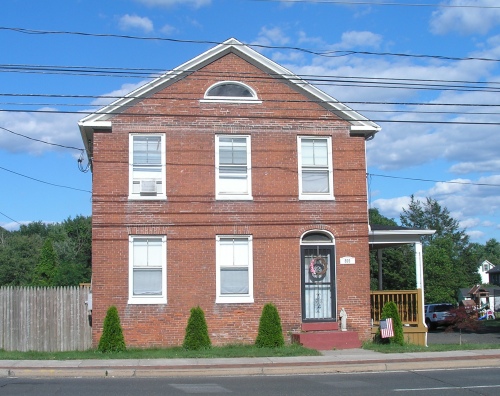
One of the many Colonial Revival houses designed by Alice Washburn in the New Haven area is one at 105 Mill Rock Road in Hamden. Washburn was possibly inspired by the Canterbury style of Federal house, as seen in examples like the Prudence Crandall and Captain John Clark Houses in Canterbury. The house in Hamden was built in 1931 for Clyde M. Hill, professor of Secondary Education at Yale University.

The Alanson Abbe House (1832)

Dr. Alanson Abbe was a doctor who specialized in spinal injuries. He used his 1832 house, at 65 South Street in Litchfield, as a hospital for a decade before moving to Boston in 1839. The house, which has a portico with Doric columns wrapping around on three sides, is one of few high-style examples of the Greek Revival in Litchfield, because the town was in a period of economic decline during the period the style was in favor nationally.

Newton E. Marble House (1874)

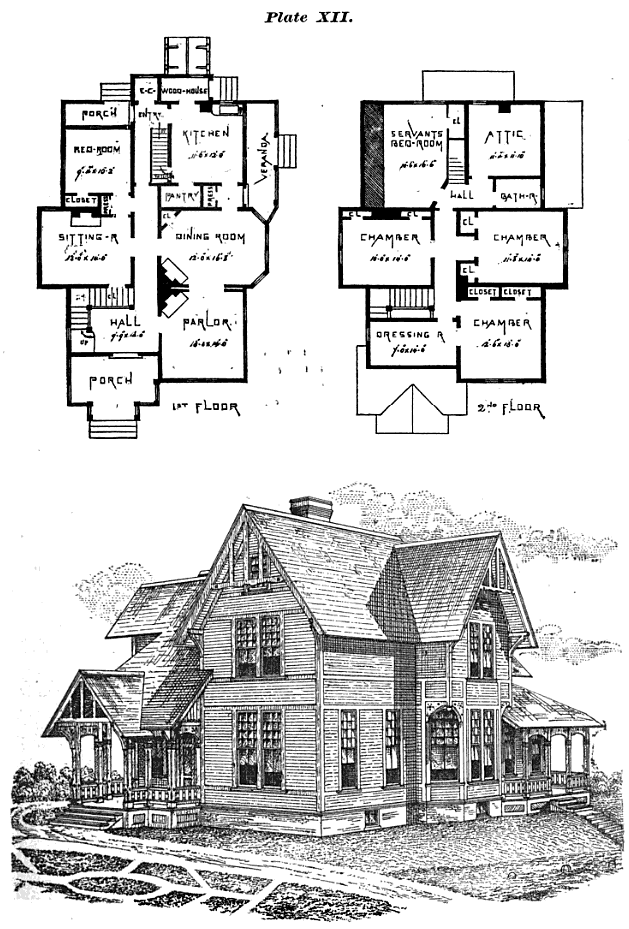
In 1874, Trinity Church in Newtown built the house at 12 Main Street for its rector, Dr. Newton E. Marble. The Stick and Eastlake-style house, known as “Seven Gables,” was designed by the Bridgeport firm of Palliser and Palliser. The brothers featured the house in their 1878 collection of model homes, writing the following:

This house commands a particularly fine view from both sides and the front, and is situated in one of the pleasantest country towns in New England, the hotels of this town being crowded during the summer months with people from the cities. The exterior design is plain, yet picturesque, and at once gives one an idea of ease and comfort. The roofing over the Hall and Sitting-room is a particularly fine feature […] The corner fire-place between Parlor and Dining-room is a feature we indulge in to a great extent in these days of economy, sliding doors and fire-places, although we sometimes have clients who object to this, thinking it would not look as well as when placed in center of side wall; but when they are asked how this and that can be provided for with the best and most economical results, they readily give in. […] The exterior is painted as follows: Ground, light slate; trimmings, buff, and chamfers, black. Cost, $2,925. The sight of this house in the locality in which it is built is very refreshing, and is greatly in advance of the old styles of rural box architecture to be found there.

The house has recently been for sale.

The Taylor-Wheeler House (1889)

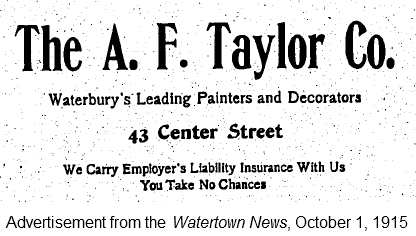
The house at 47 Holmes Avenue in Waterbury was built in 1889 by Alfred F. Taylor, who ran a painting company (see advertisement, pdf, p.11). He and his family only occupied the house for a year before he sold it to John S. Wheeler, a retired painter. Taylor then moved to a similar Queen Anne house he had built next door, at 51 Holmes Avenue. According to the History of Waterbury and the Naugatuck Valley, Vol. III (1918), “the long established business of the A. F. Taylor Company

was organized in 1880 and was incorporated in 1901 by A. F., Foster B. and Charles I. Taylor. The Taylors sold their interests about 1909 to George Reed, who had formerly been with the Scovill Manufacturing Company. He remained at the head of the business until 1908, when he sold out to W. D. Austin and C. W. Lyons, and in 1914 Mr. Austin purchased the interest of Mr. Lyons. The business was first located on Grand street and thence removed to No. 43 Center street, where the company occupies a building, which has a frontage of twenty-three feet and a depth of one hundred and ten feet. They handle a full line of wall paper, window shades and awnings and in addition do interior decorating in all its branches, taking large contracts for work of this character and employing fifty people in the busy season. The business has reached extensive proportions and has become one of the profitable industries of the city.