Hugh Mead Alcorn House (1902)

300 S Main St., Suffield

Hugh Mead Alcorn (1872-1955) of Suffield, the son of Irish immigrants, was educated Connecticut Literary Institution (now Suffield Academy) and studied law with the Hartford firm of Case, Bryant and Case. He was elected to the state legislature in 1903 and served as state’s attorney for Hartford County from 1908-1942. He prosecuted the famous Amy Archer-Gilligan poison murders of 1913-16, which formed the basis for the famous play and movie Arsenic and Old Lace. Alcorn’s Colonial Revival house, at 300 South Main Street in Suffield, was built in 1902. The house was later enlarged by Alcorn’s son, Robert Hayden Alcorn (1909-1980), who was the author of such books as No Bugles for Spies: Tales of the OSS (1962) and The Biography of a Town: Suffield, Connecticut (1970). Hugh M. Alcorn had two other sons who became lawyers and politicians: Howard Wells Alcorn (1901-1992), who served as Chief Justice of the Connecticut Sppreme Court from 1970-1971, and Hugh Meade Alcorn, Jr. (1907-1992), known as Meade Alcorn, who was the Republican leader in the Connecticut General Assembly in the 1940s.

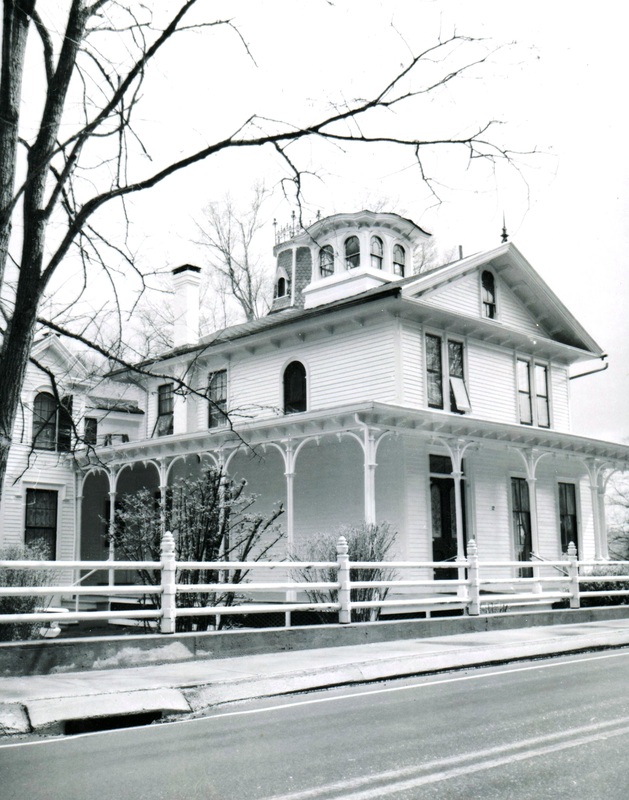
Boardman House (1875)

Boardman House

In 1842, Luther Boardman invented and patented an improved mold for creating britannia silverware. He established a factory in East Haddam where he produced britannia spoons. In 1864, Luther Boardman entered a partnership with his son Norman S. Boardman, under the name L. Boardman & Son. This successful business peaked in the 1860s and 1870s. Norman Boardman had already built the Italianate house at 8 Norwich Road when another grand residence was constructed next door circa 1875. A more eclectic house than its neighbor, it features an Italianate design and an octagonal rear tower on west side with a mansard roof and Eastlake-style iron cresting. There is some confusion over who built the house. The National Register of Historic Places nomination for the East Haddam Historic District lists the house as the Norman S. Boardman House, while an 1880 bird’s-eye-view of East Haddam lists it as the residence of his father, Luther Boardman. An online collection of images from the Boardman Collection at the East Haddam Historical Society has a photo of the house with the description “The Lawton House owned by the Boardman Family.”

93 Elm Street, Hartford (1865)

93 Elm Street, Hartford

Here’s a building that has recently been beautifully restored: 93 Elm Street in Hartford (on the left in the image above) is part of a row of houses (93, 95 and 97 Elm Street) located across from Bushnell Park. These Italianate brownstone structures, many more of which once lined Elm Street along the park, were built in the 1860s by Andrew West, builder-architect. They were probably originally built as two double (two-family) houses (93-95 and 97) and are referred to in the Nomination for the Elm Street Historic District as the Huntington-Callender and Chapman-Taft Houses. In recent years, No. 93 had fallen into disrepair, with exterior walls actually crumbling. Owners Sara and Luke Bronin restored the house, recreating a bay window to match the one at No. 95. For their efforts, they received an award from the Hartford Preservation Alliance last year.