Old Lyme Inn (1856)


Old Lyme Inn


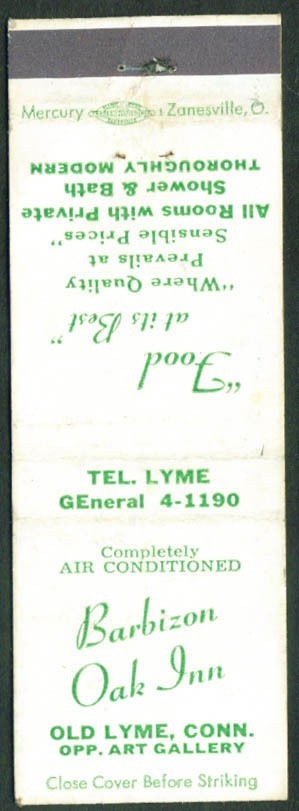
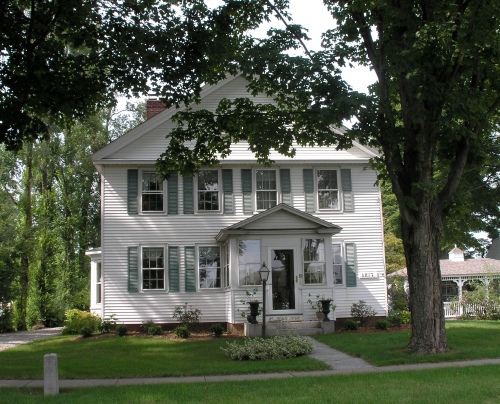
The Old Lyme Inn is located in an old farm house built around 1856 by the Champlain family. Around the turn of the century, members of the Old Lyme artist’s colony would come to the Champlain farm to paint and used the barn as a studio. Jacqueline Kennedy reportedly took lessons at the riding academy located at the farm. Construction of the Connecticut Turnpike led the Champlain family to sell the house, which became the Barbizon Oak Inn, named for the Barbizon school of painting and a 300-year-old Oak tree on the property. A fire in 1965 led to the closing of the inn, which by then had become the Elegante Restaurant, but the building was restored by later owners to open as the Old Lyme Inn (85 Lyme Street in Old Lyme).

Roger S. Newell House (1920)

82 Bellevue Ave., Bristol

At 82 Bellevue Avenue in Bristol is an American Foursquare house built c. 1920. It was originally the home of Roger S. Newell (who also once lived in the house at 101 Bellevue Avenue). As described in the Commemorative Biographical Record of Hartford County, Connecticut, Vol. I (1901):

Roger Samuel Newell was born in Bristol, Oct. 18, 1867, and received his academic education in the public schools of that town and of Hartford. He graduated from the Hartford Public High School in 1886, from Yale University in 1889, and from Yale Law School in 1891. He then read law in the office of John J. Jennings, Esq., of Bristol, and in 1891 was admitted to the Bar, after which he continuously practiced his chosen profession as a partner with his preceptor until the latter’s death, April 1, 1900. He was the first clerk of the borough of Bristol, in 1895 was elected judge of the town court, and in 1896 was elected judge of probate, to succeed Elbert E. Thorpe, on the latter’s decease. Socially he and his family are prominent, and he is a member of Franklin Lodge, No. 56, F. & A. M., and Pequabuck Chapter, R. A. M. In politics he is a Republican, and in religious belief a Congregationalist. Mr. Newell was, married in Bristol, Sept. 25, 1895, to Miss Adaline Birge, daughter of Senator John and Mary A. (Root) Birge.

James Merrill House (1901)

107 Water Street, Stonington

The Queen Anne/Colonial Revival building at 105-107 Water Street in Stonington was built in 1901 to house a drugstore and ice cream parlor on the first floor, while the business’ owner, Francis D. Burtch, lived in the apartment above. Various other businesses have been located in the building over the years. In 1954, poet James Merrill (1926-1995) and his partner David Jackson moved into the residence. Merrill‘s epic work, The Changing Light at Sandover, incorporated messages that he and Jackson transcribed from sessions using a ouija board in the house’s turret dining room. Merrill, who was Connecticut’s State Poet Laureate from 1985 to 1995, willed his home to the Stonington Village Improvement Association. The James Merrill House Committee runs a program that makes the Merrill apartment, maintained as it was during the poet’s lifetime, available to writers for rent-free stays of one or two semesters of an academic year.

John H. Brockway House (1837)

Brockway House

The house at 89 Maple Street in Ellington was built in 1837. It is referred to as the John H. Brockway House in the Nomination for the Ellington Center Historic District. John Hall Brockway (1801-1870) was a lawyer and Whig politician. He served as member of the State House of Representatives from 1832 to 1848 and as a state senator in 1834. He served in the United States Congress from 1839 to 1843 and was later prosecuting attorney for Tolland County from 1849 to 1867. In 1896, Miss Sarah K. Gilbert left the house in her will to become a parsonage (the Gilbert Memorial Parsonage) of the Ellington Congregational Church. It was the parsonage until 1973 and is now a private residence.

Austin O. Gallup House (1840)

Salem Herbfarm

In 1851, Judge Austin O. Gallup (1828-1896) purchased the Greek Revival house and farm at 320 Hartford Road in Salem, where he lived until his death. In the 1860s, Gallup made two additions to the house, which had been built around 1840, by joining structures from other properties. He also added a carriage house in 1866 and a barn in 1867. Fred Washburn purchased the farm from Julia Raymond Douglas in 1915 and in 1919 passed it to Alice Mitchell and her husband Edward, who ran a small dairy farm. Alice served as Judge of Probate and Edward as First Selectman. The farm later passed to their daughter, Margaret Mitchell, who deeded it to her niece, Anne Duncan. Anne and her husband, Joe Duncan opened the Salem Herbfarm in 1997.