
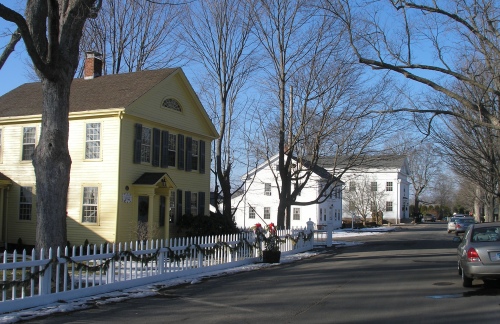
At 960 Main Street in South Windsor is a gambrel-roofed house built in 1785. It was the home of John Newberry, who may be the John Newberry who was born in 1756 and died in 1825.
At 960 Main Street in South Windsor is a gambrel-roofed house built in 1785. It was the home of John Newberry, who may be the John Newberry who was born in 1756 and died in 1825.

The house at 1015 Worthington Ridge in Berlin was built circa 1895. It was the home of Leland Gwatkin, whose father Walter Gwatkin resided in the house at 1006/1008 Worthington Ridge. Leland W Gwatkin (1882-1949) was secretary and manager of the White Adding Machine Company of New Haven.

At 18 Town House Road in Durham is a Federal-style house with a sign that indicates it was built in 1790 by Colonel Samuel Camp. According to Durham’s Historic Resources Inventory listing for the house, it was built in 1831 by Elias B. Meigs, who had purchased the land the year before from Ebenezer Camp.

At 48 North Street in Watertown is a Greek Revival house built by Eli Curtiss (1804-1878) in 1837. Next to the house is a carriage house, built at the same time. Curtiss was a manufacturer of Panama hats. As related in Vol. III of the History of Waterbury and the Naugatuck Valley, Connecticut (1918):
Colonel Eli Curtiss spent the greater part of his life in Watertown, where he first took up his abode in 1820. He was born in the town of Huntington, Connecticut, June 16, 1804, and his mother was Elizabeth Wooster, a descendant of Ephraim Wooster, a brother of General David Wooster. In his native town Eli Curtiss spent the period of his boyhood and early youth, removing to Watertown in 1820. when a lad of sixteen years. Here he found employment in the store of Benjamin de Forest, with whom he remained as a clerk until 1826, when he purchased the interest of his employer and continued the business on his own account until 1850. He built up a business of quite extensive proportions and employed several clerks. He was engaged in the manufacture of what was called the plant hat. He procured the material for the hat, cut it into strips and braided it for headgear, employing in this work women from Bethlehem, Morris, Woodbury, Middlebury, Plymouth and surrounding towns. They profited much by such employment, receiving their pay in goods from Mr. Curtiss’ store. In this way he became the most extensive and successful merchant in all that section, people coming from as far as Waterbury to trade with him. In 1850 Colonel Curtiss entered the New York store of the Scovill Manufacturing Company, where he spent eighteen years. He then returned to Watertown in 1868 and retired from active business, spending his remaining days in the enjoyment of well earned rest from further business cares.
While no longer active in trade connections’. Colonel Curtiss was a prominent figure in public affairs of the community. He served as postmaster of Watertown for several years and was a member of the state legislature in 1861. In 1877 he was chosen to represent his district in the state senate and both in the house and in the senate he carefully considered the questions which came up for settlement and gave earnest support to those which he believed of vital moment and consequence to the commonwealth. He was also a fellow of Yale College and assisted in electing Professor Porter as head of the institution. Colonel Curtiss had an interesting military experience. He was a member of the state militia and served as colonel of the Twelfth Connecticut Regiment, thus having thorough training in military procedure of that period. His entire life was actuated by high ideals and his course was ever in harmony with his professions as a member of the Congregational church of Watertown, of which he was a faithful member and liberal supporter. He contributed to many other worthy causes and took a deep interest in all those activities which have to do with the common good. He was a man of enterprise, of progressive ideas, of marked business ability and of sterling personal worth, devoted to his family, to his home city and to his country.
After his 1832 marriage to Alma Southmayd DeForest (1813-1861), who was from a wealthy Watertown family, Curtiss moved to a new house at 90 DeForest Street, built circa 1840. After the death of his first wife, he married Mary Frances Davis of Boston in 1868.

Henry B. Norton was one of the most prominent businessmen in Norwich in the nineteenth century. Born in Branford, he arrived in Norwich as a penniless young man in 1824, eventually forming a merchant partnership with Joseph Backus in 1827. Norton rose to leadership of the Norton Brothers Grocery store, the Norwich Bleaching, Dyeing and Printing Company, the Norwich & New York Transportation Company (he owned shares in steam ships) and the Attawaugan Mill, which manufactured cotton cloth. He was also a founding trustee of the Norwich Free Academy and the Norwich Y.M.C.A. His Greek Revival house, at 188 Washington Street, was built in 1840. After his death his death in 1891, his two unmarried daughters continued to live in the house into the twentieth century. In recent years, the house has been restored.

The center-chimney colonial saltbox house at 44 Fair Street in Guilford was built in 1762 by Noah Hodgkin, Sr. In 1770, his son, Noah Hodgkin, Jr., built the house next door at 52 Fair Street. Noah Hodgkin, Sr. died in 1783, leaving his house to his widow and his son, the Reverend Beriah Hotchkin (who had altered his name from Hodgkin to Hotchkin). Rev. Hotchkin was pastor of the Fourth Congregational Church in Guilford from 1784 until 1789, when he moved to Greenville, NY, where he served as a Presbyterian minister. In 1825, Rev. Hotchkin moved to Steuben County, NY, where he died in 1829. Descendents of his family family, later known by the name Hotchkiss, continued to occupy the house in Guilford for generations. This my 50th post for Guilford!

The property at 1542 Main Street in Glastonbury was once the site of the 1718 Welles Homestead. As related by Henry T. Welles in his Autobiography and Reminiscences, Volume 1 (1899):
The house and out-buildings with about forty acres of land were sold by my respected friend and agent, Hon. Thaddeus Welles, to Henry Talcott, who being unable to make payment, relinquished his claim to the property. It was then sold to Gustavus Kellogg, and by him to David Brainerd, who having previously removed the other buildings and replaced them with a new barn and tobacco and other sheds, in 1878-9 tore down the house, graded the site, and erected a good modern house thereon.
That Gothic Revival house, which was later owned by Frank Potter, still exists today.

You must be logged in to post a comment.