Woodford-Newell-Strong House (1666)

Woodford-Newell-Strong House

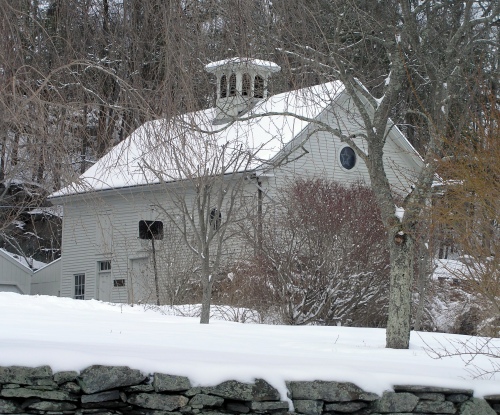
The building at 1 Waterville Road (AKA 820 Farmington Avenue) in Farmington contains sections of two much earlier houses. In 1807, Pomeroy Strong (1777-1861) purchased the land, which included the gambrel-roofed one-story Woodford House, built c. 1666 by Joseph Woodford Sr. Strong also acquired the Newell Homeasted, built some time earlier (perhaps as early as 1650) by Thomas Newell. Woodford and Newell were among the original 84 proprietors of the town of Farmington and in 1666 Woodford married Newell’s daughter Rebecca. By 1807 the Farmington Canal was being constructed and its path went right through where the Newell House stood. Strong moved the house to the east and, attaching it to the south of the Woodford House. He remodeled the structure, adding a second story. At Strong’s death his estate passed to his two daughters, Julia and Ellen Root Bartlett. In 1862 Ellen sold her interest to Julia and her husband, Dr. Chauncey Brown (1808-1879). He is described in Farmington, Connecticut, the Village of Beautiful Homes (1906):

Dr. Chauncey Brown was born in Canterbury, Conn. He went to Brown University for one year and then to Union College, whence he was graduated with honor. He was a student of Greek, reading the Greek Testament with great pleasure during the remainder of his life. From the medical school of Bowdoin he returned to Canterbury. In the last year and a half of the Civil War he was physician and surgeon in one of the hospitals of Washington. He came to Farmington about 1835 and in 1837 married Julia M. Strong. He was a strenuous believer in abstinence from alcoholic drink and also in anti-slavery when both beliefs were unpopular.

When the Amistad Committee arranged for the Amistad captives to stay in Farmington before returning to Africa, the girl named Temme was to be housed with the family of Horace Cowles. By the time she arrived at the Cowles residence on March 19, 1841, Horace Cowles had passed away and his widow soon moved to West Hartford. Temme then went to the house of Dr. Chauncey Brown, where she lived for most of her stay in Farmington. Dr. Brown’s wife, Julia Strong Brown, described her experiences with Tamme in The Farmington Magazine in February 1901:

It was a most singular episode in the quiet life of Farmington which brought to us the band of Mendians in which were included three Mendian girls.

One of these, by name Tamie, was sent directly to and remained with me until their departure for their native land, and she proved a most interesting personality. About fourteen years of age, she was tall, straight as an arrow, and lithe as a willow, with a soft low voice and a sweet smile which so far as I remember, never developed into a laugh. Her nature was rather serious and yet she was uniformly cheerful.

[ . . .] she was fond of flowers and particularly enjoyed a little garden which she tended carefully. I remember her joy when I had been preparing pineapples, she asked for the green crowns to plant and was so delighted when they began to grow. Her perceptions were keen and her questions innumerable.

The house later passed to the Browns’ son, Philip Brown, and then to his cousin, Eleanor Bartlett Phelps, who owned it until 1963. Since then it has been a commercial property. In 2011 the house was added to the town’s blighted building list because the property had deteriorated and had a shabby appearance. In 2014 there were plans to tear down the rear section (the 1666 Woodford House), but these later fell through. The building is currently vacant and is still a threatened building.

John J. Lawless House (1912)

John J. Lawless House

The house at 36 Hurlbutt Road in Gales Ferry, Ledyard, was built in 1912 for John J. Lawless, a lawyer and military veteran. Active in New London, Lawless apparently had homes in both Ledyard and the Quaker Hill section of Waterford, his home town. As related in the Gales Ferry news section of the Norwich Bulletin of Saturday, July 10, 1915:

Mr. and Mrs. John J. Lawless entertained Monday Mrs. Carlos Chapman of Groton, Mrs. D. J. Cavanaugh, the Misses Beaudry and Earle Wooten of New London. In the evening Ernestine Talbot, Mrs. Lawless’ young daughter, entertained her young schoolmates and some friends with fireworks and light refreshments on the lawn.

They were celebrating Independence Day on July 5 (no doubt because July 4 that year was a Sunday). A description of the career of John J. Lawless can be found in A Modern History of New London County, Vol. II (1922), edited by Benjamin Tinkham Marshall:

John J. Lawless was born at Vinal Haven, Maine, May 17, 1876. He received the preliminary portion of his education in the public schools of New London, having been brought to this city when very young by his parents. After graduating from the New London High School, during which time his attention had been turned forcibly to the legal profession, he decided to make it his career in life and, accordingly, prepared for college at Mystic Valley Institute, graduating from this institution in 1901 and subsequently matriculating at the Albany Law School, from which he won the degree of Bachelor of Laws in the class of 1903. Returning to New London, he entered the law office of Abel P. Tanner, where he remained until 1904, when, after passing his bar examinations, he established himself in the practice of his chosen profession which has proven extraordinarily successful, having grown extensively up to the present time.

Major Lawless has always been interested in military life, and during the Spanish-American War enlisted as a private in Company A, Connecticut Volunteer Infantry, being later commissioned a second lieutenant. After the war he was commissioned captain of the Third Regiment, and held this post for many years. The World War offered him another opportunity and this he was quick and eager to grasp. Successfully passing the examinations for major at Fort H. G. Wright, New York, he was sent to Plattsburg, where he was assigned to the 9th Company of the New England Training Division, and was mustered out of service July 15, 1919. Major Lawless is now a member of the American Legion, and is also past commander of the George M. Cole Camp, United Spanish War Veterans.

[. . .]

Respected as he is both in New London and his home town, Waterford, his advance can have known no deviation from the strictest probity and the most up-right methods. Such a record is certainly worthy of emulation.

Major Lawless married, July 5, 1910, Alice Wilbur Talbot, daughter of George L. and Emma Wilbur Talbot, of Putnam, Connecticut.

Jeremiah Shailer House (1800)

Jeremiah Shailer House

Jeremiah Shailer (1770-1845) built the house at 168 Camp Bethel Road in Haddam around the time of his marriage to Jerusha Shailer (1766-1843), i.e. just before 1800. Their daughter, Maria, married Smith Clark and her son, Jared Shailer Clark (1824-1888), a farmer and teacher who held the office of constable and justice of the peace, later occupied the house. The house’s original Federal-style doorway was later removed.

Fillmore House (1743)

Fillmore House

Bean Hill is a neighborhood in Norwich that was a local commercial and manufacturing center in the eighteenth and early nineteenth centuries. The area was home to the ancestors of several nineteenth-century US presidents: Millard Fillmore, Rutherford B. Hayes and Grover Cleveland. The home of President Cleveland’s grandfather, William Cleveland, a silversmith and deacon of the Congregational Church, does not survive, but there is a Fillmore family house at 8 Huntington Avenue, across from the Bean Hill Green. The house was built around 1743 (the date is inscribed on the house’s central chimney). Millard Fillmore‘s great-grandfather, Capt. John Fillmore, Jr. (1701-1777), lived in Norwich and later settled in Norwich West Farms (now Franklin). Millard Fillmore‘s grandfather, Nathaniel Fillmore, Sr. (1738-1814), and grandmother, Hepzibah Wood (1747-1783), were both born in Franklin and lived in Norwich. Another relative of the President, also a great-grandson of John Fillmore, Jr., was Rev. Jehiel Fillmore (1797-1862), who was born in Franklin and lived at Bean Hill.

Woodside (1729)

Woodside

I would like to know more about the house at 11 Dudley Street in Norwich. The plaque on the house gives it a date of 1729 and calls it “Woodside.” The style of the house was obviously much altered in the nineteenth century, as it now has features, such as the front portico, the brackets and the curved windows in the gable end, that are typical of the Italianate style. The property also has a large barn, which is listed on Historic Barns of Connecticut (with an address of 8 Dudley Street), but without much information about the structure. Perhaps it dates to the time the house was altered in the Italianate style, as the barn has an Italianate cupola.

The Abbey (1819)

The Abbey, Gunnery School

In 1819, on Washington Green, a meeting house was constructed on the site where the Judea Parish House stands today. The building had a large upstairs space for town and church meetings and the walls were lined with shelves that held the town’s first library. The first floor had several rooms. These were used for a time by the Judea Female Seminary, run by Mary Brinsmade, sister-in-law of Frederick W. Gunn, founder of the Gunnery School. In the 1870s, Gunn moved the building to its current location (16 Kirby Road), attaching a former one-room district school house to the rear. After Gunn‘s death in 1881, the house was the residence of his widow, Abigail Irene Brinsmade Gunn, familiarly known to Gunnery students as Aunt Abbey. For several years the house was a dormitory for the Gunnery School known as The Abbey. In 1912 it again became a private residence. It was remodeled by its new owners, who added a north wing around 1919-1925.

Benjamin Clark House (1827)

19 Long Hill Rd., Middle Haddam

Various construction dates can be found for the house at 19 Long Hill Road in Middle Haddam (in the Town of East Hampton). In the National Register of Historic Places nomination for the Middle Haddam Historic District, it is listed as the Benjamin Clark House, built in 1827. Clark sold the property a few years later. Steamboat captain Heman H. Crosby lived in the house in the second half of the nineteenth century. In the twentieth century it became the home of Raymond Peck, an engineer at Pratt & Whitney, and his wife, Helen Bates Peck. After her husband’s death in 1969, Helen Peck (1909-2008) continued to reside in Middle Haddam. According to her obituary in the Hartford Courant she was an active volunteer and a historic resource who was instrumental in Middle Haddam being listed in the National Register of Historic Places. In her later years, Peck was diagnosed with Alzheimer’s disease. A 2003 article in the Hartford Courant (“Neighbors Stir Up A Probate Debate,” by Gregory Seay, May 17, 2003) describes issues that some neighbors had with renovations made to the property (called Mulberry Farm) by Peck’s court-appointed conservator. The article describes the house as being 155 years old (giving it a date of 1848). The sign in front of the house reads: “Mulberry Farm Circa 1841 Helen B. Peck.”