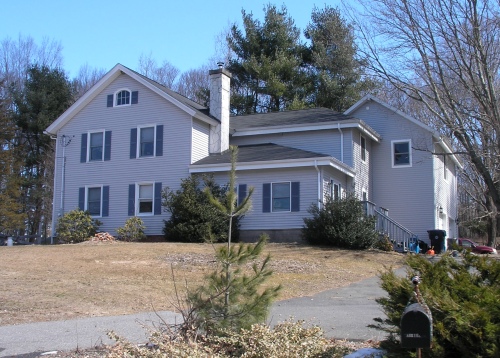
Daniel Glazier House (1808)

Daniel Glazier House

The house at 277 Tolland Turnpike in Willington was built sometime before 1808 by Daniel Glazier, the property being separated from a larger tract on which the Daniel Glazier Tavern would be built c. 1815. The town pound, where stray cattle were kept, was nearby and a number of those who lived in the house, including Glazier, were pound keepers. Across the street is a historic barn associated with the house. The barn was built in the early to mid-nineteenth century. The house no longer has its original central chimney.

Capt. Sylvanus Griswold House (1790)

Capt. Sylvanus Griswold House

The house at 1832 Poquonock Avenue in Windsor was built c. 1790 by Capt. Sylvanus Griswold (1733-1811). A prominent and wealthy man, Sylvanus Griswold served as a lieutenant in the Revolutionary War. His son, Gaylord Griswold, was admitted to the bar in 1790. He is described in Biographical Sketches of the Graduates of Yale College, Vol. IV (1907), by Franklin Bowditch Dexter:

the fourth son and fifth child of Captain Silvanus Griswold, of Windsor, Connecticut, one of the wealthiest and most influential men in Hartford County, and grandson of Captain Benjamin and Esther (Gaylord) Griswold, of Windsor, was born on December 20, 1767. His mother was Mary Collins, of Wallingford, Connecticut.

Gaylord moved to New York State in 1792. The house was owned by Charles W. Hathaway in the mid-nineteenth century.

Josiah Kimberly House (1827)

Josiah Kimberly House

The house at 144 East Plymouth Road in East Plymouth was built c. 1800. From 1827 to c. 1860 it was owned by Josiah Kimberly, a tanner and shoemaker. Kimberly took over the tannery business begun in East Plymouth by the Gaylord and Tuttle families. His son Eber E. Kimberly would continue in his father’s trade. Located at 148 East Plymouth Road is the house built c. 1870 by Eber’s son, Frederick Kimberly. As described in Francis Atwater’s History of the Town of Plymouth, Connecticut (1895):

The elder Cyrus Gaylord above alluded to, at one time also did carding in a building near the dam now standing on the same stream a short distance from his house, Josiah Kimberly at the same time using a part of the building for a tannery.

Somewhat later Mr. Kimberly had a tannery on the same stream between the grist mill and Stephen Blake’s. This tannery was afterwards conducted by Eber Kimberly.

Fowler-Frisbie-West House (1682)

33 Fair St., Guilford

The structure at 33 and 37 Fair Street in Guilford has had a long and complicated history. By 1740 Mehitabel and Anna Fowler lived in a house at 33 Fair Street. A title search has revealed that their house had been built c. 1682 by the Fowler Sisters’ father and transferred to them in 1727. The house was acquired in 1824 by Russell Frisbie, who may have rebuilt or replaced the original house. In 1864, an Italian Villa-style structure (with the address of 37 Fair Street), either moved from elsewhere or newly erected, was attached to the older house. Here resided Frisbie‘s granddaughter Cornelia and her husband, Dr. Benjamin West. Their son, Dr. Redfield West altered the entire building to have a Gothic appearance, but it was later returned to its earlier appearance. Dr. Redfield West had earlier practiced medicine in New York, Boston and New Haven. As related in the Proceedings of the Connecticut State Medical Society (1921)

In order to be with his parents in their declining years, he removed to Guilford in 1892, opened his office in the house in which he was born and where he died, and soon succeeded in establishing a large and lucrative practice. Early in life he became intensely interested and very successful in chemical researches, and in 1899, and also 1900, was granted letters patent for improvements in photographic printing. In 1894 Dr. West was appointed by Governor Morris, State Chemist; reappointed by Governor Coffin in 1896; again by Governor Cooke in 1898, and by Governor Lounsbury in 1900. In 1897 he was appointed town health officer for Guilford, and also medical examiner in the same year, offices which he held for a period of years.

(more…)

Rev. Joseph Washburn House (1796)

Rev. Joseph Washburn House

The house at 118 Main Street in Farmington was built by Reverend Joseph Washburn (1766-1805) shortly after he acquired the land in 1796. Rev. Washburn was the sixth pastor of Farmington’s Congregational Church, serving from 1795 to 1805. Suffering from consumption, he left home with his wife and four children in October 1805 to spend the winter in a southern climate. He died on Christmas Day and was buried at sea while on his way from Norfolk, VA to Charleston, SC. His widow, Sarah Boardman Washburn, later married her second husband, Deacon Elijah Porter (1761-1845). In 1846, she and her son Horace sold the house to Chauncey Rowe (1815-1900), who operated a store on Main Street with Chauncey Deming Cowles. Rowe, who was an original trustee of the Farmington Bank, owned the house until 1897.

Georgiana Van Kleek Lyon House (1893)

Lyon House

Mark Twain had a complex and ultimately troubled relationship with Isabel Lyon (1863-1958), who served as his secretary in his later years. It eventually resulted in her dismissal in April 1909 and Twain’s writing of the infamous Ashcroft-Lyon Manuscript, a 429-page diatribe that attacked Lyon and her husband, Ralph Ashcroft, who with Lyon had for a time controlled all of the author’s business matters. Many years before Lyon would live near Mark Twain in Redding, Connecticut, she had resided with her mother, Georgiana Van Kleek Lyon (1838-1926), in Farmington. In the early 1890s, the widowed Georgiana lived with her children, Isabel, Louise and Charles, at Oldagate, an historic house at 148 Main Street in Farmington. Louise married Jesse Moore, a bond salesman with Richter & Co. in Hartford, who joined the Lyon household. The family engaged Henry H. Mason to build two houses across the street from Oldgate, which they moved into in 1893. The Moores and their new baby occupied 141 Main Street. Isabel built a house for herself and her mother, Georgiana, next door at 143 Main Street. Charles H. Lyon, Jr., Isabel’s brother, died in 1893, probably a suicide.