Centerbrook Congregational Church (1790)

Potapoug Quarter, originally part of Saybrook, established its own church, Saybrook’s Second Ecclesiastical Society, in 1722 in the area of Center Saybrook, now called Centerbrook. A church, built in 1724, was renovated in 1757. The current Centerbrook Congregational Church was built in 1790-1792 and the old building was sold to Capt. Benjamin Williams and moved to the Williams family’s wharf. In 1839, the current church underwent major renovations, including the construction of a new steeple and the rotation of the originally west-facing building to face south. The adjacent Essex Borough established a separate Congregational church in 1851; the following year became part of the new town of Old Saybrook; and in 1854 became a separate town of Essex. In 1859, Centerbrook, with its much earlier church, and West Centerbrook (Ivoryton) became part of the town of Essex.

First Church Congregational, Fairfield (1892)

Fairfield‘s First Church Congregational has had six successive church buildings, the third having been destroyed when the British burned Fairfield in 1779 and the fifth burned down, apparently due to an arsonist, the night before Memorial Day in 1890. As described by Frank Samuel Child in An Old New England Church (1910):

The first Meeting-House was a small, rude building made of logs and rough hewn timbers, probably erected in 1640. Town meetings as well as church services were held in it. The second Meeting-House was built in 1765—a larger and more comfortable structure —a frame building forty feet square clapboarded, and a tower in the center of the roof. The third Meeting-House was reared in the year 1745—sixty feet in length, forty-four feet in breadth, twenty-six feet in height, with a spire one hundred and twenty feet. The Rev. Andrew Eliot called it an “elegant Meeting-House.” The fourth Meeting-House was modeled after the one destroyed in 1779. The congregation worshipped in it for the first time March 26th, 1786, but it was forty-two years before it was properly finished—a fact which suggests the slow recovery of the people from the losses of the American Revolution. A part of the funds came from the town and the confiscated property of traitors and a part from the subscriptions of the people. The Meeting-House erected in 1849 was the first one that came as the result of voluntary offerings. More than eight thousand dollars was raised for this Romanesque structure. The length of it was ninety-five feet and its breadth forty-seven. The spire extended to the height of one hundred and thirty feet. The seating capacity of this handsome Meeting-House was five hundred and fifty persons. The later changes adapted the structure to the needs of the day—a chapel being added during the pastorate of Dr. McLean and the church parlors when Dr. Bushnell was pastor.

The current church was completed in 1892 and has Tiffany windows.

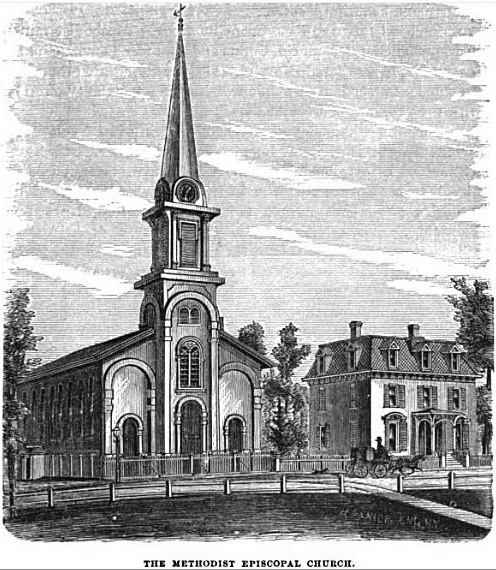
Derby United Methodist Church (1894)

The first Methodist Episcopal society in Derby was organized in 1793. In the early years, the members did not have their own building. According to The History of the Old Town of Derby (1880), “The ministers preached wherever they found open doors.” This included private homes, taverns and a schoolhouse. Again quoting from the History:

For a long time the society continued small and encountered much prejudice and some persecution. On one occasion, while a meeting was held in the house of Isaac Baldwin, which stood on the flat east of H. B. Beecher’s auger factory, the persecutors went up a ladder and stopped the top of the chimney in the time of preaching, so that the smoke drove the people out of the house. Squibs of powder were often thrown into the fire in time of worship, to the great annoyance of the people.

The Methodists constructed a church on Birmingham Green in 1837. This church continued in use until funds were raised at a tent revival in 1891 to build a new church. The current Derby United Methodist Church, built in the Romanesque style, was completed in 1894 on the site of the earlier church.

Wapping Community Church (1801)

The Church in Wapping, a section of South Windsor, was built in 1801 and initially served several denominations. The Baptists and Methodists later founded their own churches, so that by 1817, only the Congregationalists remained. They eventually organized as the Second Congregational Church in South Windsor in 1830. The Congregationalists later merged with the Methodists to found the Wapping Federated Church, which became the Wapping Community Church in 1936. The original appearance of the church is not known. It was altered to its current Greek Revival style in 1849.

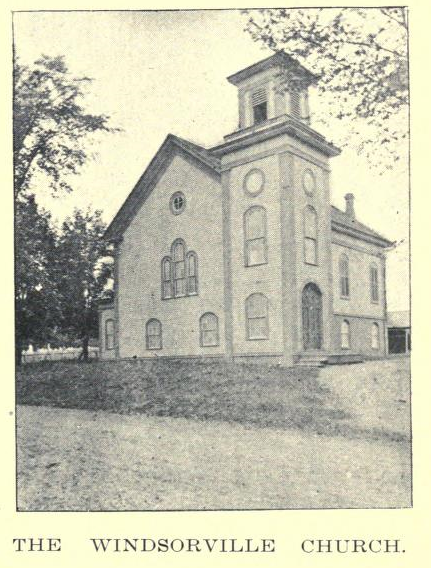
Windsorville United Methodist Church (1877)


According to Vol. 2 of The Memorial History of Hartford County (1886):

The Rev. William H. Turkington, who occupied the pulpit of the Methodist Church at Windsorville [now Windsorville United Methodist Church] in 1882, has kindly furnished the following brief record of its history : —

“The following sketch concerning the church in this place is taken from the minutes of the Methodist Episcopal Conference. The church was built in 1829 [at Thrall and Clark roads, moved to Windsorville Road in 1858]; the name of East Windsor first appears in 1829 ; the name of Ketch Mills in 1839; the name of Windsorville, in 1850. In 1876 the church was destroyed by fire. In 1878 [1877, according to the Souvenir History of the New England Southern Conference (1897)] the present church edifice was dedicated.”

A complete list of the men who in rotation have filled the pulpit of this church since its foundation in 1829 includes more than forty names. The present pastor [1886] is the Rev. H. M. Cole.

Mohegan Congregational Church (1831)

On Church Lane in Uncasville near the Tantaquidgeon Museum is the Mohegan Congregational Church. In 1827, land for the church was deeded to the Mohegan Tribe by Lucy Occom Tantaquidgeon, her daughter Lucy Tantaquidgeon Teecomwas, and her granddaughter Cynthia Teecomas Hoscoat. Their friend, missionary Sarah Huntington of Norwich, raised funds and opposed the relocation of the Mohegans during the era of Indian Removal, inspiring her relative, Congressman Jabez W. Huntington, to support the Tribe’s right to remain in Connecticut. The completion in 1831 of a Christian church played an important role at the time in preventing the removal of the Mohegans from their traditional lands. More recently, proof that the church property was the only plot of land that remained continuously owned by the Tribe was a critical factor in the reinstatement of federal recognition in 1994. With new funds, the Mohegan Tribe has restored the church, which has been for so long been a center of tribal political, social, and cultural life.

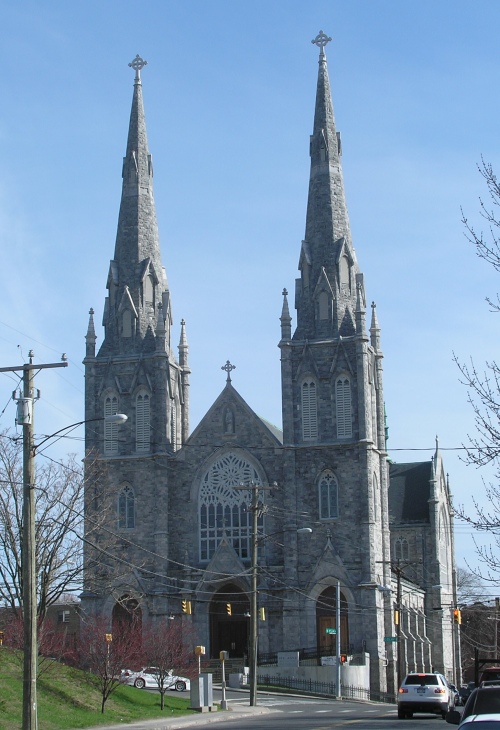
St. Anne’s Church, Waterbury (1906)

St. Anne’s Parish in Waterbury was organized in 1886 to serve the city’s French and French-Canadian Catholics. The parish’s first church was built in 1888-1889 on Dover Street. In 1906, work began on a much larger church, with the exterior being completed in one year. In 1912, the basement was finished and used for services while the rest of the interior was being worked on. It took several years to accumulate the necessary funds and there was also a delay due to the First World War, but the finished church was dedicated in 1922. The Gothic-style church has a structure of steel and brick with an exterior of granite and Vermont blue marble. The church survived fires in 1971 and 1978 and work was also undertaken in 1979 to repair the two great spires and dome. These signature features continue to impress motorists traveling through Waterbury on I-84.

UPDATE: Sadly, the condition of the two towering spires continued to deteriorate and they were removed in August, 2019.