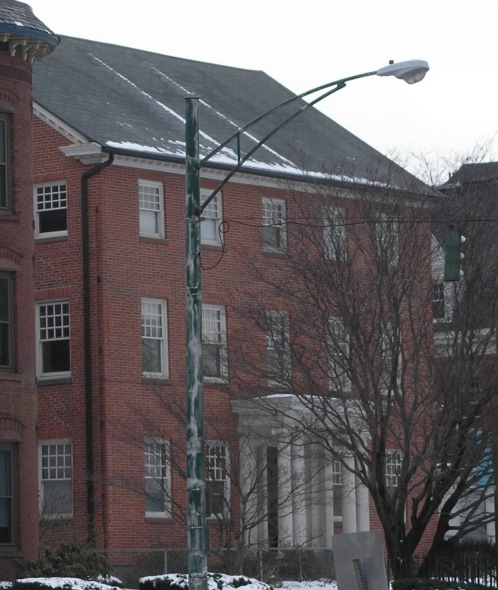
Lucius Barbour House (1865)

lucius-barbour.JPG

Built in 1865 on Washington Street in Hartford, the Lucius Barbour House was once one of many such fine houses on the street. The others are now lost, but the Barbour House remains as an example of a mid-nineteenth century Italian Villa. Many alterations have been made to the house since it was built, including the enclosing of the front porch. In the 1890s, the house was inherited by Barbour’s son, Lucius A. Barbour, who was president of the Willimantic Linen Company. He updated the interior in the Colonial Revival style. His son, Lucius B. Barbour, as State Examiner of Public Records, directed the compilation of the Barbour Collection of Connecticut Vital Records, an important source for the study of genealogy. The first two floors of the Barbour House are currently the offices of a law firm, while the top floor is the home and studio of an artist.

Appleton Robbins House (1760)

appleton-robbins.jpg

The 1760 Appleton Robbins House is a center chimney colonial home on Warner Place in Wethersfield. The house is built into a hill behind it. Recently (October, 2024) I received some information about the blacksmith shop on the property from someone who grew up in the house:

My father and crew of carpenters moved it from my grandmother’s family farm in Watertown, CT. I have newspaper clippings of the “barn raising” when they reconstructed it in Wethersfield in the 1960s. My father, Ted Tolman, actually used the forge and make some iron tools, hinges, etc. 

Henry Barnard House (1807)

The Henry Barnard House was built on Main Street in Hartford in 1807. Henry Barnard, who became the first United States Commissioner of Education in 1867, was born in the house in 1811 and died in 1900. He added the Greek Revival-style portico in 1843. The house also once had four brick chimneys, which were later removed. Overlooking Barnard Park, in the South Green neighborhood of Hartford, the house now serves as transitional housing.