Calvin Day House (1852)

calvin-day.JPG

Built in 1852 for Calvin Day, on Spring Street, on Asylum Hill in Hartord. A typical Italianate example, with a slightly visible cupola, the Calvin Day House has lost its original gray color and much of its ornamentation. Calvin Day, a successful dry goods merchant, was the father of John Calvin Day, who married Alice Hooker, the daughter of John and Isabella Beecher Hooker. John and Alice’s daughter, Katharine Seymour Day, would preserve the Harriet Beecher Stowe and Day-Chamberlain Houses in the Nook Farm neighborhood of Hartford. Since 1929, the house has served as the Gray Lodge of the Shelter for Women.

Robinson-Smith House (1864)

robinson-smith.JPG

Built in 1864, on Charter Oak Place in Hartford, the Robinson-Smith house was occupied simultaneously by the families of two flour merchants, who were business partners of Charles Northam, Charles Robinson and James Smith. The house is quite extravagant for a double house and features aspects of different revival styles, including an Italianate cupola and a Second Empire mansard roof. The house’s original symmetricality has been altered by the additions on the left side (south elevation).

Mary Rowell Storrs House (1899)

mary-rowell-storrs-house.JPG

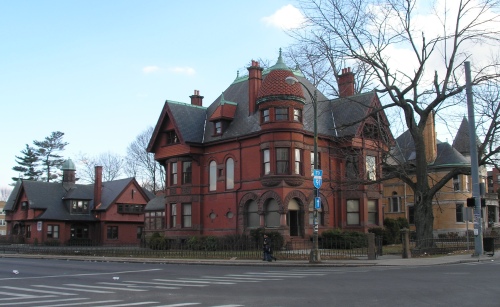
Built in 1899, on Farmington Avenue in Hartford, for Mrs. Mary Rowell Storrs, the widow of Zalmon A. Storrs, a treasurer at Society for Savings Bank. The house was designed by the prolific Hartford architect, Isaac A. Allen, Jr. The Harriet Beecher Stowe Center Library has blueprints of Allen’s original drawings for the house, as well as reminiscences of growing up there, written by Mrs. Storrs’ grandson, Lewis A. Storrs, Jr. The house was constructed in the Queen Anne style, which was becoming dated at the time (compare it with Immanuel Church, just next door, completed in the same year). The house is currently the home of the Hartford Children’s Theatre.

Col. Charles H. Northam House (1875)

painted-lady.JPG

Built in 1875, on Charter Oak Place in Hartford, for Colonel Charles Harvey Northam, a merchant and banker, just six years before he died. Northam was a philanthropist, who donated the Northam Memorial Chapel at Hartford’s Cedar Hill Cemetery and Northam Towers at Trinity College. The Northam House, with variety of its detailing, is an exemplar of the Queen Anne style of architecture. It has also been described as representative of the “stick style.” With its striking, historically accurate colors, the house is known locally as “The Painted Lady.”

The Matthew Sadd House (1750)

matthewsadd1750.JPG

Built in 1750 by the carpenter, Matthew Sadd, on Main Street in East Windsor Hill, on what had been the original land grant of Maj. John Mason in the seventeenth century. The house was originally built as a saltbox, instead of having a lean-to added later. Sadd sold it to his cousin, Abiel Grant, in 1753. Both men later worked on the building of the Ebenezer Grant House. The Sadd House was later owned by Elisha Bissell, a surveyor. It was passed down in the Bissell family until it was purchased by Dudlex Clapp in 1914. He then built and lived in a house next door, leaving the Sadd House unoccupied.