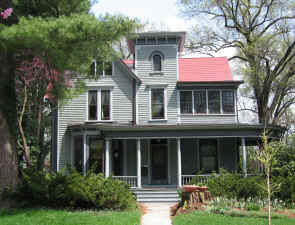
The Charles Leonard House, an 1886 Queen Anne style home on Walnut Street in Willimantic, features elements of the Stick style.
The Charles Leonard House, an 1886 Queen Anne style home on Walnut Street in Willimantic, features elements of the Stick style.

The William M. Williams House, on Broadway in Norwich, was built around 1878 and features elements of the Queen Anne and Stick styles. Williams was a partner with the Amos W. Prentice & Co hardware store in Norwich. The house is currently for sale.

The first house to be built north of Farmington Avenue, in Hartford’s West End, was an 1870 farmhouse on Kenyon Street. The house was built by the developer Eugene Kenyon, who was laying out streets and planning to construct homes in what was then an area of farmland. Kenyon’s own home was on nearby Farmington Avenue and the farmhouse was soon purchased by its first owner, Maria K. Stanley. An economic downturn in the later 1870s stalled the development of the neighborhood and Kenyon lost his money, but by the 1880s, the pace of house construction in the West End accelerated. Many classic Victorian homes were constructed on Kenyon Street around 1900 and the older farmhouse was embellished over time, combining elements of the Gothic Revival and Italianate styles.

The house at 34 Evergreen Avenue in Hartford was built around 1900 and is attributed to the architect William H. Scoville, who designed many homes in Hartford’s West End. The house has a Queen-Anne form, with siding in the Shingle Style and Colonial Revival porches. This post is Historic Buildings of Connecticut‘s 100th entry for Hartford!

The 1800 Benton-Hale House, on Main Street in Glastonbury, was built by Samuel Benton when he married Fanny Talcott. In 1838, the house was acquired by Frary Hale, “said to have been the first woolen manufacturer in Connecticut; he lived 90 years.” He also served as town clerk, 1848-1850. The house’s rear ell may be an earlier structure.

The oldest section of the Leffingwell House, on Washington Street in Norwich, dates to 1675 and was built by Steven Backus. Sometime later, the house was sold by Backus to Ensign Thomas Leffingwell, son of Lt. Thomas Leffingwell, who had given assistance to the Mohegan Chief Uncas in 1645, when he brought supplies at time when Uncas was under siege by the Narragansett. Leffingwell converted the building for use as a tavern in 1701, adding more rooms. The house is now named for his descendant, Christopher Leffingwell, who later inherited the tavern. He was a merchant and entrepreneur, who eventually built several mills. During the Revolutionary War, Leffingwell was a deputy commissary to the Continental Army and George Washington occasionally stayed at the Leffingwell Inn. In 1957, the house was moved to its present location when a connector was built linking Washington and Town Streets. Today, the Leffingwell House Museum is open to the public and operated by the Society of the Founders of Norwich.

The Italianate house of Henry Bill (1824-1891) was built in 1856 on Broadway in Norwich. Bill, a book publisher who sold many illustrated bibles, supported the education of former slaves after the Civil War. The house was acquired by the Norwich Free Academy in 1930, but is today a private home which has been restored by the current owners.
Hello to Melissa and Brett, who accompanied me on my most recent picture-taking trip in Norwich.