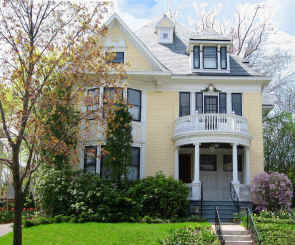
The Italianate style house built around 1864, for Jonathan W. Hooker, who sold real estate, is on Union Street in Norwich. The home’s porch and side wing may be later additions.
The Italianate style house built around 1864, for Jonathan W. Hooker, who sold real estate, is on Union Street in Norwich. The home’s porch and side wing may be later additions.

The house of Charles A. Atkins was built in 1900 on Kenyon Street in Hartford’s West End. Atkins was a lumber dealer and at one time a potential Republican candidate for governor. In 1973, Carolyn West purchased the house and in 2006 created a website for her Kenyon Street neighborhood which won a 2007 Hartford Preservation Alliance Award. There is also a PDF document at the site with information about the house.

In Avon, on Route 167 (West Avon Road) is a Gothic Revival-style one room school house which served students from 1865 to 1949. Built in 1865 as Avon‘s School Number 7, it was renamed the Pine Grove School in 1927. After 1949, it served as a branch library and a nursery school, eventually being restored by the Avon Historical Society in 1975 and opened as a museum representing an early twentieth century school.

What is now the Bradley Barnes Museum, on Main Street in Southington, began as a Greek Revival style hose, built in 1836 for Amon Bradley, the same year he married Sylvia Barnes. Bradley, who had been a Yankee peddler in the south in his youth, invested in real estate and served as postmaster and in the Connecticut General Assembly. The Barnes Homestead remained in the family for three generations and had many additions and expansions, including the c. 1860 attic windows and the c. 1900 Colonial Revival porch. Bradley Henry Barnes, Amon’s grandson, was a successful manufacturer and financier. In 1973, he bequeathed the house and its contents to the town of Southington to be a museum. Numerous antiques were collected by the Barnes family over the years and are on display in the Bradley Barnes Museum, which is located not far from the Southington Green.

Care Endodontics PC, , a dental practice specializing in root canals, was founded in 2004 by Dr. Christopher Carrington and Dr. Lester Reid. They purchased an old house on Farmington Avenue in Hartford’s West End for their expanded practice, but eventually decided to raze the original structure and replace it with a retro-Victorian house that would fit in with other structures in the neighborhood. The building features Victorian-influenced siding which disguises the fact that it is made of vinyl. The practice opened its new facility in June of 2007.

The Italianate house of George Dunham, on Lovely Street in Unionville, was built in 1868. The front portico with columns was added later. In 1860, together with A.S Upson, Dunham had acquired a company which produced nuts and bolts. Originally called Upson and Dunham, the company incorporated in 1865 as the Union (later the Upson) Nut Company. Dunham invented the Dunham forged nut machine and would go on to invent a number of others.

The home of Lucius Wyman Carroll, on Broadway in Norwich, remained in his family until it was acquired by the Phillips family in 1983. Carroll was an industrialist who owned textile mills. The construction date of 1850 (cited in a brochure PDF file) seems early for a Second Empire style house with a Mansard roof. Perhaps it was built later or the roof was added later.