First Baptist Church, Meriden (1847)

first-baptist-church.jpg

Since 1739, Baptists in Meriden had attended services in Wallingford. A seperate society in Meriden was founded in 1786 and in 1801 a dwelling house was purchased near the Meriden-Wallingford border to be used for worship by the societies of both towns. In 1815, the Meriden Baptists erected their own meeting house, near the later location of their parsonage, which was also open for the Methodists to use. This building was moved across the street and enlarged in 1831. By 1846, the Baptists required a new building but found the Congregationalists unwilling to sell the church they were planning to vacate on Broad Street (as it turned out, a group of Congregationalists continued to use the church, which is now called Center Congregational Church). Instead, the Baptists purchased the vacant lot adjoining the Congregational church and built the current First Baptist Church in 1847-1848.

In building their church next to the Congregational church, the Baptists encountered resistance from “Standing Order.” According to An Historic Record and Pictorial Description of the Town of Meriden (1907), “The work of building the new church met with a remonstrance from the neighboring church who caused an injunction to be placed on the progress of the work, the reason given for the same when the question was decided in court was as follows: “No objection to the Baptists as Christian people, as good neighbors and worthy citizens,” but Rev. Mr. Miller had a peculiarly sharp, ringing voice, that the Congregationalists claimed would disturb their society in worship. As may be readily supposed the injunction was removed and the present house of worship erected.”

The Moses Andrews Homestead (1760)

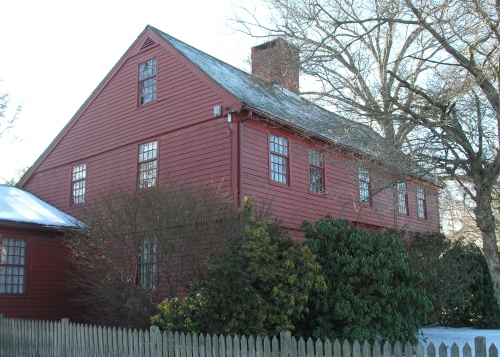
Moses Andrews Homestead

The Moses Andrews Homestead, on West Main Street in Meriden, was built around 1760 by Sgt. Moses Andrews‘s father, Samuel Andrews III. Moses was a Tory and during the Revolutionary War, the house was used as the first Episcopal place of worship in Meriden, with Andrews later acting as Lay Reader. The house remained in the family until 1864 and was then used for various purposes over the years, including as a school. In 1933, the house was restored, as a W.P.A project, to become a school and museum. When the school board ceased to use the property, it again became a museum organized by the Andrews Homestead Committee (formed in 1940). The house was again restored in 1954 and is now operated by the Meriden Historical Society as a museum. (more…)

St. Andrew’s Episcopal Church, Meriden (1867)

st-andrews.jpg

The history of the Episcopal Church in Meriden goes back to 1775, when a group loyal to the Church of England met secretly to worship at the Moses Andrews Homestead on West Main Street. St Andrew’s Parish was officially established in 1789 and the first church building, made of wood, was constructed in 1810 at the location of the burying ground. The second church was built in 1848 on Broad Street and later became the first church building used by St. Rose of Lima Church. The cornerstone of the present St. Andrew’s Church, at the intersection of Catlin, Liberty and East Main Streets, was laid in 1866. The church, consecrated the following year, was constructed of Portland brownstone and was designed by Henry Dudley of New York, an English-born architect known for his Gothic Revival churches.

Epaphroditus Champion House (1794)

epaphroditus-champion-house.jpg

Epaphroditus Champion was the son of Col. Henry Champion, the primary purchasing agent for the Continental Army during the Revolutionary War. Father and son drove a heard of 300 cattle to feed the Washington’s soldiers at Valley forge in 1778. After the War, Epaphroditus Champion, who was a merchant, later settled in East Haddam and served as a U.S. Congressman from 1807 to 1817. The house he built in East Haddam, on a bluff which provides a view of the Connecticut River, is also known as The Terraces. Champion was the cousin and brother-in-law of the merchant Julius Deming of Litchfield. He hired William Sprats, the architect of Deming’s home, to recreate a similar house for himself in East Haddam. In 1940, the Champion House was purchased by the artist, Northam Robinson Gould, who restored it. According to John Warner Barber, in his Connecticut Historical Collections (1836), the house “is distinguished for its bold and lofty terraces, and is a striking object to travellers passing on the river.”

Ira Shailer House (1791)

ira-shailer-house.jpg

UPDATE: This house was destroyed in a fire on June 7, 2023.

Ira Shailer, a descendant of Thomas Shailer, one of the original settlers of Haddam, built his house on Syabrook Road in the Shailerville district of Haddam. It was built in the 1790s, sometime after Shailer married his cousin, Anna Shailer, around 1790. Members of the Baptist Shailer family kept to themselves in their own settlement of Shailerville, often marrying cousins and avoiding outsiders.

Governor’s Residence (1909)

governors-mansion.jpg

The house, which today serves as the Connecticut Governor’s Residence, was originally built in 1909 for Dr. George C.F. Williams, a physician and president of the Capewell Horse Nail Company. Williams hired the firm of Andrews, Jacques & Rantoul, the architects of the Hartford Club, to design his 1908 Georgian Revival home on Prospect Avenue in Hartford. In 1916, additions, designed by the architects Smith & Bassette, were made to the north and south sides of the house. Members of the Williams family resided in the house until 1940 and in 1943 it was purchased by the state to become the Governor’s Mansion. The first governor to reside in the house was Raymond E. Baldwin. Guided public tours of the residence are available.

The Marcus H. Holcomb House (1876)

holcomb-house.jpg

The Italianate-style House, built in 1876 by J.F. Pratt on Main Street in Southington, was later the home of Governor Marcus H. Holcomb from 1899-1932. Holcomb was a state attorney general and superior court judge, before serving as governor of Connecticut from 1915 to 1921. Gov. Holcomb was a Mason and his house, located on the west side of Southington Green, has been the home of Friendship Lodge No. 33 since 1933.