John A. Conant House (1894)

john-a-conant-house.jpg

Located on the steepest part of Chestnut Street in Willimantic, the John A. Conant House has a basement at street level. John Ashbel Conant, who had the house built in 1894, was superintendent of the Holland Silk Company. The Holland brothers had built a steam powered mill on Valley Street in 1865 and Conant became their overseer the following year. Holland Silk Co. became a leading manufacturer of dress silk thread and, by the time Conant built his house, he had become the company’s managing director, a position he held until he retired in 1906. Conant was also involved in the temperance movement and at the American Prohibition National Convention of 1884 in Chicago, he was nominated as the Prohibitionists candidate for vice-president.

Billings & Spencer Company (1893)

billings-and-spencer.jpg

Charles Billings and Christopher Spencer were former employees at the Colt Armory who started their own drop-forging shop in Hartford’s Frog Hollow neighborhood in 1872. The Billings & Spencer Company became an important manufacturer of tools. The 1893 Billings & Spencer Company building, at the corner of Russ and Lawrence Streets in Hartford, features a distinctive Romanesque Revival office tower. The building was adapted in the 1980s for use as an apartment building, which is owned by the Melville Charitable Trust.

David Nevins House (1746)

Recent (2024) photo of the house taken by the current owner.

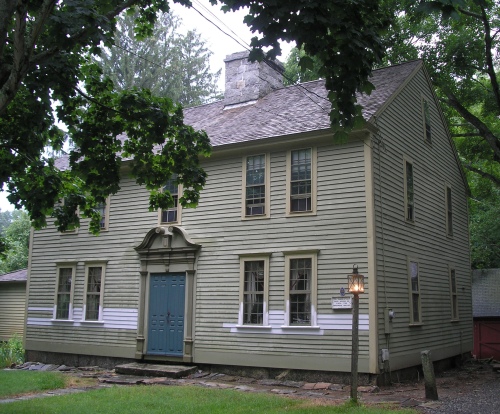
The 1746 house of David Nevins, a merchant originally from Nova Scotia who settled in Canterbury, is located across from the Canterbury Green in the Canterbury Center Historic District. The house was built the same year that Nevins married Mary Lathrop, the daughter of Col. Simon Lathrop of Norwich. Nevins died in 1758, in circumstances described in the History of Norwich (1866), by Frances Manwaring Caulkins:

It was while engaged in repairing a bridge over the Quinebaug, between Canterbury and Plainfield, which had been partially destroyed in a severe freshet, that the first David Nevins of Connecticut lost his life. He was standing on one of the cross beams of the bridge, giving directions to the workmen, and had his watch in his hand, which he had just taken out to see the time, when, losing his balance, he fell into the swollen stream, was swept down by the current, and drowned before he could be rescued.

Nevins’ son, also named David, fought in the Revolutionary War. At different times, between 1842 and 1975, the house was used as a Parsonage for the nearby First Congregational Church. In the twentieth century, the house has undergone restoration, including the restoration of the chimney using stones found in the basement of the house.

This is an earlier photo of the house that initially appeared at the top of this post.

Martha A. Parsons House (1782)

martha-a-parsons-museum.jpg

The Martha A. Parsons House, in Enfield, was built in 1792 by John Meacham on property that was initially intended for use by ministers (parsons). In 1800, the house was purchased by John Ingraham, a retired Saybrook sea captain, who placed George Washington Memorial wallpaper in the front hall. In 1906, Juliaette Parsons, the widow of Ingraham’s great-grandson, moved in with her three daughters. One of them, Martha A. Parsons, entered the world of business, eventually becoming secretary of the Landers, Frary & Clark of New Britain in 1912. After a fifty year career, she retired to Enfield to live with her sisters. She died in 1962 and the home was bequeathed to the Enfield Historical Society, which operates it as the Martha A. Parsons Museum.