Riley-Gridley House (1780)

Riley-Gridley House

The Riley-Gridley House was probably built around 1780 by Julius Riley, in Cromwell, at a time when it was a part of Middletown known as “Upper Houses.” Riley sold his house in 1784 to Isaac Gridley, with the stipulation that his two unmarried sisters could live in the house until they married; they never did and remained in the house, both living to be over 100 years old. Isaac Gridley was a graduate of the Yale Class of 1773 and had been a roommate there of Nathan Hale. He bought the house in Cromwell the same year he married Elizabeth, the daughter of Capt. John Smith. From 1855 to 1880, the house was owned by Elizabeth Crocker, the widow of Zebulon Crocker, the former minister at the First Congregational Church of Cromwell. (more…)

Bishop Abraham Jarvis House (1799)

bishop-abraham-jarvis-house.jpg

The 1799 home of Bishop Abraham Jarvis is considered to be Cheshire’s best example of Federal-style architecture. Abraham Jarvis was consecrated second bishop of Connecticut in 1797, succeeding Samuel Seabury, and two years later he moved from Middletown to Cheshire. In 1803, he moved to New Haven, where he died in 1813, and his remains are interred under the high altar at Trinity Episcopal Church. Jarvis was one of the trustees of the new Episcopal Academy (now Cheshire Academy), where his son attended school. The house passed through other owners and in recent years was in an endangered condition, but it has since been restored.

Enfield Congregational Church (1849)

enfield-congregational-church.jpg

Today we look at the congregational churches in two neighboring towns, Enfield and Longmeadow, Massachusetts (the latter over at Historic Buildings of Massachusetts, which has had a number of additions in recent days from towns such has Marlborough, Sudbury, Wayland, Weston, Waltham and Lexington, as well as Longmeadow). The church in Enfield was first authorized in 1680, when the earliest settlers from Salem, Massachusetts, set up home sites in the town. The first church building was constructed in 1683, although the congregation’s first minister was not hired until 1699. The second church building was constructed in 1708 and it was here, in July 1741, that Jonathan Edwards delivered his famous sermon, “Sinners in the Hands of an Angry God.” That church no longer exists, but a stone with a plaque marks its former location. The third Enfield meetinghouse was built in 1775, and is still standing; it later served as a town hall and is now a museum. When the current church was built, in 1849, the old building was moved across the street, rotated 180 degrees and had columns added to match the Greek Revival style of the new building.

Avery Point Lighthouse (1943)

avery-point-light.jpg

The last of Connecticut’s active lighthouses to be built was the Avery Point Light, which today is located on the University of Connecticut’s Avery Point campus. The lighthouse was built in 1943 as a memorial to all other lighthouses and lighthouse keepers. It was not lit until 1944, owing to fears of enemy invasion by sea during World War II. At time it was built, the property was used as a Coast Guard training facility and the light remained an active aid to navigation until the Coast Guard moved to a new location in 1967. Left abandoned, there were concerns that the light would be torn down, especially after UCONN declared it a safety hazard in 1997. In response, the Avery Point Lighthouse Society was formed to restore and relight the tower. In 2001, the old wooden lantern was removed, to be replaced by a newly crafted replica, lowered into place in 2005. Part of the restoration involved the building of a memorial brick walkway, with inscribed bricks that had been sold to raise donations for the restoration. Work on the tower itself was begun in 2003 and the official relighting and rededication ceremonies took place in 2006. There is a webcam view of Avery Point.

Branford House (1903)

avery-point.jpg

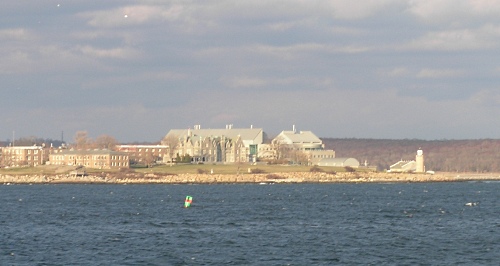
Morton Freeman Plant, son of the railroad and steamboat magnate Henry Bradley Plant, was a very wealthy businessman who was also known to live a playboy lifestyle He built the mansion known as Branford House on Avery Point in Groton. Instead of building his expensive summer home in Newport, Plant, who had a great interest in agriculture, chose the less crowded Groton, where there was greater space to build extensive gardens, greenhouses and farms. The 31-room Tudor Revival mansion was built in 1903 and named Branford House, after the town where Plant had been born. It was designed by Plant’s wife, Nellie, with English architect Robert W. Gibson carrying out her plans. The granite used in the construction was quarried from the surrounding grounds. After Plant died in 1918, the estate passed to his son and then his daughter-in-law. The house was eventually sold at auction in 1939 and later became the property of the United States Coast Guard, with the house being used as offices and quarters for the families of the station’s commanding and executive officers. Much of the grounds were bulldozed during this period and the adjacent Avery Point Lighthouse was built in 1942. In the 1960s, the Coast Guard station moved and the land reverted to the State. It was then given to the University of Connecticut and is now UCONN’s Avery Point branch campus. The mansion was refurbished in 2001 and is available for rental.

Amos Morris Hathaway House (1889)

191-prospect-street.jpg

The Amos Morris Hathaway House, at 191 Prospect Street in Willimantic, is a Queen Anne house built in 1889. Hathaway was an executive with the Willimantic Linen Company, which later became American Thread Company. In 1957, Hathaway’s surviving daughters, Kate and Marion, deeded the house to the city to become a children’s library: the Taylor-Hathaway Memorial Library. It was named in honor of Dr. Daniel Taylor, Kate’s late husband, and her brother Edgar, who had been an office manager at American Thread. Dr. Taylor was a dentist and expert on telescopes who practiced in New York City and Willimantic and who also owned a home in Noank. The house served as a library for ten years, when the children’s collection was moved to the new library on Main Street.