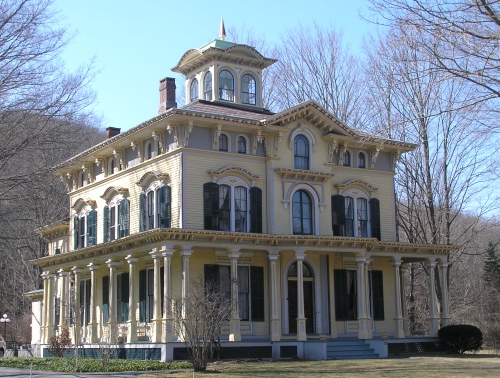
Stoddard-Sherwood House (1878)

stoddard-sherwood-house.jpg

Located in Newington Junction, the Stoddard-Sherwood House was built for John Rozwell Stoddard. He was superintendent for the Russell & Irwin Manufacturing Company and then manager for the Capewell Horseshoe Nail Company. Stoddard and his wife, Lila Marguerite Steele, had seven children and one of them, Lila Steele Stoddard Sherwood, who had married Charles Sherwood, lived in the house after her father’s death in 1936.

Philip Chapin House (1867)


On Church Street in the Pine Meadow section of New Hartford is a very impressive Italianate mansion, built in 1867 by William Bushnell as a wedding gift to his daughter Amelia, who in 1866 had married Philip E. Chapin. Philip’s father, Hermon Chapin, gave the land on which the house was built as a gift to his son. Hermon Chapin also donated land for the construction of St. John’s Episcopal Church, located adjacent to his son’s house. Hermon Chapin was a toolmaker who established the Union Factory in Pine Meadow. Philip Chapin and his brothers later established the Chapin Machine Company in 1870. After Amelia died in 1878, Chapin left New Hartford for Ohio, later remarrying and becoming the general manager of the Cambria Iron Company in Johnstown, Pennsylvania. The house in New Hartford was rented to various people and then, between 1887 and 1922, it was owned by Hubert P. Richards, who used it on weekends. After Richards died, his grandsons, Ralph and Howell owned the house and rented it out. Howell Richards eventually bought his brother’s interest in the Chapin House and owned it until his death in 1974. The house was recently on sale.

(more…)

First Congregational Church of Darien (1837)

first-church-darien.JPG

Congregational worship services in what is now the town of Darien were originally conducted in private homes starting in 1668. One such home was the Bates-Scofield House, now owned by the Darien Historical Society. At that time the community was still under the authority of the First Church in Stamford, but meetings for worship independent of Stamford began to be held in the 1730s. The Middlesex Ecclesiastical Society was officially organized in 1744, with its first minister, Moses Mather, who would remain in the pulpit for sixty-four years. The first meetinghouse was built in 1740 on the King’s Highway. Rev. Mather was a patriot during the Revolutionary War and, as described in Lossing’s Pictorial Field-Book of the Revolution (1859), “On Sunday, the 22d of July [1781], the church was surrounded by a party of Tories, under Captain Frost, just as the congregation were singing the first tune. Dr. Mather and the men of the congregation were taken to the banks of the Sound, thrust into boats, and conveyed across to Lloyd’s Neck, on Long Island, whence they were carried to New York and placed in the Provost Jail. Some died there.” Rev. Mather and most of the prisoners were eventually released. Middlesex Parish, established in 1737, remained a part of the Town of Stamford until Darien became a separate town in 1820. A new and larger brick meetinghouse, was built adjacent to the original 1837 and a bell was installed in 1841. Additional church history can be read in a pdf file on the church website.

The Caleb Stone House (1749)

caleb-stone-house.JPG

The Caleb Stone House was built in 1749, at the corner of Broad and River Streets, on the property which had been the homelot of William Leete, one of the original settlers of Guilford. Leete was a leader in Guilford and went on to become governor of the New Haven Colony and then of the Connecticut Colony, which had absorbed New Haven. While he was governor of the staunchly Puritan New Haven Colony in 1661, Leete sheltered Whalley and Goffe, two of the regicides, the judges who had signed the death warrant of Charles I and were being hunted by the Restoration government. A barn behind the Stone House stands over the cellar where the regicides hid for three days. Caleb Stone Jr. and his wife, Rebecca Evarts, bought the property in 1715 and later built his saltbox home, which was lived in by members of the Stone family until 1955.

The Charles Culver House (1832)

charles-culver-house.jpg

Built on Washington Street in New London in 1832, the Charles Culver House was the first of many to be constructed in its neighborhood by John Bishop. In 1804, Culver had owned a ropewalk adjacent to his home. When this business burned in 1834, he sold the property to a group of investors, led by John Bishop and Jonathan Starr, Jr., who opened a residential street, named Starr Street after the C. Starr and Company Soap and Candle Factory.

The Ambrose Whittlesey House (1799)

14-main.jpg

Ambrose Whittlesey was a sea captain who built his house in 1799 on Main Street in Old Saybrook. The ell of the house is earlier, dating to around 1765. The Whittleseys were civil leaders in Old Saybrook and founded the town library. In 1919, the house was acquired Grace Pratt, last surviving member of Ambrose Whittlesey’s family. In 1977, the house’s current owners bought it to become a home furnishings store, which has since grown into a shopping complex called Saybrook Country Barn.

Some readers of this site may be aware of the Connecticut town history links page I created. Each town has a page with links to relevant websites and online books. I have recently been working on a similar page for Massachusetts. So far, it only has a few towns (mostly ones where I’ve taken pictures of buildings). Some of the towns, like Cambridge, Springfield, Salem, Lexington and Concord have many links. Unsurprisingly, Boston has a massive number of links and a huge collection of online books on many different topics, which I have made easier to navigate with a number of internal links, listed at the top of the page. Please check out both the Massachusetts and Connecticut town link pages!

Olympia Diner (1950)

olympia-diner.jpg

This month’s issue of Connecticut Explored (the magazine formerly known as the Hog River Journal) has an article on the architecture of the Berlin Turnpike, written by Mary M. Donohue. According to the article, the Olympia Diner, on the Turnpike in in Newington, was built around 1950. It was one of many diners made by the Jerry O’Mahoney Company in the 1950s. Diners of the period retained many aspects of the earlier art deco style. The Olympia Diner continues to operate as a popular restaurant and historic landmark.