Southwest Ledge Lighthouse (1877)

southwest-ledge-light.jpg

Southwest Ledge Light (also known as New Haven Ledge Light) was built in 1877. Southwest Ledge, on the east entrance to New Haven Harbor, is a dangerous rock formation blocking the main channel into the Harbor. The construction of a lighthouse on the Ledge was considered in 1845, but was too expensive a project to undertake, due to the site’s isolated location. Instead, a new tower was built at that time at Five Mile Point. By 1873, technology had developed to the point that building a lighthouse on the Ledge was feasible and construction could begin. That year a storm disrupted the preparations to lay the foundation, which had to be restarted the following year. The Lighthouse, designed by Major George H. Elliott, has a cylindrical foundation, made of iron and filled with concrete. It was designed to allow winter ice to float around instead of building up and damaging the structure. The lighthouse was designed with Second Empire style details, including a Mansard roof. The superstructure, built for Southwest Ledge in a Baltimore shipyard, was considered such an impressive feat of engineering that it was put on display at the 1876 Centennial Exposition in Philadelphia, with an actual lighthouse keeper residing inside. In the end, this structure was not sent to New Haven but was sent to Delaware Bay and became the Ship John Shoal Light. Instead, an identical superstructure was sent to Southwest Ledge, although, according to some sites, it was Southwest Ledge which received the original superstructure initially intended for Ship John Shoal, while the Delaware Bay lighthouse instead received the second structure, after its stay in Philadelphia.

Put in place in 1876, Southwest Ledge Light was first lit in 1877. A new breakwall was soon built, ending at the new lighthouse. The living conditions for the lighthouse keepers remained bad for many years due leaking, dampness, bad drinking water and numerous cockroaches. In these rough conditions, Assistant Keeper Nils Nilson went into a violent rage and chased Keeper Jorgen Jonnensen around the tower with a fire axe. Jonnensen was able to lock himself in a storage room and Nilson left in a rowboat. Soon after, in January 1908, Nilson committed suicide. Despite this incident, the lives of many people were saved over the years by the keepers of Southwest Ledge Light. The Light was automated in 1953 and continues as an active aid to navigation.

Daniel Lathrop School (1783)

daniel-lathrop-school.JPG

Dr. Daniel Lathrop, who operated the first apothecary in Norwich, died in 1782 and left an endowment of £500 for the establishment of a free school in Norwich, with the condition that it remain in session eleven months of the year. Built of brick in 1783, the school is located on East Town Street, off Norwichtown Green. The Daniel Lathrop School stands next to the shop of Joseph Carpenter, built in 1772.

Union Baptist Church, Mystic (1829)

union-baptist-church.JPG

Located prominently on Baptist Hill in Mystic is the Union Baptist Church, which is actually two different church buildings that were eventually combined. The origins of the church date back to 1764, with revival services held in Groton in 1764 during the Great Awakening. Groton’s Second Baptist Church was established the following year in Fort Hill. By 1825, the village of West Mystic in Groton was being developed. According to Groton, Conn. 1705-1905, by Charles Rathbone Stark, “The need of better facilities for those on the banks of the Mystic River led a number of public-spirited men to build a house to be used for the benefit of all denominations, the pastors of the various churches rotating in occupancy of its pulpit. The house was built in 1829 and by reason of the large number of sea-faring men contributing to its erection it was called the Mariners Free Church.” The architect of the new church was Deacon Erastus Gallup of Ledyard. Over time, the other denominations built their own churches in Mystic, leaving the Third Baptist Church, founded in 1831 by members of the First Baptist Church, the only group still occupying the Mariners’ Church. Meanwhile, the Second Baptist Church had moved from Fort Hill to Mystic, building a church on High Street in 1845. In 1861, the Second and Third Churches joined to form Union Baptist Church. The Second Church’s building was moved up High Street and joined to the rear of the former Mariners’ Church. The original steeple was lost during the Hurricane of 1938 and the Church was without a steeple until a new one, with a carillon, was built in 1969.

Enos S. Kimberly House (1884)

enos-kimberly-house.jpg

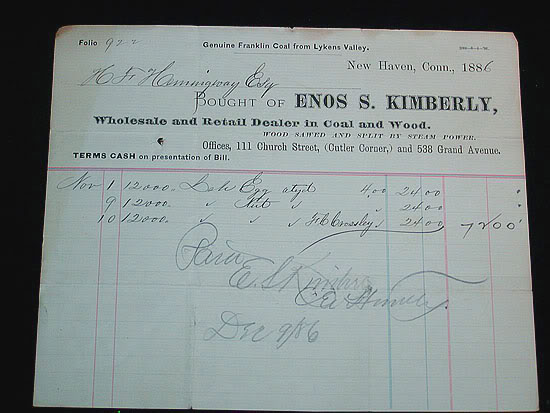
The Enos S. Kimberly House is a very solid and imposing Queen Anne house, built in 1884 on Orange Street in New Haven. Enos Kimberly was, according to an 1886 bill, a dealer in wholesale and retail coal and wood. His wife, Sarah Chatfield Kimberly, was a member of the Daughters of the American Revolution. The architect of the home was Rufus G. Russell, a former assistant of Henry Austin.

Lee Academy (1821)

lee-academy.JPG

Lee Academy was built as a schoolhouse in 1821, at the corner of the Boston Post Road and Neck Road in Madison. It was named for Captain Frederick Lee, who had led the effort to establish a private college preparatory school in town, and the new building was constructed across the street from his own house. Capt. Lee had also been the one to propose Madison as a name for the new town in 1826. Although built with a proviso that it would never be moved, the school building has been relocated several times: in 1836 to the western end of the town Green; in 1839 (when it began to serve as a district school, continuing to accommodate the preparatory school as well until 1884) to a plot across from the Green’s northeast corner; in 1896 (making way for the construction of Memorial Hall) to a location behind the Hand Academy. In 1923, the Madison Historical Society began to manage the building, which was moved, for the last time, to its present location, facing west toward the Green. Having housed a number of organizations and businesses over the years, Lee Academy is now used as a museum and as offices for the Historical Society.

Humphrey Pratt Tavern (1785)

humphrey-pratt-tavern.jpg

Built around 1785, the Humphrey Pratt Tavern in Old Saybrook was a stage stop between New York and Boston and housed Saybrook’s first post office. There is also an attached ell containing a ballroom. The Marquis de Lafayette stayed at the Tavern in 1824. Humphrey Pratt, who also built a house in 1785 for Saybrook’s minister, Frederick William Hotchkiss, was a brother of Deacon Timothy Pratt, whose house stands nearby, and the Tavern remained in the family until 1943. The building also had an adjacent general store, built in 1790, which was later moved down the street and is now the James Pharmacy and Soda Fountain.

Charles Uriah Hayden House (1819)

charles-uriah-hayden-house.JPG

Charles Uriah Hayden was the grandson of Ebeneezer Hayden, the leading shipbuilder of his time in Essex. Ebeneezer had been predeceased by his children, so when he died in 1818, he left his property to his grandchildren. They proceeded to construct several impressive homes along West Street and Champlin Square in Essex. Charles Uriah Hayden’s Federal style home was built in 1819, on West Street across from Essex town hall. Within fifteen years, he had lost his money and had to sell the house to Joseph Post, a sea captain and ship builder. Post was likely the owner who added a cupola to the house. After six years, Capt. Post sold the house to his brother in 1841. The house had other owners over the years, including the Brooklyn, New York businessman George Ives Stevens. The house was seriously damaged by a fire in 1994, but it has since been restored.