William R. Cotter Federal Building (1932)

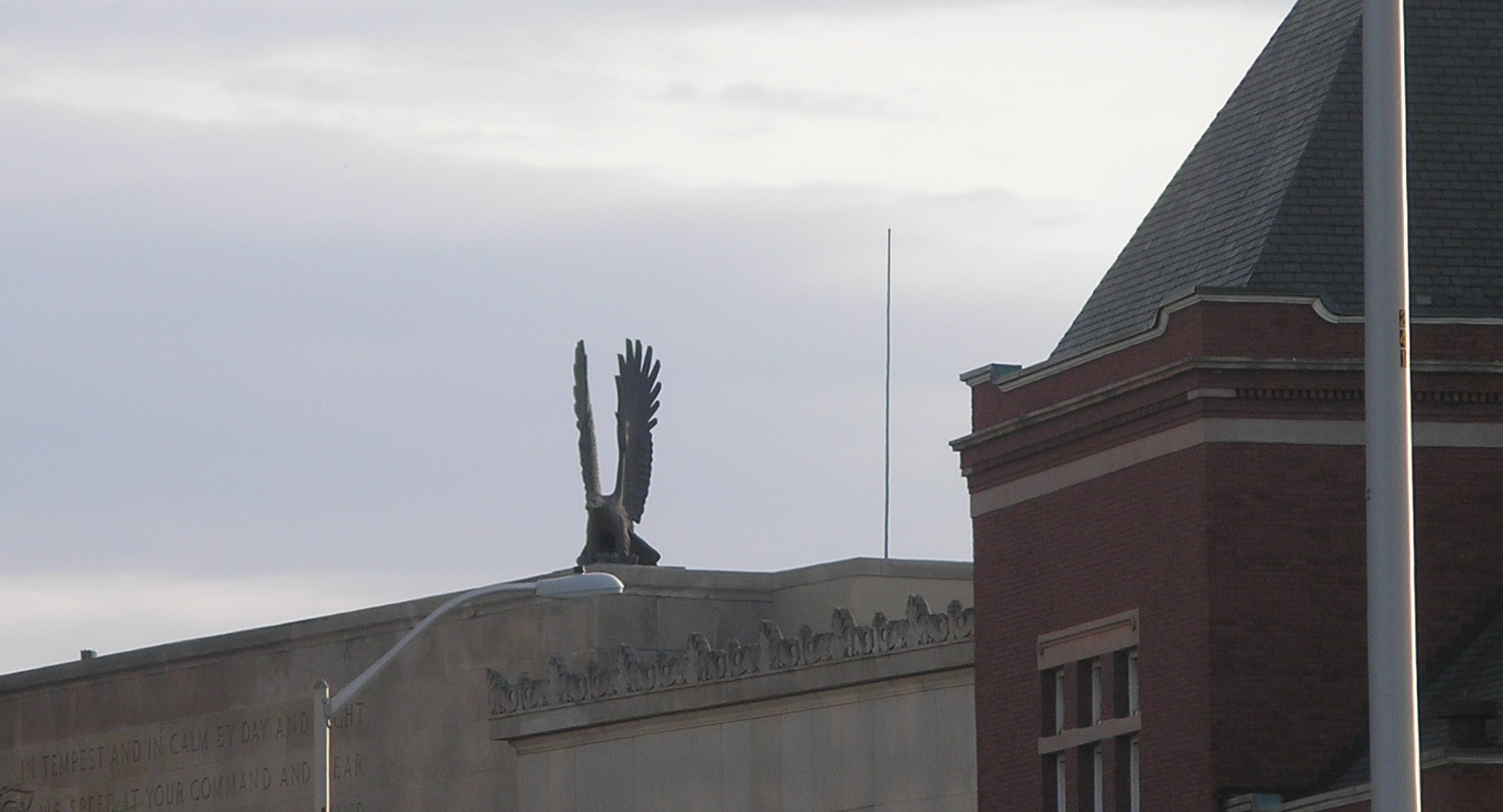
Adjacent to the Foot Guard Armory, on High Street in Hartford, is the William R. Cotter Federal Building, built in 1931-1932. Part of the federal government’s Depression-era construction program, the Federal Building once housed the post office and federal courthouse. The courts (in 1962) and post office (in 1977) moved elsewhere and the building now houses various federal offices. In 1982, the building was renamed to honor Congressman William R. Cotter, who represented the First District of Connecticut from 1971 until his death in 1981. The Art Deco and Neoclassical building (pdf), designed by Malmfeldt, Adams & Prentice, is constructed of Indiana limestone and Wisconsin black granite and has two aluminum eagles on the roof.

First Company Governor’s Foot Guard Armory (1888)

Organized in October 1771, the First Company Governor’s Foot Guard is the oldest military organization in continuous existence in the United States. In 1780, the Foot Guard escorted Washington to his meeting with the Comte de Rochambeau in Hartford. Built in 1888, the Foot Guard Armory, on High Street in Hartford, was designed by architect John C. Mead. The building’s drill hall, advertised in the 1890s as the largest public hall between New York and Boston, was once one of Hartford’s major locations for public entertainment.

Vanderbilt Hall, Yale University (1894)

Vanderbilt Hall at Yale University is a U-shaped dormitory built in 1894. Part of Yale‘s Old Campus, it faces Chapel Street and was designed by Charles C. Haight to resemble a large Tudor gatehouse, as does the same architect’s Phelps Hall, which faces New Haven Green. Vanderbilt Hall replaced South College (Union Hall), built in 1793-1794, which was part of Yale’s famous Brick Row. The impressive building has a lavish interior, built to compete with the fancy private dormitories that lined the opposite side of Chapel Street at the time. Vanderbilt Hall was the gift of Cornelius Vanderbilt II to memorialize his son, William H. Vanderbilt II, who died of typhoid fever while in his junior year at Yale. Major renovations occurred in 1976, when the internal arrangement of the dorm rooms was reorganized. The building was again renovated in 1995-1996 and 2002.

Harwinton Congregational Church (1952)

Harwinton’s first Congregational meeting house was constructed in the early 1740s, to the south of where the current Congregational Church now stands. Surplus materials from its construction were later used to build the town’s first schoolhouse. Put to municipal use for thirty years after a new church was built in 1808, the old structure became dilapidated and was eventually torn down. The 1808 church, built in the Federal style, continued in use until it burned, after being struck by lightning, in 1949. Groundbreaking ceremonies for a new church occurred the following year and the building opened for worship in 1952. Due to a shortage of funds, the new church remained without a steeple for ten years, until 1962, when the Harwinton Congregational Church acquired the steeple of the Methodist Church in Torrington, which was being torn down at the time.

Joseph Dwight Chaffee House (1889)

In 1889, Joseph Dwight Chaffee bought what was considered to be the most desirable lot in Willimantic and built an impressive Queen Anne house on the property. As stated in The Chaffee Genealogy (1909), Joseph Dwight Chaffee

was born in Mansfield, Conn., August 9, 1846, and married there, September 12, 1867, Martha W., daughter of George P. Armstrong of that place. Mr. Chaffee has served in the Connecticut Legislature as Representative and also as Senator from the Twenty-Fourth District. He has been associated with his father in the business of manufacture of silk under the firm name of O. S. Chaffee & Son, later called the Natchaug Silk Company of Willimantic, Conn. In 1883 he lived in Mansfield, and in 1894 in Willimantic.

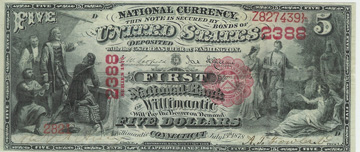
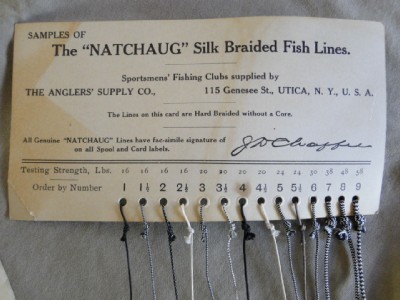
He was known as Colonel Chaffee, after serving on Governor Phineas Lounsbury‘s staff from 1887 until 1889. In 1895, a financial scandal led to the liquidation of the Natchaug Silk Company and the arrest and trial of J. D. Chaffee for fraud (the company had been capitalized in a fraudulent manner by the First National Bank of Willimantic, a fact discovered when the bank’s cashier committed suicide and the bank was investigated). Chaffee later operated, with his son, another manufacturing company, known for its Natchaug Silk Braided Fish Lines. He later llived in the factory’s basement, after the company closed in 1927, until his death in 1938 at the age of 92. His former house on Summit Street in Willimantic was restored in the late-1990s.

First National Bank, Hartford (1899)

The State House Square building complex, located just north of the Old State House in Hartford, was completed in 1985. It is the latest structure to occupy a block of state street which has had a number of interesting buildings over the years. Near the end of the nineteenth century, the First National Bank occupied the right end of a commercial block that also included the United States Hotel. Adjacent on the east was the 1834 Greek Revival building of the Hartford National Bank. From 1896 to 1899, the First National Bank moved to a temporary location on Main Street while its new building was constructed. Designed by Ernest Flagg and completed in 1899, the Beaux Arts-style Fist National Bank building had a fireproof construction consisting of steel structural columns and cinder-covered brick vaults under the floors. The facade of the building has survived to become part of State House Square.

Tunxis Hose Fire House (1893)

In 1893, the citizens of Unionville petitioned the state legislature to create a fire district for their community. The founding of the Unionville Fire District led to the creation of the Tunxis Hose Company and the construction of a Queen Anne-style fire house, begun in 1893 and completed in the following year. Located at the corner of Lovely Street and Farmington Avenue in Unionville, the Tunxis Hose Fire House was in use until a new building was constructed in 1960-1961. The old building, next used by the Town of Farmington as a storage facility for its files, has recently been restored with assistance from architect Tim Eagles.