Hartford B.P.O. Elks Lodge (1903)

The yellow brick building of the Hartford B.P.O. Elks Lodge #19, organized in 1884, was built on Prospect Street in 1903. Designed by John J. Dwyer, a Hartford architect, the building was constructed in the Renaissance Revival style. The Hartford Club, nearby on the same street, was built the same year in the Georgian Revival style. The Elks Lodge has retained its original elegant interiors.

Shetucket Grange Hall (1840)

The Shetucket Grange Hall in Scotland was built around 1840 as the Union Church. The building was moved from Pudding Hill to the center of town in 1900 to become a Grange Hall. As described in Vol. I of the History of Windham County, Connecticut (1889), by Richard M. Bayles,

[In Scotland,] The principal attention of the people is directed toward agriculture, and some improvement may be seen in that direction in recent years. Among such improvements may be noticed the organization of a Grange. Shetucket Grange, as it is named, was organized with twenty-four charter members, June 10th, 1887. The ceremonies of organization and installation of officers, which took place on the same evening, were conducted by D. M. Master Tucker of Lebanon, assisted by D. K. Bowen of Woodstock and members of Little River Grange of Hampton.

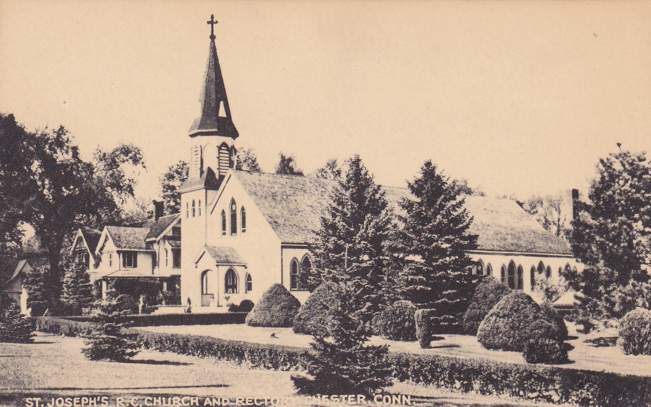
St Joseph’s Roman Catholic Church, Chester (1891)

The first Catholic mass in Chester was held in 1851 and a church was built on Middlesex Ave in 1855. At that time, the Parish served the towns of Chester, Deep River, Essex, Old Saybrook, Westbrook, Old Lyme, Lyme, and Haddam. The Parish received a full-time pastor in 1876 and the current church replaced the original one on the same site in 1891. To make way for the new church, the first church building was sold and moved to the corner of Main Street and Middlesex Avenue. The new St Joseph’s Roman Catholic Church was dedicated on February 16, 1892. The church was enlarged in 1929, at which time the peak of the gable roof was lowered and two smaller towers on the right of the front facade were removed.

David Williams House (1766)

Built by David Williams, a ship builder, in 1766-1767 (and later expanded), the house at 27 West Avenue in Essex was acquired by Abel Pratt in 1798. According to the 1884 History of Middlesex County,

The manufacture of combs in this country was first begun by Phineas Pratt and his son Abel, about the close of the last century. They were the first inventors of machinery for cutting the teeth upon combs, by which they could be produced so as to compete with English manufacturers. The shop in which they worked stood a few yards west of the site of Pratt’s blacksmith shop, and the first machinery was driven by wind power. Abel Pratt carried on the business during the first years of this century [the nineteenth].

In the later nineteenth century, it was owned by members of the Pratt family connected to the nearby Pratt Smithy, established in 1678 and handed down through ten generations.

Aldrich Free Public Library (1896)

David L. Aldrich and Edwin Milner operated woolen mills in the Plainfield village of Mossup. When Aldrich died in 1889, he left $3,000 towards the construction of a public library, with the condition that others raise a matching amount. His partner Milner pledged $2,000 and the rest was raised by the town residents. In 1893, the Aldrich Free Public Library Association was organized and the building was completed in 1895, with final construction costs paid by Milner so that the money raised by the town could be spent on books. The Aldrich Free Public Library opened on Washington’s Birthday, February 22, 1896. The house-like Queen Anne-style building (pdf) was designed by Charles F. Wilcox of Providence, Rhode Island and was built by Willis Rouse, a local carpenter and a contractor and dealer in sash and architectural millwork in Central Village.