847 North Main Street, West Hartford (1777)

847-north-main-street.jpg

The 1777 house at 847 North Main Street in West Hartford is listed on the National Register of Historic Places. It is also on a touring guide of the Historic Sites of West Hartford. No known family name appears to be associated with this home.
Also, seven new buildings have been posted on Historic Buildings of Massachusetts! These are Trinity Church and New Old South Church in Boston; the Sheldon-Hawks House and Wells-Thorn House in Deerfield; the Phillips School in Boston; Harvard Hall in Cambridge; and Connecticut’s own state building at the Eastern States Exposition in West Springfield!

John Pierpont House (1767)

john-pierpont-house.jpg

The John Pierpont House, on Elm Street in New Haven, was built in 1767 and is located between the Jonathan Mix and Ralph Ingersoll Houses. The house was used by British soldiers as a headquarters and hospital during the Revolutionary War, when they raided New Haven in 1779. It remained in the Pierpont family until 1900, when it was purchased by Rev. Anson Phelps Stokes, Secretary of Yale University, who added two symmetrical rear wings. The house was acquired by Yale in 1921 and “restored” by architect J. Frederick Kelly in 1929. Other alterations have been made over the years, some being removed by Kelly, who sought to recreate a Colonial appearance. Yale has used the house as the Faculty Club, Office of Undergraduate Admissions, and most recently as the University’s Visitor Center. The building’s interior and exterior have been extensively renovated since it became the Visitor Center in 1995.

Nicholas Callahan House (1762)

nicholas-callahan-house.jpg

Dated to 1762 or 1776, the Nicholas Callahan House, on Elm Street in New Haven, faces New Haven Green and is located between the First Methodist Church and Hendrie Hall. Callahan was a loyalist and during the Revolutionary War the house became a meeting place known as Tory Tavern. It was eventually confiscated by the town in 1781. The two-story porch around the house’s front entrance was added in the later nineteenth century and altered again in the twentieth in the Federal style. In 1910, the house was acquired by Elihu, a Yale Senior Society. The following year, the house was remodeled by Everett V. Meeks, who was the head of Yale’s Department of Architecture and later the Dean of Yale’s School of Fine Arts from 1920 to 1947

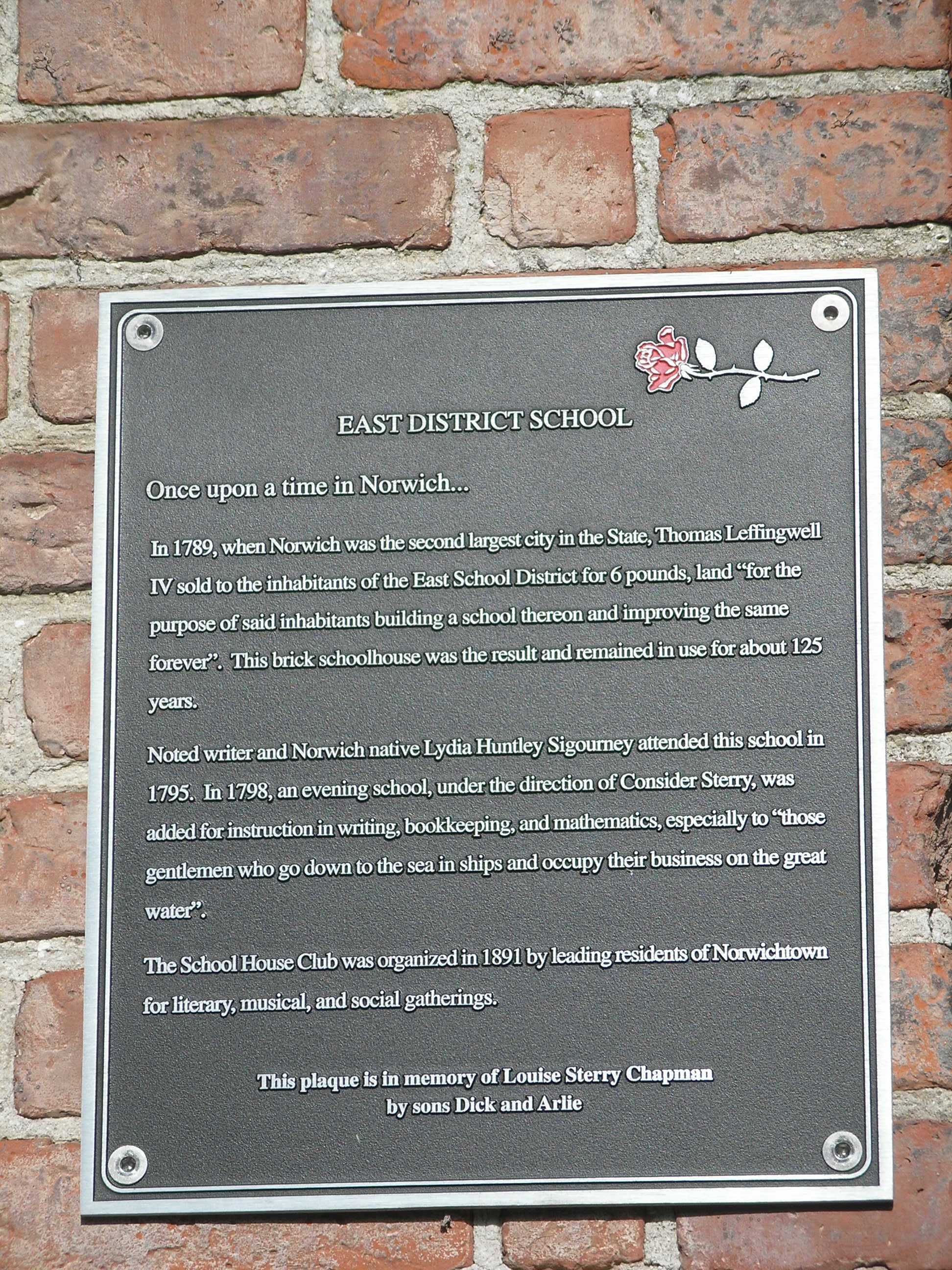
East District School (1789)

east-district-school.jpg

The brick East District School in Norwich was built in 1789, on land donated to the town by Thomas Leffingwell IV. It was used for about 125 years and its students included Lydia Huntley Sigourney, who attended in 1795. The school was quite progressive, with boys and girls being taught the same subjects. Starting in 1891, the building was used by the School House Club for cultural and social events. Located on Washington Street, it is now a historical museum.

Denison Homestead (1717)

denison-homestead.jpg

The Denison Homestead is the third successive house to be built on the land granted to Captain George Denison in 1654 in the Town of Stonington‘s half of Mystic (which is a census-designated place). Its immediate predecessor burned in a fire in 1717, the night before George Denison‘s grandson, known as “George the Builder,” was married. This grandson then built the current house just west of the original home, using charred timbers from the old house. The house, which became known as Pequotsepos Manor, continued to be the home of generations of the Denison family. In 1930, Ann Borodell Denison Gates created the Denison Society and after her death, in 1941, the house became the Denison Homestead Museum. Located on Pequotsepos Road in Mystic, the museum presents a different period of time the history of the Denison family in each of its rooms.


This is Historic Buildings of Connecticut’s 500th Post
(not including the April Fools Day post)

Peck Tavern (1680)


peck-tavern.jpg


The Peck Tavern, where George Washington once danced, is located where Sill Lane branches off from US 1 in Old Lyme. It may have been built as early as 1680, although the main block achieved its present form by about 1769, when John Peck acquired the tavern. The building served as an inn and tavern from the mid-eighteenth century into the nineteenth and remained in the Peck family until 1904. In the 1930s, the building was used by the Old Lyme Guild, a non-profit arts and crafts organization.  In recent years, the house served as a bed & breakfast.