Isaac Moss House (1785)

At 172 Old Tannery Road, across from the Monroe Center Green, is a house built in the 1780s by Isaac Moss. The building’s southwest wing was once a separate building and served as a general store and post office from the later eighteenth century through the 1940s, by which time a gas station, since removed, was located out front. The Moss-Clark General Store, which was run by Marshall Beach in the late nineteenth and early twentieth centuries, was attached to the Moss House in 1896. The house has had some changes made to it over the years, including the addition and later removal of a large veranda and the removal of two large chimneys in the 1890s, torn out at the request of Mrs. Beach due to fears of a potential chimney fire.

The Isaac Tucker House (1766)

The Isaac Tucker House is one of only a few to have survived the burning of Fairfield by British forces on July 7, 1779. The house was built in 1766, two years after Tucker married Mary Wakeman in 1764. Tradition holds that a servant, hiding upstairs, put out the flames and saved the house from destruction. There are still burn marks inside from the attempted torching. The house was later owned by Edmund Hobart, who served as postmaster in Fairfield in the mid-nineteenth century.

Capt. David Judson House (1723)

Capt. David Judson built a Georgian-style house in Stratford around 1750 (or as early as 1723), on the foundation of his great-grandfather William‘s stone house of 1639. Nine generations of the family lived in the house until 1888, when the house was sold to John Wheeler. In 1891, it was sold to Celia and Cornelia Curtis, who willed it to the Stratford Historical Society in 1925. The Judson House, which is now a museum, is known for its particularly fine broken scroll pediment door surround.

Eells-Stow House (1700)

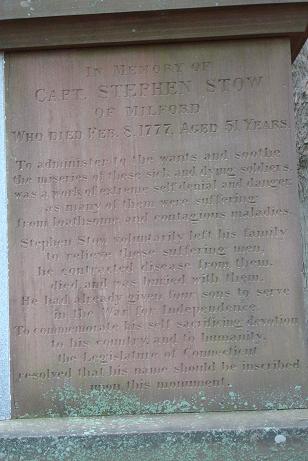
Samuel Eells settled in Milford in the later seventeenth century and owned property on Wharf Lane. He later settled in Hingham, Massachusetts and his son, Col. Samuel Eells, inherited the land in Milford, which later passed to his widowed third wife and then to Nathaniel Eells, his son by his second wife. Nathaniel, who lived in Middletown, sold the Milford property to Stephen Stow, the brother of his late wife. Stow, the captain of a coastal schooner, married Freelove Baldwin around 1751. He died in 1777 during the Revolutionary War while nursing 200 American prisoners of war suffering from smallpox, who had been cast off from a British prison ship. Four of Stow‘s sons also served in the war. The Eells-Stow House on Wharf Lane was once believed to date to the later seventeenth century, but is now thought to have been built c.1700-1720. The house was saved from destruction by the Freelove Baldwin Stow Chapter of the D.A.R. in 1930 and has since been preserved as a museum by the Milford Historical Society. The house underwent an extensive restoration in 1981-1982, which included the replacement of the later sash windows with the earlier type of diamond-pane casement windows.

Thomas Buckingham House (1640)

Thomas Buckingham was one of the original planters who settled Milford in 1639. The Buckingham House, on North Street in Milford, is said to have been built around 1640. The house, however, does not have the appearance of a First-Period seventeenth century house because it was remodeled after Jehiel Bryan, who married Esther Buckingham, acquired it in 1753. Capt. Jehiel Bryan, who served in the Revolutionary War, later built the Bryan-Downs House in Milford.

Nuttinghame (1740)

Wallace Nutting (1861 – 1941), a former minister, became a leading antiquarian, entrepreneur and a major figure of the Colonial Revival movement in the early twentieth century. He authored books, reproduced antique American furniture and opened colonial houses as museums, including the Webb House in Wethersfield. He is most well-known for his photographs of country landscapes and the interiors of colonial houses, which were hand colored by women who worked for him and sold through a catalog. In 1906, Nutting had moved to a farm in Southbury, where he soon established a studio in a new barn he built on the property. He restored the old farmhouse, built in the 1740s, and named it “Nuttinghame.” Quite a few Nutting pictures feature Nuttinghame and the landscape that surrounds it. One notable image is titled “Nuttinghame Blossoms.” A particular parlor in the house was featured in many Nutting pictures, including: “A Bit Of Sewing,” “A Sip Of Tea” and “An Afternoon Tea.”

As Nutting‘s business prospered, he decided to move his operation to Framingham, Massachusetts in 1912, where he bought an Italianate house he called “Nuttingholm.” The Framingham house was later demolished, but his earlier house in Southbury still exists. In 1953, the farm was purchased by the comedic pianist Victor Borge. In the mid-1960s, Borge sold the property to a development company, which built a retirement community called Heritage Village. The Nutting/Borge house is now called the Meeting House and has executive offices, meeting rooms and a kitchen for use by community residents.