The Benjamin Moore House (1770)

benjaminmoorehouse.jpg

This house is unrelated to the paints. The Benjamin Moore House was originally built around 1770 in Poquonock, a northern area of Windsor. It was constructed by Simeon and Hannah Barber Moore but, after they moved to Torrington in the 1780s, it was passed on to their son Benjamin and his siblings, Eldad and Hannah. In 1801 they applied for a mortgage which was held by Oliver Ellsworth. But even with an additional loan, the Moores had sold off their property by 1806. In 1986, the house was saved from demolition by Edward Sunderland, of Sunderland Period Homes, who dismantled it and moved it five miles away to its present location, where it is now part of Ellsworth Settlement in Windsor, a modern development consisting of relocated period homes. The house’s current Connecticut River Valley doorway is an appropriate reproduction. The house was featured in an article in the February, 2008 issue of the magazine, Early American Life. The house is currently for sale.

Dr. Roger Waldo House (1750)

rogerwaldohouse.jpg

At the intersection of Moulton Road and the Old Turnpike in Mansfield is a one-and-a-half story house with overhanging gable ends, probably built in the middle of the eighteenth century. Around 1770, it was purchased by Seth Pierce, Sr. and Jr., who sold it to Dr. Roger Waldo in 1798. Waldo, who died in 1816, was a prominent physician and representative at the Connecticut General Assembly. There is evidence of a blacksmith shop possibly having been on the property, which would have served the Mansfield Four Corners community.

The Corner House (1783)

cornerhouse.JPG

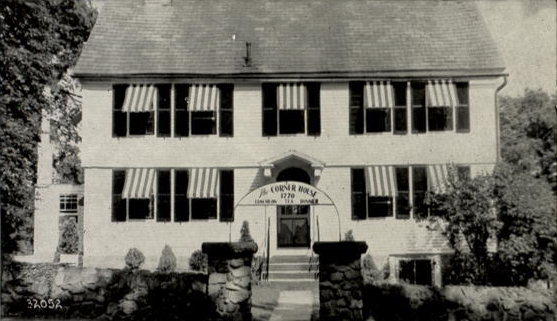
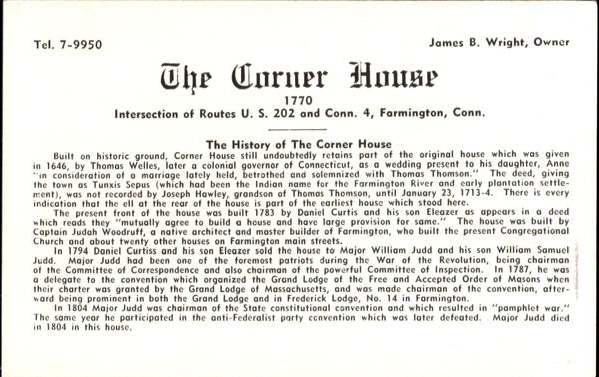
Located at the corner of Main Street and Farmington Avenue in Farmington, the Corner House was built around 1783, perhaps incorporating part of an earlier dwelling that was on the property when it was acquired by the brothers, Daniel and Eleazer Curtiss, in 1774. In 1807, the house was bought by Elijah Cowles, Jr. and Jonathan Cowles. In more recent times the building was a restaurant. Today it is used for offices and the Farmington Inn is attached to it.

The Dexter-Adams House (1781)

dexter-adamshouse.JPG

The Dexter-Adams House, on Centre Street in Mansfield, was built sometime after the land it was constructed on was purchased in 1781 by William and Nathan Dexter. It was purchased in 1803 by Barzillai Swift and was later lived in by his daughter, Lucy, and her husband, Dr. Jabez Adams, one of Mansfield and Windham’s physicians of the late eighteenth and early nineteenth centuries. He worked for a while in partnership with his brother-in-law, Dr. Earl Swift. Dr. Adams’ daughter, Alice, married the builder Edwin Fitch, who possibly made some of the later alterations to the house. The nineteenth century changes include the addition of a mansard roof and a porch.

George Hubbard House (1669)

A very early date of 1637 has been claimed for the house of George Hubbard, an early Wethersfield settler, on Main Street, near Wethersfield Cove. It is more likely that the oldest part of the house was actually constructed in the late 1660s by the merchant and ship owner, John Blackleach. This would have been a simple one room below with a chamber above. Blackleach also had a textile and silver shop. The house was later expanded into a saltbox. One website claims this was also the home of Nathaniel Stillman III. A modern wing, with seventeenth century-style facade, has been added to the house in recent years.

(more…)

The Altnaveigh Inn (1734)

altnaveighinn.jpg

The Altnaveigh Inn and Restaurant, on Storrs Road in the Spring Hill area of Mansfield, is located in a colonial house built by Isaac Sargeant, on land given to him by his father, John Sargeant, probably in 1734. The house was later owned by Dan Storrs, who purchased it from Sargeant’s widow in 1794. It was later bought by Azariah Freeman and remained in his family for over a century. It may also have, for a time, been occupied by the miniature portraitist, George Freeman. In 1951, it was purchased by Edith McComb, who named it Altnaveigh, Gaelic for “hill top.” For much of the last century it has been an inn and restaurant.