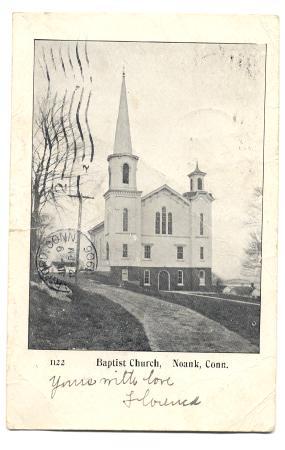
Noank Baptist Church (1962)

Located at the highest point in the village of Noank in Groton (18 Cathedral Heights) is the Noank Baptist Church. The congregation dates back to 1843. An early meetinghouse was replaced by a new an Italianate-style church with two spires. The church was destroyed in a fire on Christmas Eve, December 24, 1959. It was rebuilt and the first service in the new building was on Easter Sunday, April 22, 1962, followed by the dedication service and a recital with the new organ on September 16, 1962.

A. G. Martin House (1902)

The A. G. Martin House, built c. 1902 and now a multi-family home, is located at 27 Moss Street in Pawcatuck. According to the Legislative History and Souvenir of Connecticut, vol. VII (1909-1910):

Albert G. Martin, of Stonington (Pawcatuck), was born in Warwick, R. I., March 6, 1859. He is the son of John and Elizabeth Barnes Martin. His early days were spent at Carolina. R. I., receiving such education as the village school afforded. On September 30, 1882, he married M. Nettie, daughter of George F. and Mary E. Davis, to whom one son was born June 23, 1895. Albert G., Jr., and who deceased December 15. 1899. Mr. Martin removed to Philadelphia, Pa., in 1886, and engaged in mercantile life; assisted in organizing the Frankford Grocers’ Association, serving as president and director for years; being also identified with public matters and charitable enterprises; a most successful merchant and ardent Republican in politics Returning east in May, 1903. Mr. Martin located in Pawcatuck, town of Stonington, and has shown a deep interest in all public matters both civic and moral for town improvement. For several years Mr. Martin has served as financial secretary of the First Baptist Church, of Westerly. R. I., and is an active member and official of the Westerly and Pawcatuck Business Men’s Association and the Board of Trade. He is a member of the school committee of the Eighteenth School District and moderator of the Pawcatuck Fire District. Mr. Martin is closely associated with fraternal organizations, being a member of Pawcatuck Lodge No. 90. F. & A. M.. Palmer Chapter No. 26, Westerly Lodge of Elks No. 678, and Misquamicut Tribe of Red Men No. 19. Mr. Martin served on the Committee on Finance.

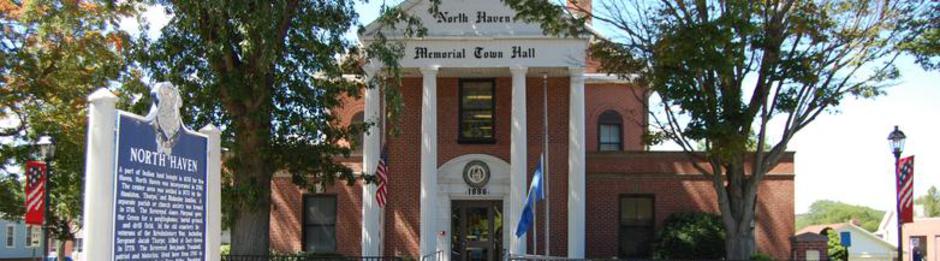
Memorial Town Hall, North Haven (1886)

Like Memorial Hall in Windsor Locks, the town of North Haven chose to honor its men who died in the Civil War with a functional building, instead of a traditional stone monument. Veterans had formed an association in 1885 to erect a monument and money was appropriated for the purpose in a town meeting, but a later meeting reversed this, as public opinion favored erecting a memorial building instead. As related in North Haven Annals (1892), by Sheldon B. Thorpe:

A lot was purchased from the Cowles estate, plans for a building adopted, and ground broken May 10, 1886. It had been voted by the town the year previous to celebrate the one hundredth anniversary of its incorporation the next October, and hence the appropriateness of dedicating the new hall at the same time.

The contract for erection was awarded to Solomon F. Linsley. The work was driven forward during the summer with all possible speed, but as early as October it was foreseen the building could not be completed in season for the Centennial ceremonies. Attention was then turned to finishing such portions of it as would be most needed on that occasion. A popular concert to be given as the inauguration of the joyful occasion, seemed to call especially for hall privileges, and consequently the upper floor was completed first

The completed building was severely criticized for inadequately referencing its memorial purpose. Thorpe, quoted above, wrote that

As the building progressed it became more and more apparent that its chief promotors [sic] sought more a public edifice than a soldiers’ memorial, and the sequel abundantly proved it. No provision whatever was made for an assembling place or headquarters for the veterans, and for some three years after its completion the latter body was required to pay rent for holding its meetings in it.

When constructed, the front of the building featured the words “1886 Memorial Hall.” Thorpe felt that

To the stranger such is an indefinite inscription. So many memorial structures are erected from other than patriotic motives in this day, that the lack of specific statement, either by word or device, makes this pile valueless as an object lesson. Furthermore, even within its doors no emblem to denote its character is seen until a small marble tablet, six feet by three, set in the vestibule on the second floor is pointed out as containing the names of those who died in service during the Rebellion.

The veterans persisted in their efforts to erect a monument, and one was finally dedicated in 1905. Memorial Town Hall has continued in use, but has a completely different appearance from what was built in 1886. It was an eclectic Renaissance Revival/Neoclassical structure, designed by local builder-architect Solomon Fowler Linsley (1830-1901). With brick provided by I. L. Stiles & Son, a local company, it showcased the thriving brick industry of North Haven, which was then at its peak. The building’s current Colonial Revival look dates to a 1949 renovation. Memorial Town Hall also housed the Bradley Library, which became the North Haven Memorial Library in 1907 and moved to its own building in 1938.

Bakerville United Methodist Church (1960)

The history of the Methodist church in New Hartford begins with the establishment of the New Hartford Society of the Reformed Methodist Church in 1845. A Methodist church building was erected on Maple Hollow Road in the village of Bakerville in the 1850s. It was destroyed by fire on September 23, 1954. Ground breaking for a new Bakerville Church, located at 1087 Litchfield Turnpike, took place in the fall of 1957. The exterior of the church was built first, followed by construction of the attached Fellowship Hall. It was in Fellowship Hall that the first church service was held on April 6, 1958. The church sanctuary was consecrated on December 11, 1960.

Old Canton Public Library (1920)

The building at 26 Center Street in Collinsville was erected in 1920 as the Canton Public Library. The library had started in 1913 and was initially housed in the basement of the Collins Company office building. The 1920 building was a gift by Helen R. Collins in memory of her husband, Howard R. Collins, son of Samuel W. Collins, founder of the Collins Company. It was erected on land donated by the Canton Memorial Association in memory of the soldiers and sailors of Canton. The library moved out in 1999 and the building now houses the law offices of Burns & Lovejoy.

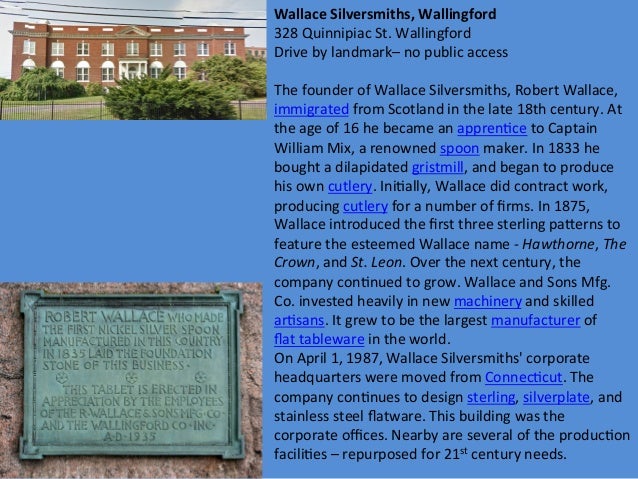
Wallace Silversmiths Administration Building (1920)

Happy Tanksgiving! Perhaps you will eat your Thanksgiving dinner with fine Wallace silverware? In the 1870s, Robert Wallace, an immigrant from Scotland, established what would become the R. Wallace and Sons Manufacturing Company, a major American manufacturer of sterling silver. Over time, the company expanded its factory complex at 340 Quinnipiac Street in Wallingford. The Administration Building was built c. 1920-1924. By the 1950s, the company was known as Wallace Silversmiths. Over the years it would be sold three times and would relocate twice within Wallingford before leaving the state in 1987.