North Haven Cultural Center (1938)

The North Haven Cultural Center, 27 Broadway in North Haven, was built in 1938 as the North Haven Memorial Library. In 1883, Silas L. Bradley of Auburn, NY, left a bequest to start a library in his home town of North Haven. The Bradley Library Association opened in 1884 in the home of Dr. Austin Lord, where it remained until it moved into the newly constructed Memorial Town Hall in 1887. The library’s name was changed to the North Haven Memorial Library in 1907 to recognize the importance of memorial bequests in establishing the library and to encourage future donations. In the 1920s and 1930s, enough funds and a gift of land allowed construction of a new library building. Dedicated in 1938, the library was designed by Robert Booth and constructed by the C. F. Wooding Company of Wallingford at a cost of $26,899.52. In the 1960s, the Memorial Library Association also came to administer the Martha Culver Library in North Haven on behalf of the town. In 1970, the Library Association offered its existing building and land to the town in exchange for constructing a new library building that would be run by the town. The new library was dedicated in 1972 and the old library building became the North Haven Cultural Center, which is now home to the North Haven Historical Society and the North Haven Art Guild.

Good Will Grange Hall (1929)

John H. Hale, famous for his growing of peaches in Glastonbury, also organized the town’s chapter of the Grange in 1885 and became Master of the Connecticut State Grange in 1886, serving for four years. He also served as a representative to the state’s General Assembly and was a founding trustee of the Connecticut Agricultural College In 1929 the Glastonbury Grange erected a new Hall, called Good Will Grange Hall, at 43 Naubuc Avenue. Today, the Glastonbury Grange #26 meets at the Masonic Hall at 895 Main Street and the East Central Pomona Grange #3 (founded in 1887) meets at Good Will Grange Hall.

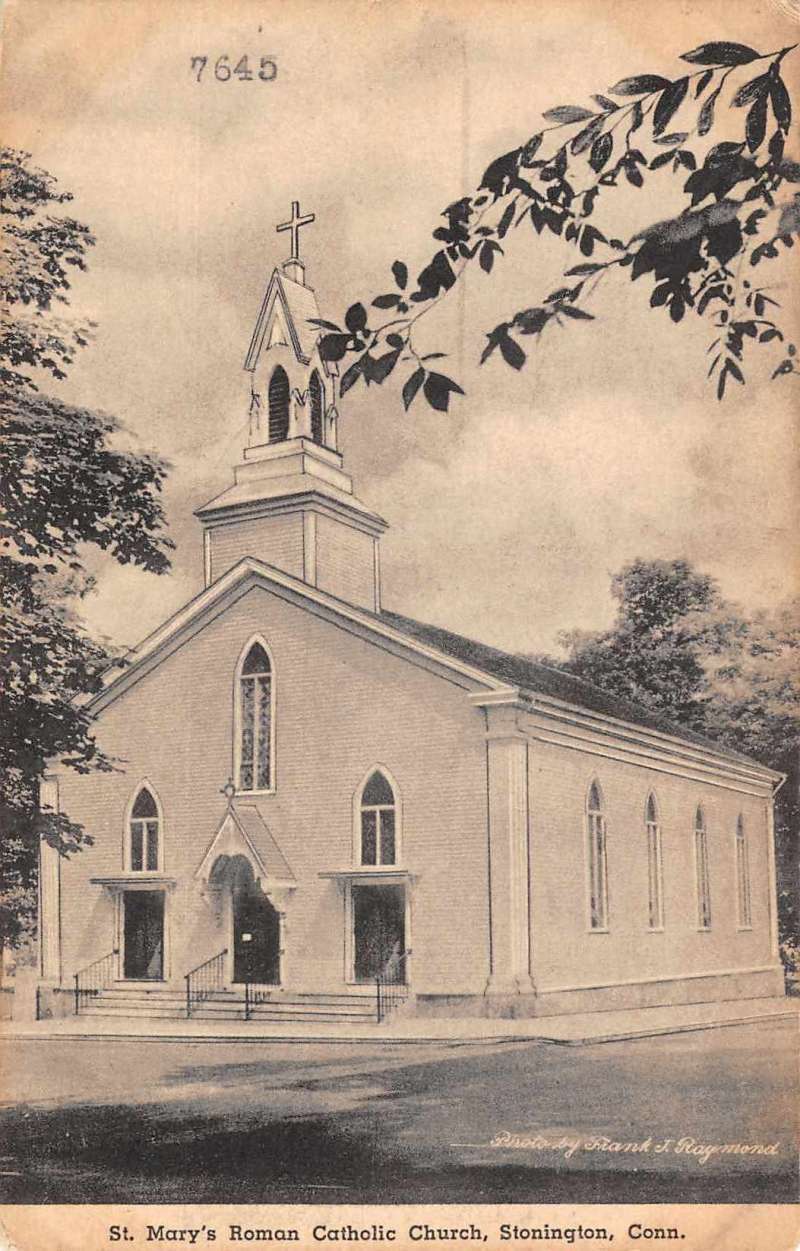
St. Mary Church, Stonington (1901)

The Blessing of the Fleet each summer is a yearly tradition in the Borough of Stonington. The event honors local fisherman who died at sea and blesses the fishing fleet for the safety and success of current fishermen. It begins with the Fishermen’s Mass at St. Mary Catholic Church, followed by a parade and the blessing at the dock by the Catholic Bishop of Norwich. By 1950 more than half of Stonington’s fishermen were of Portuguese descent and the first Blessing of the Fleet, which took place on July 1, 1956, was inspired by similar events held in other Portuguese fishing communities. Two institutions that are central to Stonington’s Portuguese community are St. Mary’s Church and the Portuguese Holy Ghost Society. As described in the History of the Town of Stonington (1900), by Richard Anson Wheeler:

St. Mary’s Roman Catholic Church at Stonington Borough.— This church was formed in 1851, and the edifice was erected the same year by subscriptions from the Catholics of Stonington, Westerly and the Mystics, under the supervision of Rev. P. Duffy, who was the first pastor. At present it is joined to Mystic as an out-mission and attended by the priests at Mystic, the Rev. Father Murphy being its present pastor.

The 1851 church was eventually expanded/replaced by a new structure. According to the Town of Stonington’s Property Listing Report, the current church building at 22 Broad Street was built in 1901.

Elmwood Community Church (1928)

In 1873, the South District Sunday School was organized to serve the Elmwood section of West Hartford. Within a few years the organization raised funds to erect a chapel. Built in 1876, the interdenominational Elmwood Chapel was located at the corner of New Britain Avenue and Grove Street/South Quaker Lane. Classes were held there on Sunday afternoons followed by services in the evening. After the First World War, attendance at the Chapel was increasing and there was a need for a new house of worship. In April 1921, a new independent Community Church was organized which merged with the earlier Elmwood Chapel Association. The new church would be Congregational, but members of the old Chapel would maintain their denominational affiliation. Funds were raised and work began on the new church, located at 26 Newington Road, in 1926. The corner stone was laid on May 8, 1927 by a Masonic delegation from the Wyllys Lodge No. 99 of West Hartford. The church opened for services in 1928, but parts of the interior and the steeple were not completed for several years. The sanctuary was renovated and rededicated in 1955 and in 1958 the church undertook an expansion program that included the raising of the steeple.

St. Thomas the Apostle Church, Oxford (1973)

Pictured above is the rear elevation of St. Thomas the Apostle Catholic Church, located at 733 Oxford Road in Oxford. The parish, established in 1966, began as a mission of St. Augustine Parish in Seymour. It later passed to the care of St. Rose, Newtown and then to St. Michael, Beacon Falls in 1924 before returning again to St. Augustine in 1948. In 1909, Judge Thomas Coman of New York donated money to build a chapel. Dedicated on July 2, 1912 to St. Mary, the chapel was renamed for St. Thomas the Apostle on October 9, 1916. In 1971 the site for the current church was chosen and the Coman chapel was sold the following year. The new church was dedicated on January 28, 1973.

Hodge Memorial Library & Museum (1937)

The first public library in the town of Roxbury was established in October 1896. It was housed in the back rooms of the old Town Hall until Charles Watson Hodge, upon his death in 1936, bequeathed $15,000 to erect a building for a library and museum. Completed in 1937 by Clayton B. Squire, the stone building was named after Charles Hodge’s father, Albert Lafayette Hodge. A north wing addition was completed in 1967 through a donation by Everett Hurlburt. A new building, the Minor Memorial Library, was erected in the early 1990s to become the town’s public library, with the Hodge Memorial, at 4 North Street, continuing as a museum open to the public by appointment only.