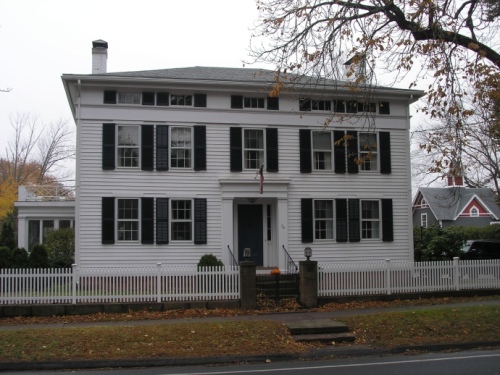
Kimberly Mansion (1725)

kimberlymansion.jpg

Kimberly Mansion, on Main Street in Glastonbury, was built sometime in the early eighteenth century by Eleazer Kimberly, a Secretary of the Connecticut Colony. It was purchased in 1790 by Zephaniah Smith, a former Sandemanian minister, who had become a lawyer. He added an addition to the house, with a separate entrance, to serve as his law office. He and his wife, Hannah Hickok , an amateur mathematician and poet, would raise five talented daughters in the house: Hancy, an inventor; Laurilla, an artist; Cyrinthia, a poet; and Julia and Abby, who would become famous political activists in the nineteenth century. Julia was also a scholar who, in 1876, published the first translation of the Bible into English by a woman.

Although they were involved, together with their mother, in Abolitionism in the years before the Civil War, Julia and Abby Smith became known throughout the country in the early 1870s for their stand against the unfair assessment of their land by the Glastonbury tax collector. By this time, the two unmarried elderly sisters were the only survivors of their family and owned the most valuable property in town, but as women they could not vote and so were taxed without representation. They therefore refused to pay taxes until they were granted a say in the use of their money. The tax man then seized and auctioned off their cows to pay the taxes. This incident, and other confrontations that followed, were extensively covered in contemporary newspapers and the sisters became prominent in Women’s Suffrage circles. After two years of legal wrangling, they would eventually win a court judgment in 1876, but not the vote. After Abby’s death, Julia finally married and moved to New Hampshire, at the age of 87!

Noah Welles House (1790)

noahwelles1790.jpg

Noah Welles, like his father Moses Welles, was probably a hatter and had a shop just north of his house, built in 1790 on Main Street in East Windsor Hill (now part of South Windsor). The new home was constructed after he sold his earlier house down the street. The house is close to the street, owing to the relatively small size of the original lot, purchased by Noah’s wife, Elizabeth. The house was built in the Federal style, with details influenced by those of the John Watson House nearby. Later additions include the veranda on the right side.

Universalist Church of West Hartford (1931)

universalistchurchwh.jpg

The First Universalist Society in the City of Hartford was formed in 1821, with its first church building being constructed on Main Street, across from the Old State House, in 1824. The congregation moved to a second building in 1860, located where the Travelers Tower now stands, and to a third building in 1906, in Hartford’s Asylim Hill neighborhood. The fourth and current church, located on Fern Street in West Hartford, was built in 1931 and was designed by Walter Crabtree in the Colonial Revival style. A large addition to the rear was constructed in 1962. Known from 1870 to the early 1960s as the Church of the Redeemer, it is now called the Universalist Church of West Hartford.

Hale-Newson House (1725)

Located just south of the Buttolph-Williams House, on Broad Street in Wethersfield, is a house of similar age, built in stages between the 1720s and 1750s. The first owner, Benezer Hale, began the construction of the house around 1725 by building what is now the section to the south (the left side). The section to the north (right side) was added later. Capt. Thomas Newson, a privateer during the Revolutionary War, added the lean-to on the rear, which gives the house a traditional saltbox form. Capt. Newson had a reputation for violence towards his slaves and was believed to have murdered a 42-year-old slave woman named Doll, who was found dead on the highway in 1802 from wounds inflicted with an ax. An inquest panel, on which Isaac Stevens sat, determined that the murder was committed by “some person or persons unknown to the jury.”

(more…)

Town and County Club (1895)

townandcountryclub.jpg

In 1895, an imposing Colonial Revival house, built of buff brick and limestone, was constructed on Woodland Street, in Hartford’s Asylum Hill neighborhood. Built for the lawyer Theodore Lyman and his wife Laura Lyman, the house was designed by the architectural firm of Hapgood & Hapgood. With the death of Mrs. Lyman, in 1925, the building was bought by the Town and County Club and has since been preserved by its members.

Hill-Stead (1901)

hill-stead.jpg

Constructed between 1898 and 1901, the Pope Riddle House, centerpiece of the Hill-Stead estate in Farmington, was constructed as a retirement home for the industrialist and art collector Alfred Atmore Pope and his wife, Ada Lunette Brooks. It was designed by their daughter, Theodate Pope Riddle, working with Edgerton Swartout, an architect with the firm of McKim, Mead, and White. Gaining a valuable apprenticeship in architecture through this experience, she would go on to design many buildings over the next 30 years, including the 1920 reconstruction of the Theodore Roosevelt Birthplace in New York and the Avon Old Farms School, which she founded.

Once described by Henry James as, “a great new house on a hilltop,” the Colonial Revival-style building combines various influences, from the traditional New England farm house to George Washington’s Mount Vernon. Various additions were made in the following years by Theodate Pope Riddle (who married diplomat John Wallace Riddle in 1916). She later inherited the house and left the estate to become a museum after her own death in 1946.

The museum showcases Alfred Pope’s art collection. Begun in the 1880s, it includes works on paper, Japanese woodblock prints, and Impressionist paintings by Claude Monet, Edgar Degas, Édouard Manet, Mary Cassatt and James M. Whistler. It was featured in the 1907 book, Noteworthy Paintings in American Collections, edited by John LaFarge and August Jaccaci.