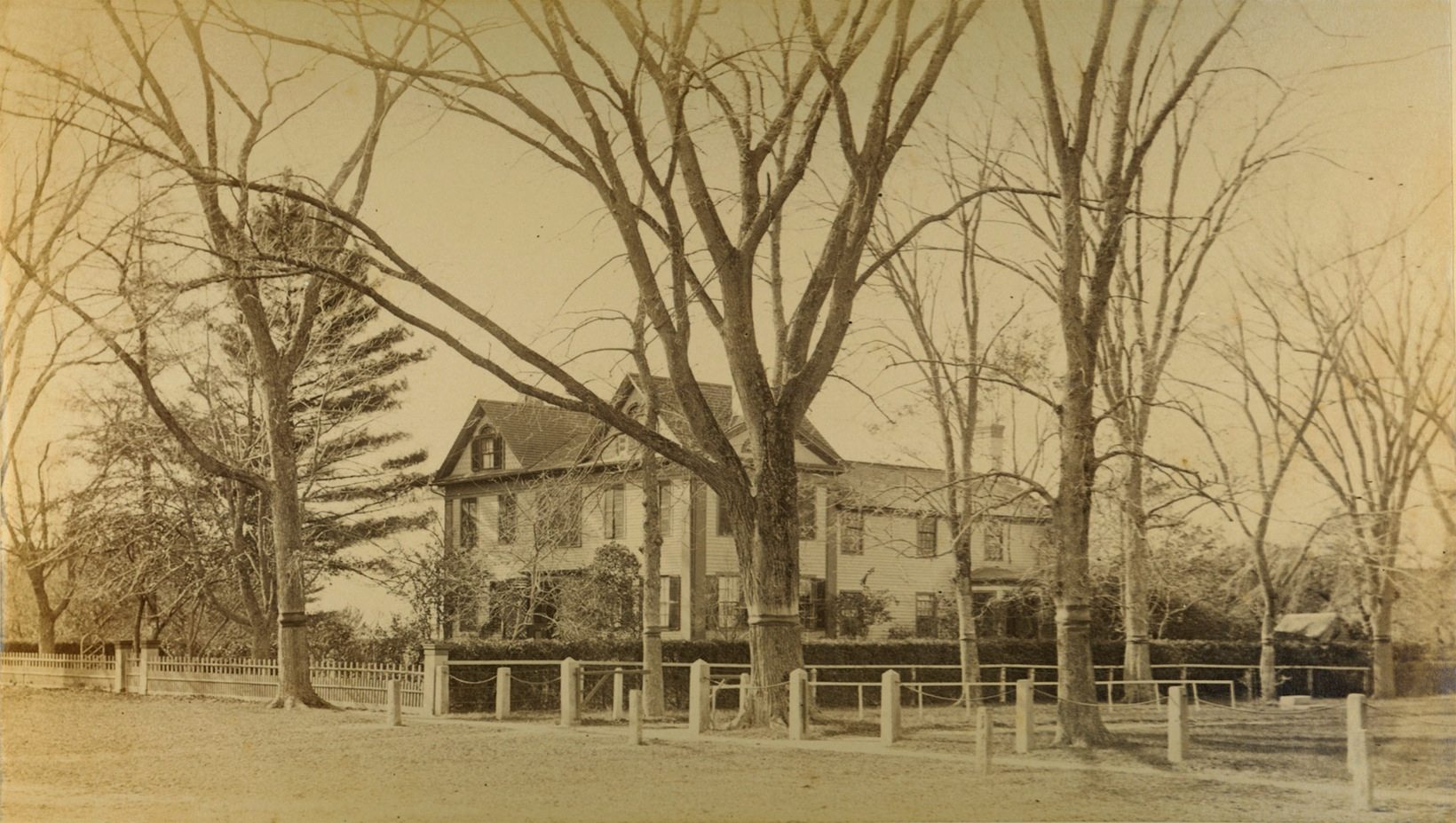
The Alexander Catlin House, built in 1778, is located at 258 North Street in Litchfield, where the street splits into Goshen Road and Norfolk Road. The colonial home features a gambrel roof and widow’s walk. The house was built by Alexander Catlin, one of the founders of the Litchfield China Trading Company. This may be Alexander Catlin, Sr. (son of John Catlin), who was born in Litchfield in 1738 and died in Burlington, Vermont in 1809. Later owners of the house included Stephen Deming and M. W. and K. L. Buel.
The first Methodist sermon preached in what is now the town of North Canaan was given in 1786 at the Lawrence Tavern (the Isaac Lawrence House on Elm Street). A Methodist church was erected in 1816 and remained in use until the current Canaan United Methodist Church was erected in 1868-1873. It is located at 2 Church Street, at the west end of Main Street where it divides into Church and West Main Streets. The original church building was sold to a farmer. The large stained glass window at the front of the church was installed in 1905. The church merged with the Falls Village Methodist Church in 1966. That church’s first structure, built in 1793, was the first building for Methodist worship erected in the New England states.
The house at 22 Main Street in East Hampton has a sign indicating it was the home of Franklin Ackley and was built c. 1872. This may be Franklin M. Ackley (1842-1922) who died in East Hampton and is buried in East Haddam.
The house at 1392 Main Street in Glastonbury was erected c. 1840. In the mid-1850s, it became the home of Gideon Kinne (1807-1890), a stone mason and farmer. He was the son of Aaron Kinne, Jr. (1773-1815), a merchant, who was the first member of the Kinne family to settle in Glastonbury. Gideon married Sally (or Sallie) Ann Taylor and had four children. Two of his sons, Aaron and James, were Civil War veterans who became merchants in Fort Edward, New York. The house has extensive rear additions.
The Phoebe Griffin Noyes Library in Old Lyme was established in 1897 as a free public library. It was built on the site of the old Lord family homestead, dating back to 1666, where Phoebe Griffin Lord was born in 1797 and grew up with her sisters and widowed mother. After spending her teenage years with her uncle in New York, she returned to Old Lyme and began a long career as an artist and educator, which she continued after her 1827 marriage to Daniel Noyes, a merchant. In 1831 they purchased the Parsons Tavern , which had been an important meeting place during the Revolutionary War. The tavern’s former ballroom became a classroom. Phoebe Griffin Noyes (1797-1875) contributed a large part to the community’s development as a center of art and culture. To honor her memory, her family decided to erect a library in her honor, which was funded by the gift of her son-in-law, Charles H. Luddington, and opened in 1898. The Evelyn McCurdy-Salisbury wing was added in 1925, and the library was more than doubled in size with an expansion in 1995.
It is fine to see this spontaneous recognition of the obligation which men owe their fellow-men, to contribute their best, whatever that may be, for the promotion of the good of those among whom they have dwelt.
That is what Mr. Ludington has done. He has provided a commodious, spacious, and attractive building to be the literary centre of Lyme. It furnishes a suitable place for the books already brought together by the members of the Library Association. The ample shelves are suggestive of future accessions. The reading room silently invites the neighbors to enjoy their leisure hours in the quiet companionship of the best of contemporary writers and illustrators. Not only the residents of Lyme, but those of the region around, are welcome. Here too is a place for occasional lectures and readings and for exhibitions of historical mementos, or works of art. The building is placed on a beautiful site, and it is associated with the life of a woman whose rare gifts and noble character are to be perpetuated as a memory and an example.
One of Noank‘s most memorable buildings is the grand Victorian residence at 81 Pearl Street. It was erected in 1884 by Robert Palmer, a deacon in the Noank Baptist Church. Robert Palmer (1825-1913) and his brother John developed the Palmer Shipyard (now known as the Noank Shipyard) begun by their father, John Palmer, Sr. Robert Palmer is featured in “The Village Feudists,” one of the stories in Theodore Dreiser’s Twelve Men (1919). After John’s death in 1879, Robert brought his son, Robert, Jr., into the partnership. Robert Palmer, Jr. would run the shipyard until his death in 1914. Deacon Palmer’s house displays a variety of Victorian-era stick-style elements and “gingerbread” trim. The porch’s wood decoration includes a rail and frieze made of panels with geometric cut-outs and the porch screen consists of fifteen panels, each with an intricate design depicting scenes from Aesop’s Fables. The second-floor balcony is also an exuberant example of the woodworker’s art. The house remained in the Palmer family for many years: Deacon Palmer’s granddaughter, Grace Knapp, lived in the house from 1923 until shortly before her death in 1959. She sold it to E. William Gourde and his wife, who had long admired the house. They restored and painted the home for the first time in fifty-five years. The house was sold again in 1970 and in 1992.
One of the structures that make up the former American Thread Company complex in Willimantic is a former stable, which housed horses, wagons and hay. It was constructed in 1872-1873 by the Willimantic Linen Company, original builder of the mills that were taken over by the American Thread Company in 1898. Like the adjacent mill buildings, No. 1 and No. 2, the stable was constructed of granite gneiss in the Romanesque Revival style. Because the building is located along a slope leading the nearby river bank, the basement level is visible on the south side (facing the river), but not on the north side.


You must be logged in to post a comment.