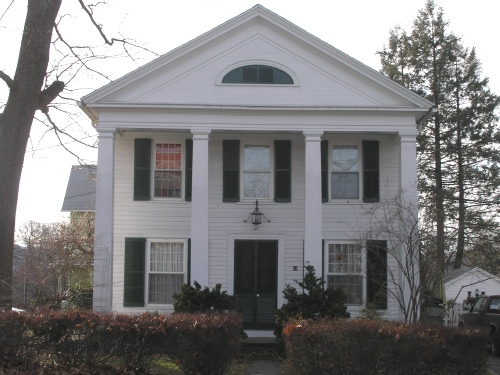
The J.S. Ely House, on Broadway in Norwich, was built around 1850 for the owner of Ely & Company, a dry goods store. The house is in the Gothic Revival style and has a prominent gable featuring a quatrefoil window.

The J.S. Ely House, on Broadway in Norwich, was built around 1850 for the owner of Ely & Company, a dry goods store. The house is in the Gothic Revival style and has a prominent gable featuring a quatrefoil window.

The earliest (eastern) section of the Strong-Porter House, on South Street in Coventry, was built around 1730 by Aaron Strong. Strong’s niece, Elizabeth Strong, married Deacon Richard Hale, who came from Newburyport Mass. to Coventry. In 1758, the Strongs sold the house to the Porter family, who expanded the western section and added a rear lean-to by about 1777. In 1930, the house was purchased from the Porters by the lawyer and antiquarian, George Dudley Seymour, who lived there during his restoration of the nearby Nathan Hale Homestead. Seymour mistakenly believed that Nathan Hale’s mother Elizabeth Strong Hale had lived in the house. The building is now a property of the Coventry Historical Society and is open to visitors as a house museum.

Built on Broadway in Norwich at the same time (1789) as the neighboring Perkins House, the Burnham-Dewitt house has a very similar appearance. It was built for the nephew of Hezekiah Perkins, Zebulon Perkins Burnham, who was also a sea captain. Burnham was lost at sea in 1810 and the house was later owned by the sea captain Jacob Dewitt. In 1812, Lydia Huntley (later Mrs. Sigourney) and Nancy Maria Hyde used the house as a girl’s school.

In 1869, the General Assembly of Connecticut granted the Town of Norwich and the County of New London the right to jointly erect a multipurpose building for town, city and county purposes, which originally included a county Superior Court and a jail in the basement. The Second Empire-style City Hall of Norwich, at the intersection of Union Street and Broadway, was built between 1870 and 1873. The clock tower was added in 1909 and a European plaza in 1999. There is also HABS documentation for this building from 1984.


The Commodore Charles Green House, designed by the important architect A.J. Davis is an excellent example of the Gothic Revival style. Built in 1851 on Main Street in South Windsor, it was the home of Commodore Green, a naval officer who captured a Confederate blockade runner during the Civil War. (more…)

In 1701, the people of Hartford living east of the Connecticut river were granted the right to their own minister. In 1783, when East Hartford became a separate town, the church became the First Congregational Church in East Hartford. The first meeting house was begun in 1699 and took several years to complete. It was later replaced by the second meeting house in 1740, which was torn down in 1835 when the current structure was built on Main Street. The completed church was dedicated in January 1836. The interior was extensively altered after a fire in 1876.