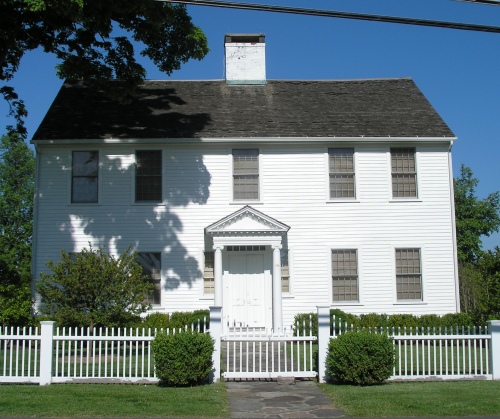
Revolutionary War Office (1727)

revolutionary-war-office.jpg

The building known as the Revolutionary War Office, in Lebanon, was originally built around 1727 for Joseph Trumbull, and has been moved several times over the years to different sites on the town green. At the start of the Revolutionary War, it was located closer to Jonathan Trumbull’s house and was serving as a store and office for his merchant business. Trumbull was Governor of Connecticut during the war and he used the office to plan the state’s defense with the Council of Safety from 1775-1784. Notable figures who conferred with Trumbull in the office include George Washington, Henry Knox and Israel Putnam, as well as Rochambeau and Lafayette. In 1891, the building was acquired by the Connecticut Sons of the American Revolution and restored. A bronze tablet was placed in 1896. Today it is open to the public as a museum.

The Horace B. Cheney House (1895)

horace-cheney.jpg

One of the Manchester mansions of the Cheney family of Silk Manufacturers, the Horace B. Cheney House was built in the mid-1890s. It has a Forest Street address and is also adjacent to the “Great Lawn,” where many of the mansion are located. Horace B. Cheney was the son of Frank Woodbridge Cheney and Mary Bushnell Cheney, the daughter of Horace Bushnell. His brothers were Ward, Howell, Austin and Frank D. Cheney.

Bullet Hill School (1789)

bullet-hill-school.jpg

Bullet Hill School is located on Main Street in Southbury. Built in 1789, it is one of New England’s oldest surviving brick schoolhouses. Earlier known as the brick school, it is thought to have acquired its name from a hill in Southbury where bullets were cast during the Revolutionary War (or, in an alternate version of the story, a hill where bullets were discharged during militia practice, which were then remolded for reuse at the school. Used as a school until 1942, the building was saved in the 1960s and and restored in the 1970s by the Friends of Bullet Hill School, which became the Southbury Historical Society in 1974. It is now maintained by the town and the Historical Society and for over twenty years has hosted a living history program for the region’s third graders.

Edward Savage House (1837)

Edward Savage House

The Greek Revival-style home of Edward Savage, on Main Street in Cromwell, was built in 1837. Savage had inherited half of his father’s farm and then bought the other half from his brother. He was also involved with manufacturing, founding the Savage Revolving Firearms Co. in 1858. The house was later significantly altered, with the addition of the cupola, porches and a new wing on the north side. Some of these changes were probably in response to the popularity of the Italianate style on Cromwell’s Main Street in the 1850s and 1860s.

The Bradford-Huntington House (1705)

jabez-huntington.jpg

A portion of what would later be known as the Bradford-Huntington House was built in Norwich on the home lot of John Bradford sometime prior to 1691 (perhaps as early as 1660, although a D.A.R. marker on the property gives the date as 1705). The house was bought by Capt. Joshua Huntington, a merchant, in 1719 (or by his father, Simon Huntington, in 1691). In later years he would enlarge and update the house in the Georgian style, adding a gambrel roof and a new chimney. The house was later owned (1745), and expanded with the addition of a rear ell, by his son, Jabez Huntington, who became Major General of the Connecticut militia in 1776, the same year George Washington spent a night in the home during the Revolutionary War. Later, Huntington experienced mental strain from his efforts and resigned in 1779. He died in 1786 and is buried near his house in the Old Norwichtown Cemetery.

Joseph Carpenter’s Shop (1772)

joseph-carpenter-shop.jpg

Joseph Carpenter was a silversmith in Norwich whose shop, built in 1772, still stands on East Town Street, on Norwichtown Green. The shop, where Carpenter also made clocks, may be the only frame silversmith shop surviving in New England. The building is now owned by the Society of the Founders of Norwich and is currently used as a law office.

Today I have also added five new buildings to this blog’s sister site, Historic Buildings of Massachusetts! Please check them out!!!