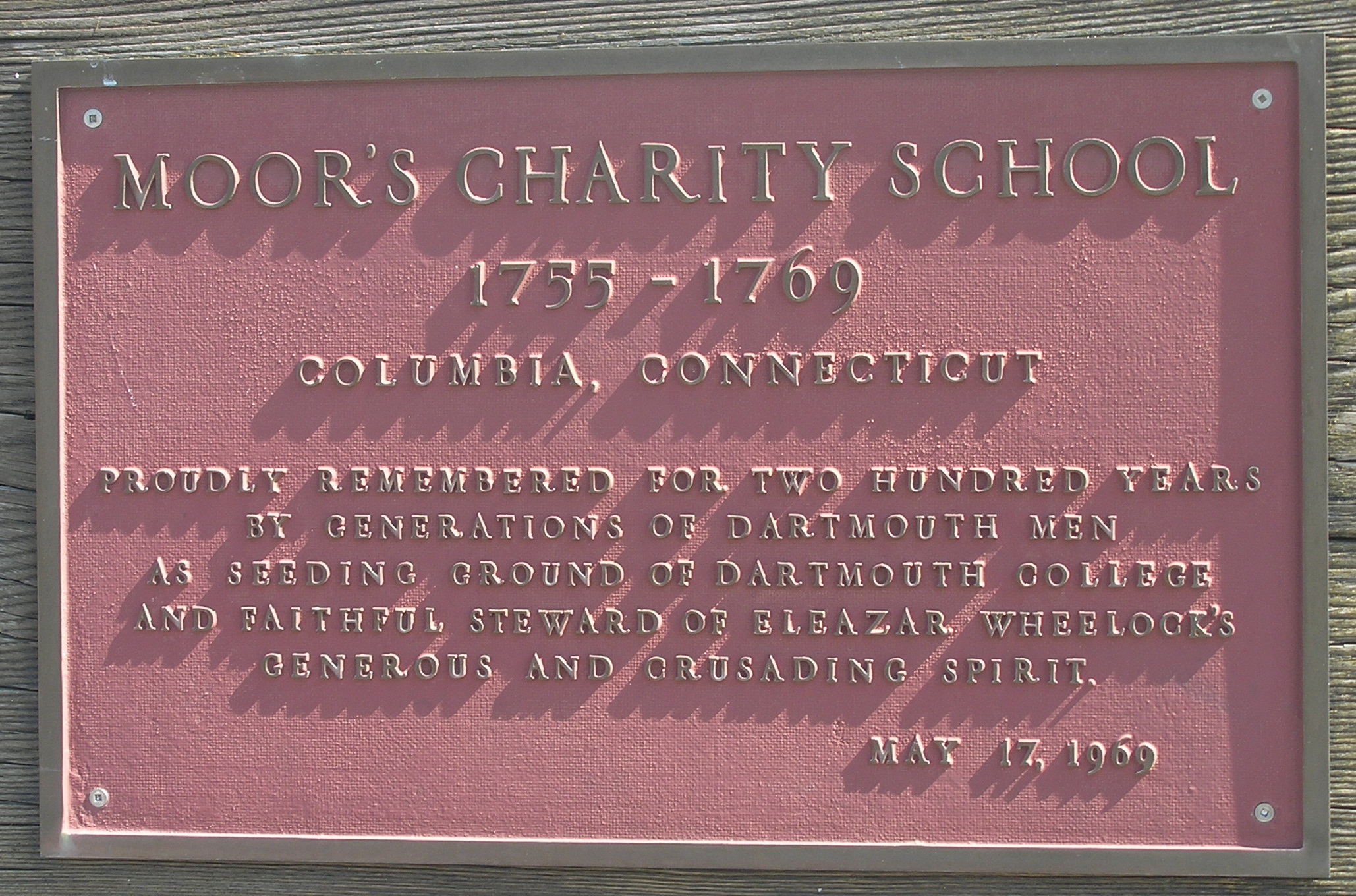
Moor’s Charity School (1755)

moors-charity-school.jpg

One hundred years ago, a man of worth,
With a big heart–Old Windham gave him birth–
Started in Lebanon–Columbia now the name–
A little school the forest sons to tame:


So run four lines from a poem by Dr. O.B. Lyman in honor of Rev. Eleazar Wheelock, the founder of Dartmouth College in Hanover, New Hampshire. The origins of that college began in 1754 in a part of Lebanon which is now the town of Columbia. Rev. Wheelock, an important minister of the Great Awakening, founded a school called Moor’s Charity School, which was dedicated to providing a Christian education for Native American Indians who might serve as missionaries to the Indian tribes. A 1755 school building, used by Wheelock, survives in the town of Lebanon today, although it was later altered in the Greek Revival style. Eventually, as Wheelock was having difficulties recruiting Indian students due to the school’s distance from tribal lands and as he also wished to expand his school to include a college for whites, he decided to move the institution. In 1770, the move to New Hampshire was completed, a year after receiving a royal charter, the last to found a college in Colonial America before the Revolution. For this reason, the Moor’s Charity School in Lebanon was described, in a 1969 plaque placed on the side of the building, as “Proudly remembered for two hundred years by generations of Dartmouth men as seeding ground of Dartmouth College and faithful steward of Eleazar Wheelock’s generous and crusading spirit.

The Benjamin Taylor House (1830)

benjamin-taylor-house.jpg

The house built for Benjamin Taylor, a Hartford merchant, on Main Street in Glastonbury in 1830, represents a transition from the Federal to the Greek Revival styles, but is still primarily Federal. The property had earlier been owned by Abraham Phelps, a blacksmith whose shop was located behind the building. For many years the building housed the Blacksmith’s Tavern, during which time the elaborate staircase was added. The restaurant closed in 1997 and the building now houses offices.

Also today, two new entries have been added to Historic Buildings of Massachusetts: The Nathaniel Hawthorne Birthplace and the Old State House.

Downey House (1842)

downey-house.jpg

The early Italianate Downey House, on the corner of Court Street and High Street in Middletown, represents the transition from the Greek Revival to the Italian villa style. It was built in 1841-1842 for Elihu W. N. Starr, a member of a well known family of sword and gun manufacturers, but was sold to the son of Samuel Russell in 1853. It was later used (1889-1911) as the Misses Patten’s School for girls and was purchased by Wesleyan University in 1922. It was named Downey House in honor of Dr. David G. Downey, a president of the University’s board of trustees.

The Exchange Building (1832)

exchange-building.jpg

The Exchange Building, on Church Street across from New Haven Green, was built in 1832 to serve as a commercial structure with a simple repeated Greek Revival window pattern. The builder, Atwater Treat, may have followed a design of Ithiel Town. The Exchange, New Haven’s first building constructed specifically as a commercial one, featured an open ground floor for shops. The building had a number of later changes, including the removal of the original cupola, which was eventually replaced by a billboard. In 1990, the building was restored, with a rebuilt cupola and and stone columned facade on the ground floor.

Herbert J. Mills House (1899)

herbert-j-mills.jpg

The house built in 1899, on Summer Street in Bristol for Herbert J. Mills, is an example of how a historic home can suffer from later unsympathetic alterations. Mills, who was the president of the H.J. Mills Box Shop company, lived in a Queen Anne-style house that still stands. With the exception of the decoration of the front entry porch, the rest of the exterior has lost most of its original stick style decoration and roof brackets. The integrity of the house’s tower has also been compromised by an addition on the north side of the building.