Bee and Thistle Inn (1756)

bee-and-thistle.jpg

North of the house of William Noyes, Jr. (now known as the Florence Griswold House), on Lyme street in Old Lyme, is the house built in 1756 for his father, Judge William Noyes. Judge Noyes was himself the grandson of Rev. Moses Noyes, Lyme’s first minister. Originally located right next to the road, the house was moved back and restored by the Hodgson family around 1900 in keeping with the ethos of the Colonial Revival. The house’s front portico and end porches are also twentieth century additions. In the 1930’s, the house was owned by a widow, Henrietta Greenleaf Lindsay, who followed the advice of her friend, the actress Elsie Ferguson, in converting the house into an inn. It was named the Bee and Thistle Inn to honor her, as those are the symbols of the Ferguson Clan in Scotland. The Inn is still in operation today.

Lyme Art Association (1921)

lyme-art-association.jpg

The Lyme artists’ colony that began with visitors to Florence Griswold’s boardinghouse eventually grew and established the Lyme Art Association in 1914. Florence Griswold gave land to the Association, next to her own house on Lyme Street, for a gallery (of which she would be the first manager). The architect of the 1921 Lyme Art Association building was Charles Adams Platt, who also designed the Freer Gallery in Washington and the Lyman Allen Museum, as well as four of the Cheney mansions in Manchester.

Florence Griswold House (1817)

flogris-house.jpg

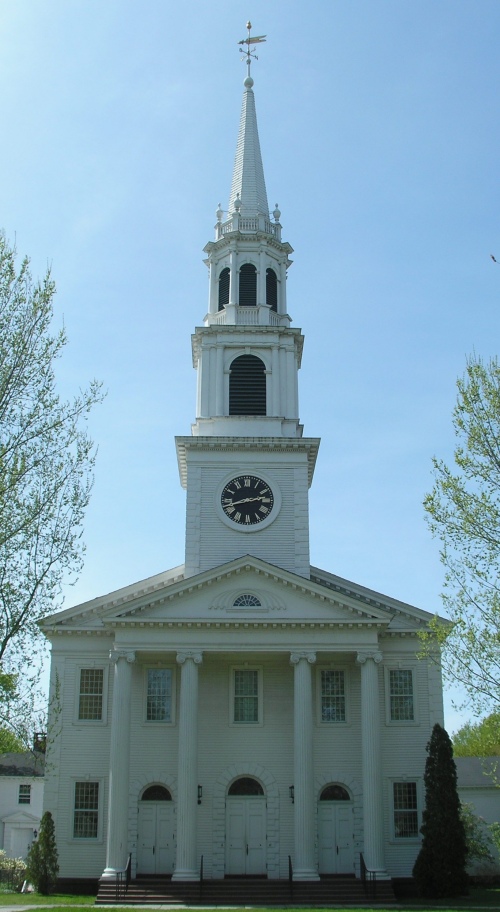
This week we will look at some notable buildings on Lyme Street in Old Lyme. The most famous residence on the street is the Florence Griswold House. Originally built in 1817 for William Noyes, Jr., a son of Judge William Noyes, the house was designed by Hartford builder Samuel Belcher, who was already at work on Old Lyme’s Congregational Church. In 1839, the house was sold to Richard Ely and in 1841 to the sea captain Robert Griswold. His daughter, Florence Griswold, was born in 1850. “Miss Florence” and her sister Adele inherited the house but, left in a precarious financial position, had to take in borders. In 1899, artist Henry Ward Ranger boarded at the house and soon encouraged other artists to stay there. In the following years, a number of notable American Impressionist painters made the home the center of an artist’s colony. The artists included Childe Hassam, Willard Metcalf, Matilda Browne, William Robinson and many others. Several of the artists painted panels in the house’s dining room.

By the 1930s, Florence Griswold was in debt and her property was sold, although the land’s new owner, Judge Robert McCurdy Marsh, who built a new house, allowed her to live in the old house until her death in 1937. In 1941, the house was purchased by the Florence Griswold Association and opened as a museum in 1947. In recent years, the Florece Griswold Museum has expanded, with the gift of the Hartford Steam Boiler and Inspection Company’s art collection in 2001, the construction of the Krieble Gallery in 2002 and the 2005-2006 restoration of the house, which is furnished as it would have been in 1910 at the height of the art colony. Edit: I’ve replaced my earlier image of the house with a new one!

The Howell Cheney House (1901)

howell-cheney.jpg

The Howell Cheney House is one of the mansions of the Cheney family of silk manufacturers in Manchester. Built in 1901, the house has a Forest Street address and is visible from both that street and across the Great Lawn from Hartford Road. The red brick Howell Cheney House is a Colonial Revival building, similar to the nearby Philip Cheney House, but not as symmetrical. Howell Cheney, who would serve as secretary and director of the family firm, was strongly interested in education, particularly vocational education. In 1915, he founded the Howell Cheney Technical High School in Manchester. Howell Cheney’s house is near to those of two of his brothers, Frank D Cheney and Horace Cheney. The house is currently for sale and is featured in a video on YouTube.

King Solomon’s Lodge No. 7 Masonic Temple (1838)

king-solomons-lodge-masonic-temple.jpg

The oldest Masonic Temple in continuous use in Connecticut is the Temple of King Solomon’s Lodge No. 7 (originally chartered in 1765), built high on a rocky cliff on Main Street in Woodbury. The front section of the Temple was built in 1838 on land sold to the Lodge by Ashbel Moody. Construction materials had to be hauled from the street over the face of the rock because Moody’s son-in-law, Levi Douglas, an anti-Mason, would not allow transportation across his family’s land, although he later sold an additional 2 foot strip of land when the building was expanded. A set of stairs from the street (no longer in use) were constructed in 1839. The Temple was enlarged in 1866, with further additions in the twentieth century.