Christopher Leffingwell House (1675)

leffingwell.jpg

The oldest section of the Leffingwell House, on Washington Street in Norwich, dates to 1675 and was built by Steven Backus. Sometime later, the house was sold by Backus to Ensign Thomas Leffingwell, son of Lt. Thomas Leffingwell, who had given assistance to the Mohegan Chief Uncas in 1645, when he brought supplies at time when Uncas was under siege by the Narragansett. Leffingwell converted the building for use as a tavern in 1701, adding more rooms. The house is now named for his descendant, Christopher Leffingwell, who later inherited the tavern. He was a merchant and entrepreneur, who eventually built several mills. During the Revolutionary War, Leffingwell was a deputy commissary to the Continental Army and George Washington occasionally stayed at the Leffingwell Inn. In 1957, the house was moved to its present location when a connector was built linking Washington and Town Streets. Today, the Leffingwell House Museum is open to the public and operated by the Society of the Founders of Norwich.

The Henry Bill House (1856)

bill-house.jpg

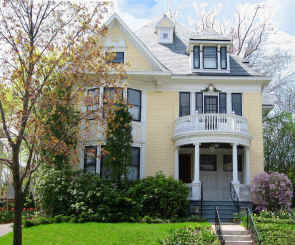
The Italianate house of Henry Bill (1824-1891) was built in 1856 on Broadway in Norwich. Bill, a book publisher who sold many illustrated bibles, supported the education of former slaves after the Civil War. The house was acquired by the Norwich Free Academy in 1930, but is today a private home which has been restored by the current owners.

Hello to Melissa and Brett, who accompanied me on my most recent picture-taking trip in Norwich.

Upper Middletown Academy (1834)

academy.jpg

Constructed on Main Street in Cromwell in 1834, when it was still part of Middletown, the Upper Middletown Academy served as a private and a public school from 1834 to 1902. It was originally built as an extension of the Ecclesiastical Society, being right across the street from the old Congregational Church. In 1938, the Academy was acquired by the Belden Library Association (which later moved to a new location on West Street). The Greek Revival building, now used as offices, originally had a bell tower which was later removed.

The Perkins-Rockwell House (1818)

perkins-rockwell.jpg

The Perkins-Rockwell House, on Rockwell Street in Norwich, is an interesting stone Federal Style house. It was built around 1818 by Joseph Perkins, a merchant and Revolutionary War soldier. The house was inherited by his daughter, Mary Watkinson Perkins, who married John Arnold Rockwell, a lawyer and politician, who served in the U.S. House of Representatives. The house was inherited, in 1924, by Mary Watkinson Rockwell Cole. Today it is a museum, operated by the Faith Trumbull Chapter of the Daughters of the American Revolution.

Sylvester C. Dunham House (1904)

830-prospect.jpg
Check out my YouTube short about this house!

Displaying features of a Craftsman style bungalow on a Colonial Revival structure, the 1904 Sylvester C. Dunham House, on Prospect Avenue in Hartford, was designed by Edward T. Hapgood, who was the architect of the Shepard House, also located on Prospect. Sylvester Clark Dunham became president of the Travelers Insurance Company in 1901. His son, Donald A. Dunham, a Yale graduate, also resided in the house.