Avon Old Farms Inn (1757)

avon-old-farms.jpg

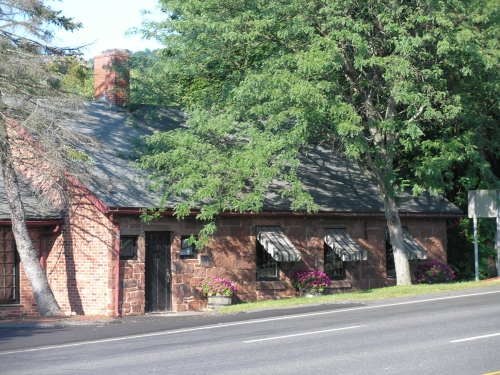
The oldest section of what is now the Avon Old Farms Inn, at the intersection of Routes 10 and 44 in Avon, is a house built by Nathaniel North in 1757, on land which had been granted to his father, Thomas North, after his service in King Phillip’s War. Thomas’ father, John North, had arrived in the vicinity of Northington (the north part of Farmington, now Avon) in the 1630s. The house was later owned by Nathaniel North‘s great-grandson, John North, a blacksmith who added the 1832 stone blacksmith shop, which is now connected to the house. Across Route 44, once stood Marshall Tavern, a former stagecoach stop, which was demolished in 1933 to improve traffic safety at the intersection. The North House was also used to accommodate travelers, becoming the Old Farms Inn in 1923.

LaSalle Market (1890)

lasalle-market.jpg

The building which now houses the LaSalle Market, on Main Street in Collinsville (in Canton) is a late nineteenth century commercial building with projecting eaves and brackets in the Italianate style. A picture from the 1890s survives showing various businesses in operation, including a meat market and a boots and shoe store. The LaSalle Market began in the 1970s on LaSalle Road in West Hartford and moved to Collinsville in 1984.

Asa Andrew’s Tinsmith Shop (1803)

99-main-tinsmith-shop.jpg

Built in 1803 (or possibly much earlier), the tinsmith shop of Asa Andrews is located next to a small green, off Main Street in Farmington. The tinsmith Andrews, whose house was nearby, specialized in japanned tinware (japanning is a type of varnishing or painting on tin and other materials). He was also “the maker of those chandeliers, compounds of wood and tin, that long hung from the meeting-house ceiling.” The building is now a private residence.

The John Johnson House (1840)

john-johnson.jpg

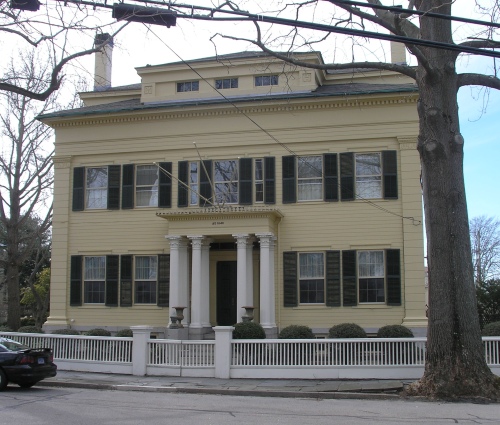
The John Johnson House, a large Greek Revival home, was built around 1840 on Broadway in Norwich. Johnson’s father was a president of the Norwich Bank. Later residents included a Dr. Linnell and Henry E. Bourne, who taught history and psychology at the Norwich Academy from 1889 to 1892. Later, Bourne joined his brother and former roommate at Yale, Edward Gaylord Bourne, as a professor of history at Western Reserve University. Henry Eldridge Bourne wrote articles and books, including A History of Mediæval and Modern Europe, The Teaching of History and Civics in the Elementary and the Secondary School, A History of the United States and The Revolutionary Period in Europe. The house, which originally had a center-hall plan, was later subdivided into five apartments.

The Thomas Lathrop House (1783)

thomas-lathrop.jpg

Thomas Lathrop’s mansion in Norwich was built in 1783 on a hill off Washington Street. The Georgian and Federal style house, possibly with later Greek Revival and Colonial Revival embellishments, also had a garden in the rear and commands an impressive view of the Yantic River below. Thomas Lathrop, together with his cousin, Daniel Lathrop Coit, imported goods from Europe and conducted the apothecary business begun by their uncle, Dr. Daniel Lathrop.