The John Johnson House (1840)

john-johnson.jpg

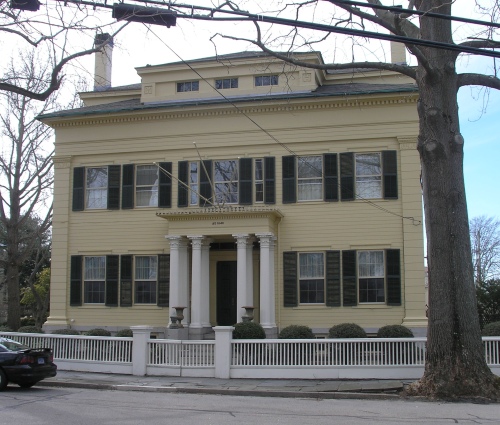
The John Johnson House, a large Greek Revival home, was built around 1840 on Broadway in Norwich. Johnson’s father was a president of the Norwich Bank. Later residents included a Dr. Linnell and Henry E. Bourne, who taught history and psychology at the Norwich Academy from 1889 to 1892. Later, Bourne joined his brother and former roommate at Yale, Edward Gaylord Bourne, as a professor of history at Western Reserve University. Henry Eldridge Bourne wrote articles and books, including A History of Mediæval and Modern Europe, The Teaching of History and Civics in the Elementary and the Secondary School, A History of the United States and The Revolutionary Period in Europe. The house, which originally had a center-hall plan, was later subdivided into five apartments.

The Thomas Lathrop House (1783)

thomas-lathrop.jpg

Thomas Lathrop’s mansion in Norwich was built in 1783 on a hill off Washington Street. The Georgian and Federal style house, possibly with later Greek Revival and Colonial Revival embellishments, also had a garden in the rear and commands an impressive view of the Yantic River below. Thomas Lathrop, together with his cousin, Daniel Lathrop Coit, imported goods from Europe and conducted the apothecary business begun by their uncle, Dr. Daniel Lathrop.

Charles A. Atkins House (1900)

charles-atkins-house.jpg

The house of Charles A. Atkins was built in 1900 on Kenyon Street in Hartford’s West End. Atkins was a lumber dealer and at one time a potential Republican candidate for governor. In 1973, Carolyn West purchased the house and in 2006 created a website for her Kenyon Street neighborhood which won a 2007 Hartford Preservation Alliance Award. There is also a PDF document at the site with information about the house.

Pine Grove Schoolhouse (1865)

pine-grove-schoolhouse.jpg

In Avon, on Route 167 (West Avon Road) is a Gothic Revival-style one room school house which served students from 1865 to 1949. Built in 1865 as Avon‘s School Number 7, it was renamed the Pine Grove School in 1927. After 1949, it served as a branch library and a nursery school, eventually being restored by the Avon Historical Society in 1975 and opened as a museum representing an early twentieth century school.

The Bradley Barnes Museum (1836)

barnes-museum.jpg

What is now the Bradley Barnes Museum, on Main Street in Southington, began as a Greek Revival style hose, built in 1836 for Amon Bradley, the same year he married Sylvia Barnes. Bradley, who had been a Yankee peddler in the south in his youth, invested in real estate and served as postmaster and in the Connecticut General Assembly. The Barnes Homestead remained in the family for three generations and had many additions and expansions, including the c. 1860 attic windows and the c. 1900 Colonial Revival porch. Bradley Henry Barnes, Amon’s grandson, was a successful manufacturer and financier. In 1973, he bequeathed the house and its contents to the town of Southington to be a museum. Numerous antiques were collected by the Barnes family over the years and are on display in the Bradley Barnes Museum, which is located not far from the Southington Green.