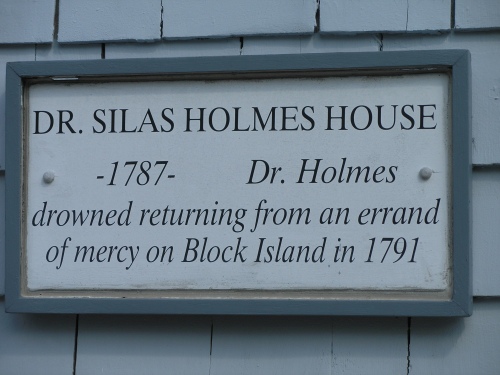
The Dr. Silas Holmes House (1787)

silas-holmes.jpg

The Stonington Borough house of of Dr. Silas Holmes was built in 1787. Holmes was a physician and, according to Richard Anson Wheeler’s History of the Town of Stonington (1900), “He was summoned to visit a sick man on Block Island, who sent for him in his boat, which took and bore him safely over to the island, and after he had visited his patient and diagnosed his physical condition, he started with the boatman and craft to return to his home in Stonington, but unfortunately a terrible thunder storm arose with a rushing cyclone of wind, which lashed the ocean into fearful waving foam, which capsized their boat and filled it with water, which, in spite of all the efforts of the doctor and the boatman, sunk, and they were both drowned.” Wheeler gives the date of this event as September 12, 1790, but a sign on the house states that “Dr. Holmes drowned returning from an errand of mercy on Block Island in 1791.”

Hiram G. Marvin House (1824)

hiram-g-marvin-house.jpg

The house built for Hiram G. Marvin, on Lyme Street in Old Lyme, is an 1824 Federal style structure with some Greek Revival influences. In 2007, the house became the first in Old Lyme to have an historical plaque from the Historic District Commission. Hiram G. Marvin had two brothers, one named Aaron Burr Marvin and the other named Alexander Hamilton Marvin (probably both born in the 1790s). I wonder if they got along later in life?

The Captain George Phillips House (1750)

george-phillips-house.jpg

Captain George Phillips was a leading merchant of Middletown and, like his neighbor, Jehosaphat Starr, he answered the Lexington Alarm in 1775. His brick gambrel-roofed house, on Washington Street, was built around 1750. The Greek Revival entryway and the reduction in size of the first floor windows are nineteenth century changes. There is also an obviously later addition to the house’s east elevation.

First National Bank of Litchfield (1816)

The First National Bank of Litchfield began in 1814 as a branch of the Phoenix Bank of Hartford. Benjamin Tallmadge was one of its founding directors. Its impressive Federal style building on North Street was built in 1816. The bank was reorganized as the First National Bank of Litchfield in 1864 and remains the oldest continuosly operating business in Litchfield and the oldest nationally chartered bank in Connecticut.

Charles Deming House (1900)

charles-deming-house.jpg

In the late nineteenth century, Litchfield became a showplace for the Colonial Revival movement. Old houses were restored and new ones constructed in the Colonial Revival style. One such home is the Charles Deming House on North Street, built in 1900. The architect was E. K. Rossiter and the house was built for Charles Deming, a grandson of Julius Deming, whose house is also on North Street.

First Congregational Church in Bloomfield (1858)

first-congregational-church-bloomfield.jpg

For Thanksgiving, we focus on the First Congregational Church in Bloomfield. Originally established as the parish of Wintonbury, the first meetinghouse was erected in 1737 and the first official gathering was in 1738. A second meetinghouse was built in 1801 and served for 56 years before being moved aside for the current church building, built in 1858. Wintonbury had by then became the Town of Bloomfield in 1835. The church’s steeple blew down in 1862 and was replaced with a sturdier one that includes a clock.