The saltbox house of Deacon Stephen Hotchkiss, on South Main Street in Cheshire, was built in stages, beginning around 1730. Hotchkiss was one of the founders of Cheshire as a separate parish from Wallingford. (more…)

The saltbox house of Deacon Stephen Hotchkiss, on South Main Street in Cheshire, was built in stages, beginning around 1730. Hotchkiss was one of the founders of Cheshire as a separate parish from Wallingford. (more…)

The Foote House, on South Main Street in Cheshire, was built in 1767 for Rev. John Foot (d. 1813), the second minister of the town’s First Congregational Church. John Foot‘s son, Samuel Augustus Foot, was born in the house in 1780. Samuel A. Foot(e), who studied at Yale and with Tapping Reeve in Litchfield, went on to become a US Representative, Senator and Governor of Connecticut. Foot continued to live in the 1767 house, adding a Greek Revival portico to the entryway in the 1830s. Gov. Foote’s son, Andrew Hull Foote, was an admiral in the US Navy during the Civil War.

Different sources indicate two different dates for the construction of the Abijah Beach Tavern in Cheshire: 1750 and 1814. The Federal style of the building is consistent with the latter date. The Beach Tavern, located just south of the Cheshire Green, was at the center of town life in the early nineteenth century: in addition to serving as an tavern, inn and store, it was also used for town meetings and court sessions before a town hall was built in 1867. The top floor of the Beach Tavern has a large ballroom. The Tavern is named for its first owner, Abijah Beach, who died in 1821. For a time it was known as the Benjamin Franklin Inn and became a private residence in 1852.

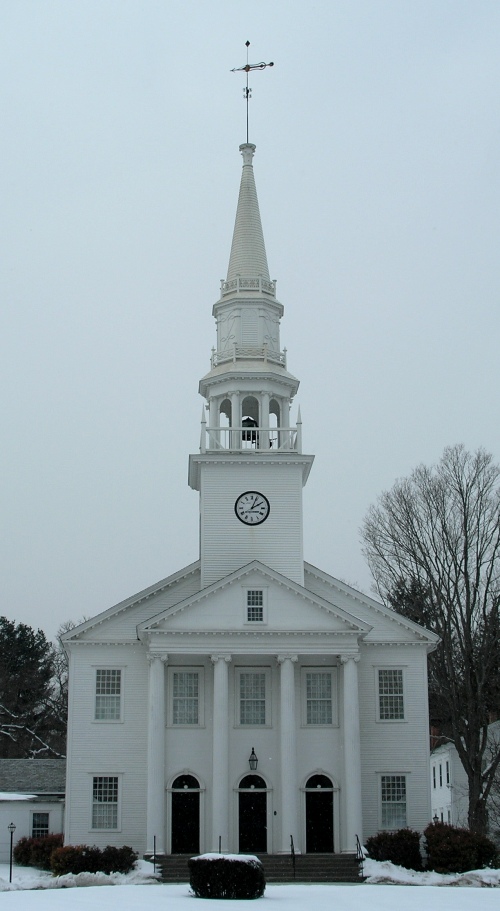
Southington‘s First Congregational Church‘s first meetinghouse was built in 1726 and stood where Oak Hill Cemetery is today. It was constructed after the farmers of Southington had successfully petitioned to have a seperate church, independent of the Farmington parish. The first meetinghouse was used until 1757, when it was replaced by a new building, located closer to what is today the center of town. The third and current church was built in 1830. Located on Southington Green, the church has a very similar design to the Congregational churches in Cheshire and Litchfield.

The house originally occupied by Seth Stanley is in Berlin, at 155 Robbins Road, off Kensington Road. The house was built in 1750.

Built in 1847 (some sources indicate 1861), the Ira H. Palmer House, at the corner of High and Main Streets in Stonington Borough, is transitional in style between the Greek Revival and Italianate. It was built by John F. Trumbull, who owned a factory in town, for his daughter, Harriet, who married Ira Hart Palmer.

On South Main Street in Wallingford is the home of Reverend Samuel Street, built in 1673. Samuel Street was the town’s first minister and one of its first settlers, being one of the original 39 signers of the 1668 Wallingford Agreement, or original covenant of the first Wallingford planters. Rev. Street‘s daughter, Mary, married John Hall. Their son, Lyman Hall, Street‘s great-grandson, was a signer of the Declaration of Independence. Rev. Street, who died at age 82 in 1717, served as minister for 45 years.