The Kelo House (1890)

kelo-house.jpg

The Kelo House, also known as the Little Pink House, was built in 1890 in a residential area of New London by John Bishop, a prominent local carpenter. It had various owners after Carpenter’s death in 1893 and few years later was moved to the Fort Trumbull neighborhood of New London. In the late 1980s, the Little Pink House and the house next to it were restored by the preservationist, Avner Gregory. On the market for many years, the house was not occupied until Susette Kelo moved in in 1997. When the City of New London sought to use the right of eminent domain to acquire the neighborhood for private development (which would bring in more tax money) it started a legal battle that went all the way to the Supreme Court in 2005. Although Kelo lost in Kelo vs. City of New London, the public reaction to the abuse of eminent domain laws led to citizen activism and new reform legislation in favor of property owners. Three years after the decision, in 2008, the house was rededicated on a new site on Franklin Street in New London. The house had been reacquired and moved by Avner Gregory and stands as a monument, with an explanatory plaque out front, to the battle over eminent domain. A new book about the case, Little Pink House: A True Story of Defiance and Courage, by Jeff Benedict, has just been published.

William Coit House (1763)

coit-house.jpg

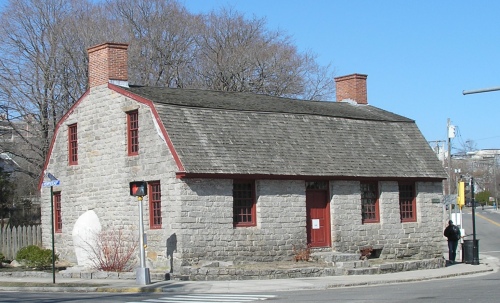
In the eighteenth century, Coit Street (then Cove Street) in New London followed the shoreline of Bream Cove, an arm of New London Harbor. The Cove later shrank in the nineteenth century from silting and filling in to create additional land. When the William Coit House, on the corner of Washington and Coit Streets, was built around 1763, it was therefore on the water, although this is no longer the case. The Coits were a shipbuilding family and William Coit commanded ships during the Revolutionary War. Coit was also captain of a militia company, composed largely of sailors, that marched to the Siege of Boston in 1775.

New London Ledge Lighthouse (1909)

new-london-ledge-lighthouse.jpg

The New London Ledge Lighthouse was built in 1909, on the Southwest Ledge at the mouth of the Thames River in New London Harbor. It was built after much lobbying to construct a new lighthouse, as the New London Harbor Light was deemed insufficient to direct ships around the dangerous ledges at the entrance to the harbor. The red brick New London Ledge Light is to have been built in the French Second Empire style at to the request of wealthy homeowners on the nearby shore, who wanted the new lighthouse to match the elegance of their own residences. The Coast Guard took over manning the lighthouse in 1939 and it was automated in 1987. New London Ledge Light is also famous as a haunted lighthouse (There are YouTube Videos here and here).

St. Panteleimon Russian Orthodox Church (1972)

st-panteleimon.jpg

St. Panteleimon Russian Orthodox Church in Hartford was organized in 1958. It is a parish of the Russian Orthodox Church Outside Russia (ROCOR), founded by Russian refugees as a response to the rule of the Bolsheviks. Another Orthodox church in Hartford, All Saints Orthodox Church, is a parish of the Orthodox Church in America (OCA), which traces its origins to the church established in Alaska when it was still part of the Russian Empire. St. Panteleimon Church was built in 1972 and was designed by Dimitri Alexandrow with the architectural firm of Austin & Mead. Labor for the construction was provided by members of the congregation. Fr. Dimitri, who was the congregation’s priest and also a master icon painter, taught himself architecture in order to design the church, learning the type of masonry used in constructing Orthodox churches. He was later consecrated a monk, taking the monastic name of Daniel, and in 1988 was consecrated as Bishop at the Russian Orthodox Old Rite Church of the Nativity in Erie, PA. Bishop Daniel, who speaks a dozen languages, also wrote a book called, Selected Fables From the East, Translated by a Russian Priest. (more…)

Goodspeed Opera House (1876)

goodspeed-opera-house.jpg

The Goodspeed Opera House is a notable historic landmark along the Connecticut River in East Haddam. It was built in 1876 by William Goodspeed, a merchant and banker. Originally serving as a store, office and steamship docking point, as well as having a theater on its top two floors, the Goodspeed was built in the distinctive Second Empire style (with a mansard roof) to attract the attention of traffic along the river. The first performance at the Opera House was on October 24, 1877. After Goodspeed’s death in 1926, the building was used for various purposes, including being a World War I militia base, a general store and a storage facility for the Highway Department. Having fallen into disrepair, it was restored in 1959 by Goodspeed Musicals, a non-profit organization dedicated to musical theater. Rededicated in 1963, the Goodspeed Opera House has continued since then to be the home for performances of musicals and is one of several facilities currently owned by Goodspeed Musicals.

Storrs Congregational Church (1927)

storrs-congregational-church.jpg

The Congregaional Church in Storrs began as a the Second Ecclesiastical Society of Mansfield, separating from the First Congregational Church in Mansfield Center in 1737. The first meeting house was constructed in 1745-1746 at what is now the corner of North Eagleville Road and Route 195. A later church, built in the 1840s, replaced it and can be seen in many old photos of Storrs. The church was designed by builder-architect Edwin Fitch. It was here that the Second Commencement for the Storrs Agricultural School (which became the University of Connecticut) was held in 1883. That church was replaced by the current brick church, built in 1927. This church was built at the same location as its predecessors, in what was then the center of the campus. At the same time, UCONN purchased the Dunham Memorial Carillon and, not having a suitable tower to place it in, installed it in the church.