The Nehemiah Hubbard House (1744)

nehemiah-hubbard-house.jpg

Across from the Harriet Cooper Lane House in Middletown is the Nehemiah Hubbard House, a center-chimney Colonial saltbox, built in 1744. Nehemiah Hubbard, Jr., who was born in 1752 and was a later owner of the house, was a fourth-generation descendant of early settlers of Middletown. A prominent merchant, he served as Deputy Quartermaster for Middletown during the Revolutionary War and was the first president of the Middletown Bank. He was also the original land-owner in what would become Hubbard, Ohio. Hubbard used his Middletown house and extensive property, which was away from the center of town, for his farming operations and it remained in his family into the twentieth century. For a time, Thomas McDonough Russell, Sr. lived in the house and in 1916, it was acquired by Colonel Clarence Wadsworth. Restored in 1929, the house remained in the Wadsworth family until 1952. Still a private home, the property has a garden established in 1956.

Patricelli ’92 Theater (1868)

patricelli-92-theater.jpg

Wesleyan University‘s Patricelli ’92 Theater was originally called Rich Hall and was built in 1868 as the college library. It was designed by Henry Austin and David Russell Brown. In 1928, Olin Library opened and Rich Hall was converted to become a theater, funded by a donation from the class of 1892. The theater was renovated in 2003 with a gift from Robert Patricelli (’61) in honor of Leonard J. Patricelli (’29). Wesleyan’s student-run theater, Second Stage, is based in the theater.

The Mather-Douglas House (1811)

mather-douglas-house.jpg

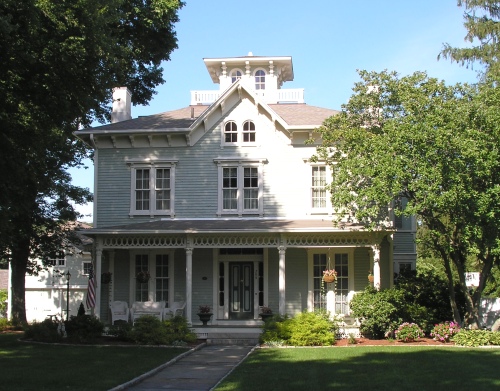
The Mather-Douglas House was built around 1811-1813, on South Main Street, off South Green in Middletown. It is a Federal style house with later Italianate additions. Built by a Mather, a later owner of the house was Benjamin Douglas, who was a factory-owner and politician. He was a founder of the W. & B. Douglas foundry company (Wesleyan’s Douglas Cannon was named after him) and he was a member of the state general assembly and mayor of Middletown from 1849 to 1855. He was an abolitionist and there is “strong circumstantial evidence” that his house was a stop on the Underground Railroad.

The Wadsworth Mansion at Long Hill Estate (1911)

wadsworth-mansion-at-long-hill.jpg

Starting in 1900, after he married Katharine Fearing Hubbard, Colonel Clarence S. Wadsworth began to acquire land in the rural western section of Middletown for his estate. Known as Long Hill, it eventually grew to 600 acres and featured landscaping designed in part by John Charles Olmsted. The estate also included the $90,000 Wadsworth Mansion, built between 1909 and 1911. Designed by Francis Hoppin, the architect of Edith Wharton’s home, the Mount, the mansion was ahead of its time in the use of reinforced structural concrete and fireproofing. It was occupied by the Wadsworths as a summer home, until the Colonel died in 1941. He bequeathed it to the Rockfall Corporation, which he had established in 1935— an organization dedicated to natural resource conservation, preservation and development. Part of the Estate became Wadsworth Falls State Park, while the house and remainder of the Estate was sold in 1947 to Our Lady of the Cenacle, an order of nuns. Sold to a developer in 1986, the building fell into disrepair and was vandalized. A fire in 1990 almost destoyed the house, which was saved owing to its reinforced concrete. Purchased by the City of Middletown in 1994, the Mansion was restored and opened in 1999 as a facility available for weddings and other functions.

Fort Trumbull (1852)

fort-trumbull.jpg

In 1775, Governor Jonathan Trumbull recommended that a fort be constructed near the mouth of the Thames River to protect the port of New London. The first Fort Trumbull, completed in 1777, was captured by the British during Arnold’s 1781 Raid. The Fort was rebuilt around 1808 as a “second system” fort, a structure that was later replaced by the present fortification, a “third system” fort, constructed between 1839 and 1852. Fort Trumbull is a five-sided, four-bastion coastal defense fort and is unique among American forts because it was built in the Egyptian Revival style, inspired by the Temple of Luxor. During the Civil War, the Fort was an organizational center and the headquarters of Connecticut’s 14th Infantry Regiment. Over the years, Fort Trumbull has also been used as a training facility: it was the site of the the U.S. Revenue Cutter Academy and then the Coast Guard Academy until 1932; the Merchant Marine Officer Training School program from 1939 to 1946; and was used as the Fort Trumbull campus of the University of Connecticut from 1946 to 1950, where it served veterans attending college under the GI Bill. Fort Trumbull next became the Naval Under Water Sound Laboratory. After the Laboratory was closed in the 1990s, the site was redeveloped to become a State Park. Work began in 1999 and in 2001 it was opened to the public for tours.