William J. Asher House (1899)

321-prospect-street-willimantic.jpg

The rate of development for residential use on Willimantic’s Prospect Hill was increasing in the 1890s and many fine Victorian homes were being constructed by town’s prosperous upper middle class. In 1899, the industrialist William J. Asher, originally from Springfield, Massachusetts, began the construction of his home at 321 Prospect Street, on land he had purchased from the Windham Manufacturing Company. His Queen Anne house, located across the street from the recently built high school, was completed in 1900. Asher, who owned the Maverick Steam Laundry and also manufactured washing machines, was a prominent member of Willimantic’s early Jewish community. The apex of his home’s front gable contains inlaid scallop shells, a symbol of good fortune. The stone used to construct the front porch came from a textile mill which had been destroyed in a fire in the 1890s. At the rear of the house, Asher had a custom-built garage for his new automobile with an underground fuel tank. Asher left Willimantic in 1914 and sold the house to Archibald W. Turner, a diamond and jeweler dealer, who also acquired Willimantic’s leading livery stable.

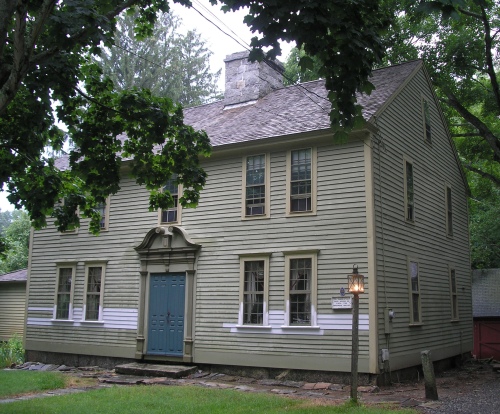
Huntington Homestead (1700)

Built sometime in the period 1700-1722, the Huntington Homestead in Scotland was the birthplace and childhood home of Samuel Huntington, who went on to become a Signer of the Declaration of Independence, President of the Continental Congress from 1779 to 1781 and Governor of Connecticut. Huntington later lived in a house in Norwich. The Homestead was later owned by the Kimball family, who sold it to the Town of Scotland in 1994. The house was then acquired by The Governor Samuel Huntington Trust to be opened as a museum.

Also, Historic Buildings of Massachusetts now has a new blog theme!!!

Dr. Joshua Kendall House (1875)

kendall-house.jpg

Dr. Joshua Kendall came to the Humphreysville section of Derby (now the town of Seymour) from Pennsylvania in 1833 and practiced medicine in town for over fifty years. According to The History of the Old town of Derby (1880), by Samuel Orcutt and Ambrose Beardsley, Dr. Kendall,

attended medical lectures at Castleton University, Vt, where he graduated. As a physician and as a citizen he has been a leading and influential man; has been a most efficient member of the school board over thirty years, and has done good work for the advancement of education, temperance and sound morality in the town. He has been ardent and unyielding in his politics and represented Derby in the Legislature in 1849, before Seymour was organized as a new town.

Dr. Kendall’s 1875 house is at the corner of West and Church Streets in Seymour, across Church Street from the Dr. Sheldon C. Johnson House.

Edmund Fanning Birthplace (1761)

fanning-birthplace.jpg

At 44 Main Street in the Borough of Stonington is a house, built in 1761 by the merchant Gilbert Fanning. Fanning was soon forced, due to his economic circumstances, to deed the house to his father-in-law, Dr. Nathan Palmer. Gilbert’s son, Edmund Fanning, was born in the house in 1769 and would go on to become the first American captain to circumnavigate the globe, in 1797-1798, aboard the Betsey, with a crew from Stonington. His elder brother, Nathaniel Fanning, served with John Paul Jones in the Revolutionary War during the 1779 battle of USS Bonhomme Richard and the HMS Serapis.