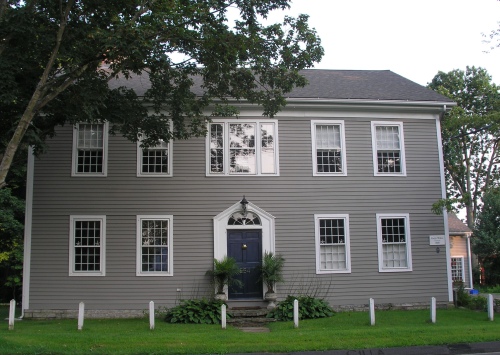
The Cook-Dallas House (1832)

cook-dallas-house.jpg

In 1832, Joseph K. Selden built a house on Quarry Hill Road in Haddam Neck, although the following year he moved to Ohio. The house was purchased by Harris Cook and was later rented and then purchased by Alexander Dallas, a stonemason born in Scotland. After a fire in 1880 nearly destroyed the house, Dallas rebuilt the originally Federal style house, changing the facade to reflect the Gothic Revival.

Asa Brainerd House (1790)

asa-brainerd-house.jpg

The Asa Brainerd House sits on land in Haddam which was owned, from 1788 to 1795, by Leveus Eddy, and was built sometime during that period. It was then purchased by Simon and Asa Brainerd, the latter of whom lived there until his death in 1815. The Brainerd family, who operated nearby granite quarries, sold the house out of the Brainerd family for a time, but later in the nineteenth century, the elegant house, which had fallen into disrepair, was acquired and restored by Asa Brainerd’s grandson, William E. Brainerd. It has remained in the Brainerd family ever since. The Greek Revival entryway was added in the 1830s.

John Brainerd House (1825)

john-brainerd-house.jpg

On Quarry Hill Road in Haddam Neck is the home of John Brainerd, built in 1825. According to The Genealogy of the Brainerd Family in the United States (1857), by David Dudley Field:

John Brainerd married first Eliza Day, daughter of Daniel Day, of Westchester, in Colchester, November 1, 1826, who died January 5, 1844, in her fortieth year; and after her death, Delina Dickinson, daughter of Abner Dickinson, of Eastbury, in Glastenbury (sic), February 14, 1845.

Delina Brainerd lived in the house until her death in 1900.

The Brainerd Store/Russell Inn (1813)

russell-inn.jpg

On the east bank of the Connecticut River at Haddam Neck is an impressive building built in 1813 by Dudley Brainerd as a house and store. It was a good location: facing Haddam Neck’s main dock at Rock Landing and with a shipyard to the south, sailing vessels would often stop. According to the chapter on Haddam Neck by Henry M. Selden, in the 1884 History of Middlesex County,

The pioneer merchant was Robert Clark. The next was Dudley Brainerd, who built the house now occupied by Captain Charles S. Russell, in the basement of which he had his store. This store was next managed by Selden Huntington one year, succeeded by Elias Selden and Colonel Theodore H. Arnold, under the firm name of Selden & Arnold, then by a Mr. L’Hommedieu, and in rotation by Lavater R. Selden, James S. Selden, Lucius E. Goff, Captain Charles S. Russell, Albert S. Russell, George E. Russell & Co, and Joseph Griffin.

Charles S. Russell bought the building in 1846 and by the 1870s he had converted it to become an inn, serving the steamboat passengers traveling between Hartford and New York City. It was at this time the building was updated, with a Second Empire-style mansard roof and an impressive ornamented three-level front porch. A later addition onto the first story has a granite foundation featuring round windows resembling portholes.

The Capt. Elias Selden House (1800)

elias-selden-house.jpg

This week we’ll be looking at buildings in the Haddam Neck section of Haddam. Haddam Neck is on the east side of the Connecticut River, separated from the rest of the town on the west side without a direct bridge connecting them. A prominent Federal-style house, noticeable when entering Haddam Neck from East Hampton, was built by Capt. Elias Selden around 1800. Selden was a lieutenant in the Revolutionary War and became a captain of militia in 1802. He first built a smaller earlier home across the street from his later house. When he built the current structure, he included part of his late father’s house as a rear ell. Henry M. Selden lived in the house in the later nineteenth century and became postmaster in 1860, running the post office in the building. Selden also wrote a history of Haddam Neck for The History of Middlesex County (1884). The house served as a post office until 1908.

First Congregational Church of Guilford (1830)

first-church-guilford.jpg

The First Congregational Church in Guilford dates back to 1639, when Rev. Henry Whitfield and his followers sailed from England to New Haven and settled the town of Guilford, then part of New Haven Colony. They had drawn up a covenant on shipboard during their journey to America. The town’s first meeting house, a small stone building with a thatched roof, was soon built on Guilford Green, replaced in 1713 by a new church, said to have been the first in Connecticut to have a steeple clock and bell. In the early nineteenth century there was a movement to clear the Green of buildings. The current church was then built in 1830, on a site overlooking the Green. The Hurricane of 1938 toppled the original steeple, which was rebuilt the following year.