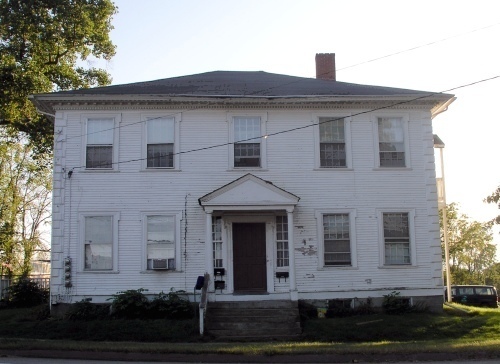
Coggshell House (1816)

cogshell-house-02.jpg
UPDATE: This house has been demolished.

Update: The house is in danger of demolition!

In 1816, Nathaniel and Rebecca Coggeshall (Coggshell) purchased property on Broadway in Colchester from members of the Bulkley family. It is uncertain if the Coggshells or the previous owners built the house which is now on the site. Rebecca Cogshell died in 1848, at the age of 81 and her three daughters were owners of the house.

The Medad Holcomb, Jr. House (1848)

medad-holcomb-jr-house.jpg

Medad Holcomb, Jr. was a Guilford farmer who built a Greek Revival home on Fair Street around 1848. The house features expensive flush board siding on the front facade; the two pilasters on each side are later additions. Holcomb was the son of Medad Holcomb and his fourth of five wives, Nancy Parnel Dudley. When he died in 1871, he left the house to Sydney Dowd, a local temperance leader. The second floor of the house was used as a hayloft before an addition was built later on. There is also an historic barn on the property.

Second Congregational Church, East Hampton (1855)

second-congregational-church.JPG

The Second Congregational Church of East Hampton was organized in 1740. This church originally served the communities of both Middle Haddam (pdf) and Haddam Neck, but these separated in 1855, when the Second Congregational Church was built in Middle Haddam. The church was moved to its present site in 1864 and was completely rebuilt in 1877 in the High Victorian Gothic style, to a design by Henry Austin. Today, the church remains the most imposing and architecturally significant building in Middle Haddam.

The Eliza Huntington Memorial Home (1832)

eliza-huntington-memorial-home.jpg

The Eliza Huntington Memorial Home in Norwich began as a private house, notable for its Greek Revival ornamentation. It was most likely built before 1835 (a “dwelling house” is already mentioned in an 1836 warranty to Jedidiah Huntington). Huntington bought the house when he retired from business. He died in 1872 and his will established the Eliza Huntington Memorial Home for Respectable and Indigent Aged and Inform Females on his former property. As described in a Report of the State Board of Charities to the Governor (1921):

The Home is located at no. 99 Washington Street and occupies a pleasant old-fashioned house surrounded by attractive grounds. It was formerly the residence of Mr. Jedediah Huntington, whose generosity established the Home as a memorial to his wife. The original endowment has increased until the income from it largely supports the Home.

As further explained in Caulkins History of Norwich (1874):

Mr. Huntington has made a deep and lasting impression upon the regard of our community, by the liberality which he has exhibited in his large and frequent donations to religious and benevolent objects, principally connected with the church to which he was attached. By his last will and testament, he gave the beautiful place, which was the residence of himself and wife for nearly forty years, as a home for indigent females, and appropriated $35,000 as a fund for its support. It is called the “Eliza Huntington Memorial Home,” as a tribute to his wife, who, during her last illness, expressed an earnest desire that a portion of his estate, which she would have received had she survived him, should be appropriated to found such an institution.

Levi W. Eaton House (1893)

eaton-house.jpg

In 1893, Levi W. Eaton, president of the Bryant Electric Company, built a house on the southeast corner of Marina Park and Linden Avenue in Bridgeport. Eaton had been invited to build a home there by P.T. Barnum, whose fourth and final mansion was also located on the elliptical Marina Park circle. Eaton’s financial situation led him to sell the house right after completion to William A. Grippin, president of the Bridgeport Malleable Iron Company, Vulcan Ironworks and the North and Judd Manufacturing Company of New Britain. Three years after Grippin‘s first wife died, he married again in 1910, but died at the Grand Canyon in Arizona in 1911, while he was on his wedding trip. The Eaton-Grippin House was acquired by the University of Bridgeport in 1959 and for thirty years it served as a dormitory for law school students. The house, known as Darien Hall, has been unoccupied since the early 1990s and is in currently in disrepair.