Otis Library (1850)

otis-library.jpg

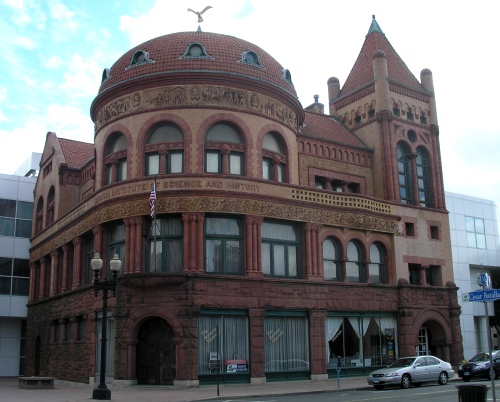
The old Otis Library building was constructed in downtown Norwich in 1850. It was founded by Deacon Joseph Otis, a retired merchant, who erected the building, purchased its first books and provided an endowment in his will for its continued operation. The library was originally housed on the first floor of the building, with a pastor’s study above. The library eventually outgrew the original structure and was moved to Main Street in the 1960s. The current Otis Library on Main Street was built in 2007. The original building is now known as the William F. Bourgun Memorial and serves as offices for the city’s Department of Human Services.

The Buckingham Memorial (1847)

buckingham-memorial.jpg

William Alfred Buckingham was the governor of Connecticut from 1858 to 1866. A wealthy businessman, he entered politics as a Whig, serving several terms as mayor of Norwich. Buckingham later became a republican, winning election as governor in 1858. In 1860, he traveled with Abraham Lincoln as the Illinois Republican made six speeches throughout Connecticut. The two became friends and the governor responded quickly when Lincoln, as president, requested volunteers after the firing on Fort Sumter. Buckingham served throughout the ensuing Civil War, leaving the governorship in 1866 to return to his former business pursuits. He later served as a U.S. senator from 1869 until his death in 1875. Buckingham‘s house, on Main Street in Norwich, was built in 1847. After his death, it was purchased by the veterans group, Sedgwick Post No. 1 of the Grand Army of the Republic. The house, thereafter known as the Buckingham Memorial, has more recently been turned over to the Norwich Historical Society for use as offices and perhaps, in the future, a museum.

Coggshell House (1816)

cogshell-house-02.jpg
UPDATE: This house has been demolished.

Update: The house is in danger of demolition!

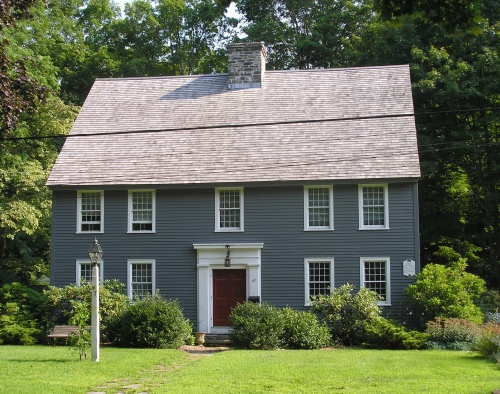
In 1816, Nathaniel and Rebecca Coggeshall (Coggshell) purchased property on Broadway in Colchester from members of the Bulkley family. It is uncertain if the Coggshells or the previous owners built the house which is now on the site. Rebecca Cogshell died in 1848, at the age of 81 and her three daughters were owners of the house.

The Medad Holcomb, Jr. House (1848)

medad-holcomb-jr-house.jpg

Medad Holcomb, Jr. was a Guilford farmer who built a Greek Revival home on Fair Street around 1848. The house features expensive flush board siding on the front facade; the two pilasters on each side are later additions. Holcomb was the son of Medad Holcomb and his fourth of five wives, Nancy Parnel Dudley. When he died in 1871, he left the house to Sydney Dowd, a local temperance leader. The second floor of the house was used as a hayloft before an addition was built later on. There is also an historic barn on the property.

Second Congregational Church, East Hampton (1855)

second-congregational-church.JPG

The Second Congregational Church of East Hampton was organized in 1740. This church originally served the communities of both Middle Haddam (pdf) and Haddam Neck, but these separated in 1855, when the Second Congregational Church was built in Middle Haddam. The church was moved to its present site in 1864 and was completely rebuilt in 1877 in the High Victorian Gothic style, to a design by Henry Austin. Today, the church remains the most imposing and architecturally significant building in Middle Haddam.