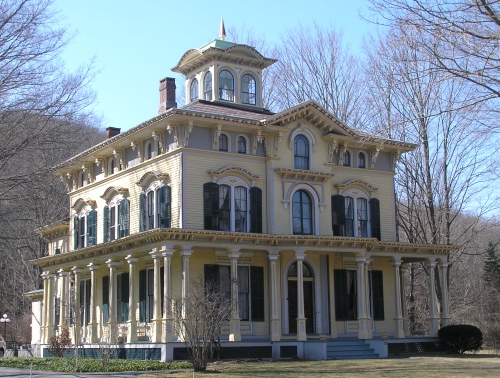
Albert Sisson House (1867)

albert-sisson-house.jpg

Albert L. Sisson was born in Bloomfield and became successful in Hartford operating a meat market in the Sisson Block, a building which once stood at Main and Sheldon Streets, and as a tobacco trader. In 1867, he built a brick Italianate house on his estate on Hubbard Street, which was renamed Sisson Avenue in his honor in the 1870s. He was also involved at the time in the founding of the Asylum Avenue Baptist Church. Sisson died in 1886 and his wife, Mary Gorton Sisson, died in 1898. The house was used for a time as a hospital for scarlet fever patients and in 1902 was acquired by the cathedral corporation of the Hartford diocese. Bishop Michael Tierney of Hartford gave the property to the Sisters of the Good Shepherd for use as a home for wayward girls. The house was expanded in 1905 and additional buildings, including Marian Hall and Euphrasia Hall, were constructed on the estate in 1920s. The “House of the Good Shepard” complex was sold by the Sisters in 1979 and today serves as subsidized senior housing.

Blockhouse at Fort Trumbull (1796)

blockhouse.jpg

The oldest surviving structure at Fort Trumbull in New London is a granite blockhouse, built in 1796. It was built after Congress authorized funds for the fortification of American seaports in 1794. The fortifications in New England were under the direction of a French engineer, Stephen Rochefontaine. Designed with tapering walls to resist exploding shells, the blockhouse (also known as a citadel) housed a powder magazine and soldiers’ living quarters. It was also intended to become its own mini-fort, a final stronghold if the main fort fell to an enemy. Of all the buildings constructed in America as part of the 1794 program, the blockhouse at Fort Trumbull is the only one still standing today.

Jordan Schoolhouse (1740)

jordan-schoolhouse.jpg

One of the historic structures on Jordan Green in Waterford is the 1740 Jordan Schoolhouse, the oldest surviving public building in Waterford. The earliest mention of a schoolhouse in Jordan actually dates to 1737. The present schoolhouse building was converted into a private home in the mid-nineteenth century for the widow Eliza Gallup and her three children. The building’s granite front steps came originally from the nineteenth-century West Neck Schoolhouse. The Jordan Schoolhouse was moved to Jordan Green in 1972 and is now a museum run by the Waterford Historical Society.

The Martin Wells House (1800)

646-wolcott-hill.jpg

Not much is known about the construction of the house at 646 Wolcott Hill Road in Wethersfield. Most likely built by 1800, it may date to much earlier. The house is associated with the name Martin Wells, perhaps an ancestor or relative of Judge Martin Wells, who lived in the Webb House starting around 1820 and hosted Tocqueville when he visited the Connecticut State Prison in Wethersfield in 1831. The Wells House on Wolcott Hill Road at one time had a front porch attached, which was later removed.

Whale Oil Row (1835)

whale-oil-row.jpg

Whale Oil Row is a row of four similar Greek Revival houses on Huntington Street in New London. They each have a portico with Ionic columns supporting a triangular Greek pediment with a semicircular window. The houses were built between 1835 and 1845 on speculation by Ezra Chappel. The original owners included two whaling ship owners, a merchant and a physician. Because the wealth of three of these owners derived from the whaling industry, the houses became known as “Whale Oil Row.”

See below for images of each of the four houses. (more…)