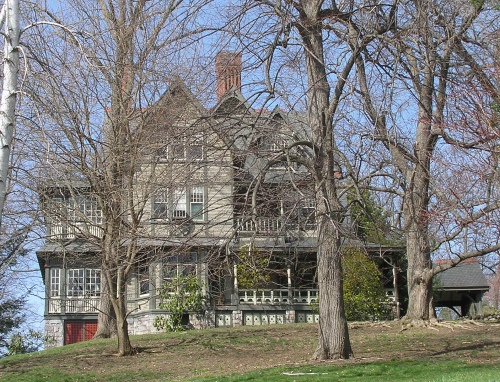
The Daniel Judd House (1730)

The Daniel Judd House in Farmington (not to be confused with the 1875 Daniel Judd House in Cheshire) is a colonial saltbox home built around 1725-1730. The house was built on land that Daniel Judd inherited from his parents, William and Mary Steele Judd, early settlers of Farmington. Judd sold his house to his oldest surviving son, James, in 1741 and it was willed to James Judd, Jr. in 1779, although the younger James lost his money and the property was foreclosed on in 1805. It then passed through various owners until it was acquired by James O’Rourke in 1874. In 1890, O’Rourke rented the house to Theodate Pope, daughter of the wealthy industrialist Alfred Atmore Pope. She soon purchased the house in 1892. Calling it the “O’Rourkery” after its previous owner, Pope hired the architectural firm Hapgood and Hapgood to restore the house. Some years later, she added a side entrance porch to the house and would continue to make other alterations to the building over the years.

In 1896, she acquired the property next to her home, which included an earlier, seventeenth-century dwelling, possibly built for William Judd. She had this building moved and attached to the O’Rourkery as an ell. Calling it the “Gundy,” Pope opened the ell in 1902 as an “Odds and Ends Shop” for students at Miss Porter’s School. Pope would later persuade her parents to settle in Farmington, using her experiences in restoring the O’Rourkery in designing for them the famous Hill-Stead estate. She would go on to design a number of other buildings. Theodate Pope later resided at Hillstead with her husband, John Wallace Riddle, but continued to own the O’Rourkery, using it as a retreat. After her death, the estate, including the O’Rourkery, became the property of the Hill-Stead Museum. The Gundy shop continued in operation under various people until 1969, but in 1975 the Museum sold the house. It is now a private residence. Behind the Gundy today is a notable (private) Colonial Revival garden.

24 Lewis Street, Hartford (1840)

The former house, now a business, at 24 Lewis Street in Hartford was built around 1840. It has been attributed to the builder Austin Daniels, who also probably constructed the two adjacent buildings. Stylistically, the house represents the transition from the Federal to the Greek Revival styles and is typical of houses built in Hartford in the decades before the Civil War. The Italianate-style front portico was added later in the nineteenth century and the enclosed porch is a later Colonial Revival addition.

The James R. Lanyon House (1903)

The house at 96 Cornwall Avenue in Cheshire is an American Foursquare built in 1903. It was constructed for James R. Lanyon, who was born in New Hamburg, NY, but five years later came to Cheshire, where his grandfather, James A. Lanyon, had been superintendent of the Barite Mines. Lanyon served as town clerk of Cheshire for 59 years, from 1894 to 1953. He served in the Connecticut General Assembly and chaired the Republican Town Committee. As described in Taylor’s Legislative Souvenir of Connecticut for 1901-1902, “Mr. Lanyon has been the recognized leader of his party in Cheshire—its leader without being its boss—thus winning the admiration of his party associates and the profound respect of his political opponents. He is a highly respected member of the Masons and Odd Fellows.”

Holmes Building (1904)

Located along a row of commercial buildings, across from the post office on Grand Street in Waterbury, is the Holmes Building, constructed in 1903-1904. It was one of many structures built in the area after the devastating Waterbury Fire of 1902. The building was home to C.L. Holmes & Company, which became Holmes and Burr in 1905. As described in the History of Waterbury and the Naugatuck Valley, vol 3 (1918), “The building is a three story structure with sixty foot frontage on Grand street, the upper stories being used for offices, while a part of the lower story is occupied by the Waterbury Trust Company. The firm of Holmes & Bull conducts a general brokerage business, handling investment securities, and they have an extensive clientage.” The Waterbury Trust Company, established in 1907 with C.L. Holmes as its president, eventually gave its name to the entire building. The Elks Club occupied rooms in the building until the Lodge constructed the a new Home in 1910. The WBRY radio studios were also in the building in the early 1940s.

New Britain National Bank (1927)

The New Britain National Bank building is on on West Main Street, next to the buildings which now serve as New Britain’s City Hall. It was built for the Commercial Trust Company in 1927, which failed during the Great Depression and was bought out by the New Britain National Bank in the 1930s. The building, which is also known as the Anvil Bank for the anvil motif which recurs frequently in its intricate brickwork, was designed in the Romanesque Revival style, with some Gothic elements as well. The bronze doors feature designs of beehives and Mercury and Buffalo coins. The building’s interior is also impressive: the lobby makes use of marble and bronze and has a 30-foot ceiling. The structure has been mostly vacant since 1996 and has suffered from deferred maintenance. After several years of planning to restore and adapt the bank building to new uses, work began a few years ago to covert it for stores and residential units, although progress was later halted by the economic downturn.

Charter Oak Bank (1861)


In the nineteenth century, many brownstone-faced commercial buildings were constructed in downtown Hartford. Most of these have since been demolished, but the Italianate building at the northeast corner of Asylum and Trumbull Streets survives. The ground floor has been altered, but the floors above have original brownstone moldings over the regularly-spaced windows, a different design for each floor. The building was constructed in 1861 for the Chater Oak Bank, which occupied it until 1915, being succeeded by City Bank, which closed in 1932.

YouTube player

Center Congregational Church, Manchester (1904)

In 1772, the Ecclesiastical Society of Orford was established, in what would later become the town of Manchester. Owing to the unsettled conditions at the time of the Revolutionary War, it took twenty years for a Congregational meeting house to be built, although the congregation used the unfinished building for worship, starting in 1779, before it was finally completed in 1794. This first church building, which stood about 130 feet east of the present Center Church, was replaced by a new structure in 1826 on the same location. The building was raised up in 1840 so that a basement could be added below. The basement was then rented to the town for the transaction of public business. In 1878, the church’s steeple blew off and crashed through the roof. It was then sold to the town and a new church was built the following year in the Gothic style. The current church, now known as Center Congregational Church, was built in 1904 in the Colonial Revival style. The neighboring brick parish house was added in 1930 and the Simpson Educational Wing in 1957.