
The Main Street Diner in Plainville is a late-1950s Master diner, which was originally in Hempstead, Long Island. It’s the third diner on the site on West Main Street.
The Main Street Diner in Plainville is a late-1950s Master diner, which was originally in Hempstead, Long Island. It’s the third diner on the site on West Main Street.

Adjacent to the Center Congregational Church in Manchester is the town’s Municipal Building. The brick and limestone building was constructed in 1926 and is typical of the colonial revival civic architecture of its era.

Architect Henry Austin designed the home of Wallingford industrialist Samuel Simposon, which originally stood on North Main Street in Wallingford. In the mid-nineteenth century, Simpson, a silver manufacturer, partnered with Robert Wallace in the firm of R. Wallace & Company, the forerunner of Wallace Silversmiths. He was later president of Simpson, Hall & Miller. Simpson’s great-granddaughter, Margaret Tibbits Taber, later had a bookstore in the house. The home was later moved to its current location on Scard Road in Wallingford.

Built in 1909-1914, the New Haven County Courthouse, facing New Haven Green, is an impressive Neo-Classical building. Designed by New Haven architects William Allen and Richard Williams, the courthouse was modeled on St. George’s Hall in Liverpool and has statuary outside by J. Massey Rhind. Today, the building serves as a state circuit court.

Built sometime between 1830 and 1840, the William Niles House, at 184 South Main Street in Colchester, is an example of Greek Revival architecture, but now has modern asbestos siding. Niles’ widow lived in the house after his death.

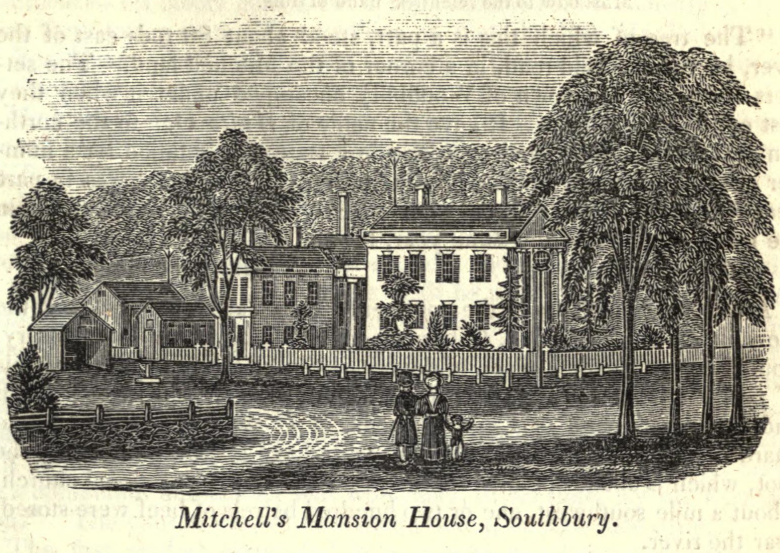
In Connecticut Historical Collections (1836), John Warner Barber features an image of
the Mansion House of M. S. Mitchell, Esq. recently erected, and designed as a house of public entertainment. It is about three quarters of a mile north of the Congregational church. For beauty of situation and superior accommodations, it is not exceeded by any establishment of the kind in any country village in the State. This edifice stands on the spot where the house of the first minister of the place, Mr. Graham, formerly stood.
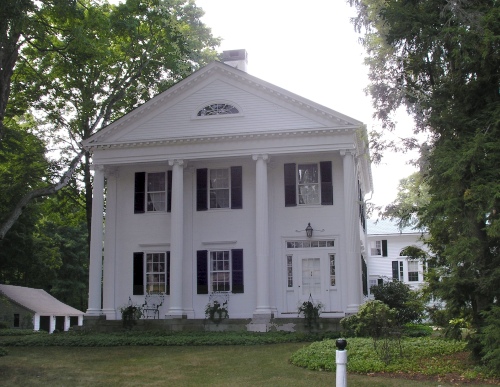
The Mansion House, on Mansion House Road in Southbury, was built in 1827-1829. One of the builders was James English, later a governor of Connecticut. The house was later owned by the famous furniture-maker Duncan Phyfe, who left the mansion in 1853 to his daughter, Mary, who had married Captain Sidney B. Whitlock, but was a widow by that time. There exists a table, made by Phyfe around 1840, that is known as the “Wedding Cake” table because it held the wedding cake of Phyfe’s grandson, Duncan Phyfe Whitlock, when he married Margaret Donaldson in Southbury.

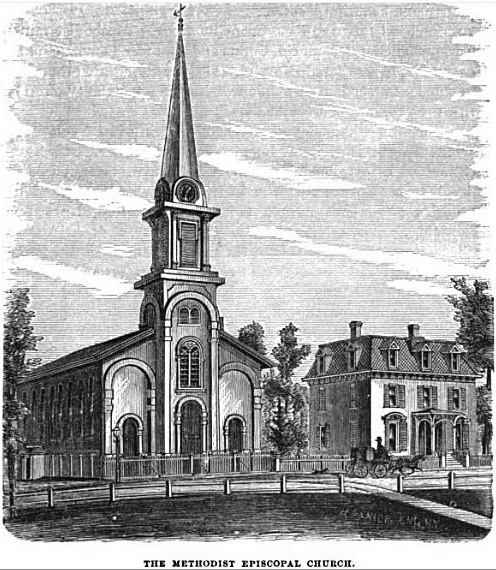
The first Methodist Episcopal society in Derby was organized in 1793. In the early years, the members did not have their own building. According to The History of the Old Town of Derby (1880), “The ministers preached wherever they found open doors.” This included private homes, taverns and a schoolhouse. Again quoting from the History:
For a long time the society continued small and encountered much prejudice and some persecution. On one occasion, while a meeting was held in the house of Isaac Baldwin, which stood on the flat east of H. B. Beecher’s auger factory, the persecutors went up a ladder and stopped the top of the chimney in the time of preaching, so that the smoke drove the people out of the house. Squibs of powder were often thrown into the fire in time of worship, to the great annoyance of the people.
The Methodists constructed a church on Birmingham Green in 1837. This church continued in use until funds were raised at a tent revival in 1891 to build a new church. The current Derby United Methodist Church, built in the Romanesque style, was completed in 1894 on the site of the earlier church.

You must be logged in to post a comment.