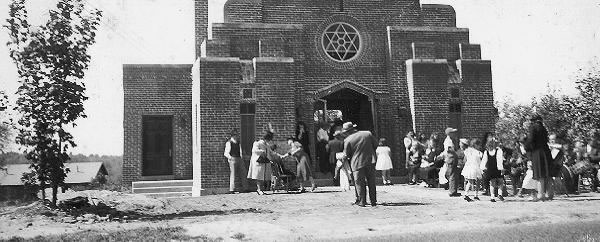
Immanuel Lutheran Church, Bristol (1907)

German immigrants founded the German Lutheran Church in Bristol in 1892 (or 1894). A church was built on School Street, on the south bank of the Pequabuck River, in 1896. A split in the church soon emerged: one group, which would affiliate with the Lutheran Church-Missouri Synod, constructed Immanuel Lutheran Church in 1907 at 154 Meadow Street. The other group built Zion Evangelical Lutheran Church on Judd Street (the original church building has since been replaced) in 1906. School buildings were constructed adjacent to Immanuel Lutheran Church in 1925 and 1963.

Moses Seymour, Jr. House (1817)

The Moses Seymour, Jr. House, at 24 South Street in Litchfield, is a Federal-style house with a distinctive trefoil window in the front gable. Moses Seymour, Jr. (1774-1826), a merchant and businessman, was the son of Maj. Moses Seymour and the brother of Ozias Seymour, whose house is at 34 South Street. The 1903 book, Chronicles of a Pioneer School from 1792 to 1833, Being the History of Miss Sarah Pierce and Her Litchfield School, contains a reminiscence by Dr. Josiah G. Beckwith, who writes:

In 1797 Mabel Strong, Lucy Case and a Miss Dwight, all of Addison, Vt., made a start for Litchfield, Ct., to attend Miss Pierce’s School — They made the journey to Bennington on horseback, and from thence the Rev. Mr. Dwight drove them to Litchfield — the latter part of the journey was made in a wagon. Mabel Strong made her home during the years of her stay in Litchfield, with Mrs Brace, a sister of Miss Pierce, and the mother of John P. Brace — her wardrobe was made up after her arrival. The Brace house stood on the site now occupied by the Congregational parsonage. […] My grandfather Moses Seymour Jr. drove from Litchfield, with a sleigh and pair of horses in Feb. 1800, to bring home Mabel Strong as his bride; […] Moses Seymour Jr., and his bride commenced housekeeping in what was then known as the Skinner house, now occupied by the Bissells next the United States Hotel; they afterwards removed to the Marsh house on the corner, where the Library building stands, where they remained until 1817, when the house which I now occupy, was completed for my grandfather and they took possession of it in that year. Moses Seymour Jr. was for many years high Sheriff of the County. […] [Their daughter] Jane Seymour married Dr. Josiah G. Beckwith who was for forty years in active practice in this town, she lived, until her death, which occurred in 1868, in her father’s homestead.

Hezekiah Goodrich House (1800)

Hezekiah Goodrich (1771-1854) grew up in Portland. His uncle, David Goodrich, was killed in the Revolutionary War and his widow, Penelope Holcombe Goodrich, and two sons lived with Hezekiah’s family during the war. Hezekiah later married Penelope’s niece, Millicent Holcombe, and in 1800, he moved to Granby, building his house and setting up a tanning shop on on what is now North Granby Road. Goodrich employed two men and a woman and produced 1,000 pairs of shoes and boots a year.

East Windsor Academy (1817)

The East Windsor Historical Society is headquartered in the brick East Windsor Academy, also known as the Scantic Academy (pdf), which was built in 1817 by the Academy Company, a group of stockholders. It originally had a cupola containing a school bell. The first floor served as a school until 1938, except for an period between 1871 and 1896, when it was owned by the First Congregational Church and used for various meetings. It was then used as a dwelling for a number of years and was converted into two apartments for teachers in the area in 1946 by L. Ellsworth Stoughton. He later donated, first, the upper floor for a museum in 1968 and then the entire building in his will to the Society.